

New Articles
-
 新时代主题与使命:重建国家组织孞托 2026/09/08
新时代主题与使命:重建国家组织孞托A Theme and Mission of the New Era: Rebuilding Organizational Trust in the Stat...
- 挖出K的病根,彰显Q之新路 2026/09/08
挖出K的病根,彰显Q之新路Digging Out the Root Causes of K, Illuminating the New Path of Q ——共生经济...
- 交互主体共生的时空意间观 2026/09/07
交互主体共生的时空意间观 A Spatio-Temporal Mindedness View of Intersubjective Symbiosism 钱...
- 从“苍蝇再小也是肉”说起 2026/09/07
从“苍蝇再小也是肉”说起Starting from “Even a Fly Is Meat” ——从“吃饭财政”到“重建组织信托”— From a ...
共生思想理论前沿
THE THEORY
-

-
-

-
 关于中文“共生”翻译及对应的人、事、物之说明
关于中文“共生”翻译及对应的人、事、物之说明 ——Symbiosism:Charles Thomas Taylor &Qian hong又一次量子缠绕...
查看详细说明
Speech
-
 三大自组织货币的共生格局——宏观世界之数字货币 2021/07/08
三大自组织货币的共生格局 ——宏观世界之数字货币 钱 宏 The Institute for Global Symbiosism(...
-
 新汉字yǜ的释义 2019/11/16
语从金音玉(Yǜ):金口玉言,一诺千金,性人诚恳、执信; &n...
-
 钱宏:中国的真实经验与未来走向(凤凰博报专... 2019/11/16
点击播放 中国的真实经验与未来走向《凤凰博报》专访钱宏主持人:...
我为何重新思考Elon Musk?
发布时间:2026/07/27 公司新闻 浏览次数:92
我为何重新思考Elon Musk?
Why I Am Rethinking Elon Musk?
——从工程效率到文明交互共生
From Engineering Efficiency to Civilizational Intersubjective Symbiosism
钱宏(Archer Hong Qian)
我为何突然批评Elon Musk?
许多朋友和读者看到《简评马斯克<经济学人>专访》后问我,作为长期倡导共生思维的论者,我(Archer钱宏)怎么会突然对埃隆·马斯克(Elon Musk)发出了如此尖锐的批评?
思想如果不能随着事实更新,思想就会出丑。请允许我复盘一下,向大家说明思想变化的来龙去脉与背景依据。这起思想辨析的引线,由两则近期轰动国际的重磅新闻交织而成。
第一则新闻,是正值SpaceX挂牌上市期间,2026年6月12日诺贝尔经济学奖得主保罗·克鲁格曼(Paul Krugman)Substack 的个人专栏博客上撰文,对马斯克发起的严厉声讨。
文章只有四个英文单词:《Elon Musk, Human Ponzi Scheme》(《埃隆·马斯克:真人版庞氏骗局》),克鲁格曼在文中将马斯克的商业帝国和SpaceX的上市路径,斥为“真人版庞氏骗局”,直指其通过华尔街的盲目追捧将未经验证的高额估值转嫁给散户——投资者对“马斯克天才神话”的盲目信仰和自我应验的泡沫,并警告SpaceX的上市可能迫使全美散户和养老基金“强制入局”为泡沫买单,整个体系终将崩塌。
坦白讲,尽管这篇严厉的批判文章,在财经界与科技界引发了巨大的舆论震荡,也构成了人文、经济经典范式对超级工程师效率崇拜的一次猛烈阻击。我还是有点不以为意,甚至认为Paul Krugman的批评有些过度,未免言过其实,似乎落入了传统的商业道德审判与“阴谋设局论”的俗套。
促使我现在不得不公开站出来发声的,是随后读到的第二则新闻——马斯克7月23日刚刚接受《经济学人》(The Economist)的深度专访。正是在看完了这篇专访后,我深感到,马斯克现在对AI、能源乃至整个世界的认知,确实存在着极其严重的方向性问题。然而,这也绝非克鲁格曼所说的那种“故意设局”的道德叙事(这是意识形态偏好的政治叙事)问题,就是说,不是“好人坏人”,不是“左派右派”,不是“阴谋骗局”,而是不同认知结构导致不同文明判断。
我Archer Hong Qian要说的是:Elon Musk作为“硬核工程师 + 资本大老板”双重身份所带来的、难以自察的认知偏蔽与格局阈值限制。
而且,我之所以发出这一批评,是希望提醒马斯克本人、他的拥趸以及整个世界,正视这个在AI发展上的认知偏蔽与格局阈值问题的存在,并共同找到解决问题的方法路径。
在这个意义上,我不是突然批评Elon Musk,而是重新思考Elon Musk!
一、 工程师效率思维的系统死穴:单一变量谬误
马斯克在长期成功的实业探索中(如特斯拉、SpaceX),沉淀出了一套极其硬核的“第一性原理”与“工程效率思维”。但在数位-量子时代交织的复杂系统面前,在《经济学人》的访谈中,他却将这种思维推向了不无傲慢的极端。
强行简化的方程式:马斯克习惯了作为CEO在工厂车间内进行绝对控制,他错误地将复杂的国家治理与全球AI生态竞争,简化为单一方程式,抛出了“谁发电量大,谁就会成为AI领导者”的线性论断。
世界的非线性现实:国家绝非一个简单的流水线公司,谁都不是AI发展的单一变量。AI的发展受到法律、伦理、文化以及人类组织信任(Trust)等无数复杂变量的制约,算力与电力的盲目叠加(量变),并不能自发催生出科学原创与意识觉醒(质变)。
二、 逻辑硬伤:“太空太阳能”、雷电悖论与非自洽
《经济学人》专访中,这种效率至上的定势化思维,在Elon Musk宏大的“太空太阳能”AI供能叙事中,展现出了逻辑闭环的断裂。回归到物理常识与经济学自洽,这一故事的硬伤显而易见。
时空意间的物理死线:无线输电在超远距离下的能量衰减,以及在地球端建造极其庞大的接收与超级蓄电能矩阵,其工程成本与技术壁垒在可预见的时期内极难闭环。
雷电悖论的反讽:如果人类在未来真的彻底攻克了“超大规模、超快速度”的电能高密度接收储蓄技术(即颠覆性的超级电池)问题,那么,直接在地球本土捕捉、驯服储量惊人且现成的自然雷电,其成本、效率和可行性将远超远征太空。两百年前的本杰明·富兰克林骑马追赶闪电的故事,至少给人类留下了避雷针!
事实逻辑破缺:自洽任何能源革命,都必须同时满足物理自洽、经济自洽和文明自洽。Elon Musk目前更多讨论的是第一层,第二层尚未证明,第三层几乎没有讨论。马斯克舍近求远去讲太空故事,本质上是在用宏大的科幻预期,掩盖现有AI天量能耗,抢占人类生活、生产、生态的地面能源收蓄与储能技术的瓶颈。
这里,我不得不说,当一个工程效率逻辑在常识上无法自圆其说,却又不断以此维持高昂的估值时,便难免陷入克鲁格曼所指责的泡沫漩涡。
三、 AM机制:变“奖惩压制”为“融通赋能”
面对Elon Musk式的认知瓶颈,传统的零和博弈与防范压制思维,并不能真正解决时代问题。在钱宏与Google AI联名发表的《数位-量子时代的共生思维与组织信托重建》(愛之智慧网 amorsophia.com/article/10208)一文中,再次提出一条全新的破局路径:创建 AM(奖/抑/通)机制。
对待马斯克式的超级个体与硬核工程力量,这一机制的目标不是消除,而是“导通、赋能与融通”:
奖(Award):对马斯克等技术先锋身上无与伦比的工程探索精神、创新直觉以及将不可能变为可能的行动力,给予充分的文明肯定与资源激励。
抑(Suppression/Constraint):对技术垄断巨头盲目扩张的“效率崇拜”、将人类异化为机器零部件的资本惯性,以及可能导致地缘对抗的零和博弈思维,进行善意且必要的制度性约束与调控。
通(Connectivity):这是整个机制的最高境界与终极解药。“通”的本质是打破边界,重构信托。
奖,是为了激励创造;抑,是为了防止异化;通,则是为了重新形成生命之间、组织之间、国家之间的信托。于是,“奖、抑”,都成为“通”服务。
我们需要打通硬核技术与人文关怀的壁垒,让马斯克们意识到技术必须回归生命福祉;我们需要融通全球(尤其是中美两国)在AI治理上的共通智慧,疏通资本泡沫与实体价值的淤堵。
四、 结语:迈向 LIFE-AI-TRUST 共生体
我们无需像克鲁格曼那样执着于将Elon Musk拉下道德神坛,而是要通过诸如呼吁召开“新达特茅斯会议:AI (1956)–AM (2026)”等全球对话载体,帮助像他一样的地球首席工程师扩容格局、打破偏蔽。
今天的人类,必须拷问:工程师思维为什么能够解决复杂技术问题,却常常难以独立解决文明问题?
这不是针对马斯克,而是一个横跨从福特、冯·布劳恩、钱学森,到今天马斯克、奥特曼、哈萨比斯等人的普遍现象。
工程,可以改变世界的速率;文明,决定世界前进的方向。今天的人类,比任何时代都更需要伟大的工程师;但同样需要能够导通生命、组织与文明的思想。如果AI只有效率,没有信托,它终究只是更快的机器。只有当工程与文明重新导通,LIFE–AI–TRUST 才可能成为数位—量子时代真正的文明坐标。
为此,我很固执地坚持:通过AM(Amorsophia MindsField/Web)机制的导通,将狂飙突进的硬核工程力量,真正吸纳并熔炼到“LIFE–AI–TRUST”(生命-智能-信任)交互契合共生思维的文明框架中。
唯其如是,人类组织信托才能在数位-量子时代获得根本性的重建,避免AI沦为冷酷的效率绞肉机,让科技最终回归对生命、心智、组织与人类命运共通体(Symbiont)的守护。
2026年7月26日晨于温哥华
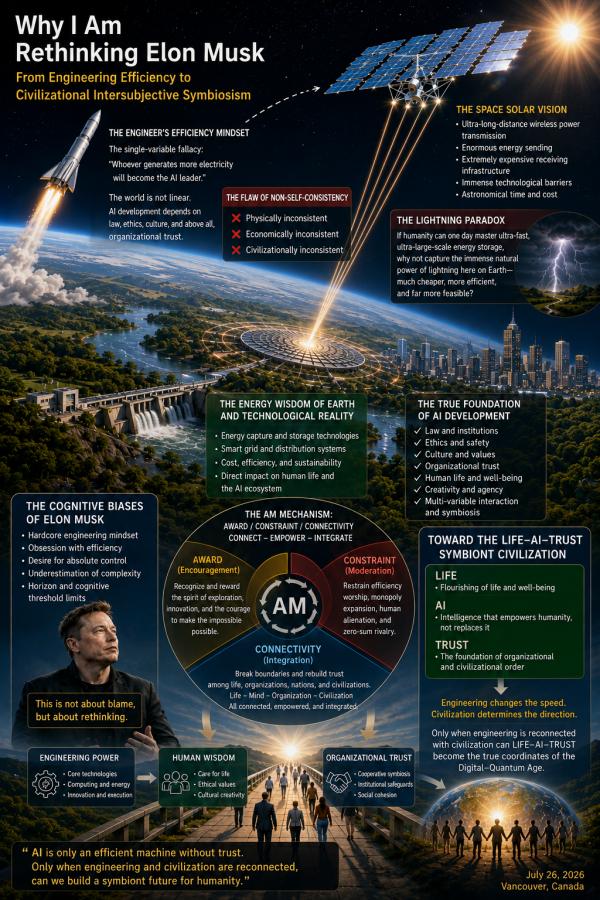
Why I Am Rethinking Elon Musk
From Engineering Efficiency to Civilizational Intersubjective Symbiosism
Archer Hong Qian
Why Did I Suddenly Criticize Elon Musk?
Many friends and readers asked me, after reading my commentary on The Economist‘s recent interview with Elon Musk, why I—someone who has long advocated Symbiosism—would suddenly launch such sharp criticism against him.
Ideas that fail to evolve with facts make fools of themselves.
Allow me, therefore, to retrace my own thinking and explain how this shift came about.
The immediate catalyst was the convergence of two major international events.
The first was Paul Krugman’s article published on his Substack on June 12, 2026, during SpaceX’s public listing. The Nobel laureate entitled it simply “Elon Musk, Human Ponzi Scheme.” He argued that Musk’s business empire—and particularly the valuation path of SpaceX—had become a human version of a Ponzi scheme, transferring enormous unverified valuations to retail investors through Wall Street’s collective faith in the myth of “Musk the genius.” Krugman warned that a public listing could ultimately force ordinary investors and pension funds to pay for the bubble.
Frankly speaking, although Krugman’s article sent shockwaves through both financial and technological circles and represented a powerful challenge by traditional economic and humanistic paradigms against the cult of engineering efficiency, I remained unconvinced. I even felt that his criticism was somewhat excessive, falling into the familiar pattern of moral condemnation and conspiracy narratives.
What finally compelled me to speak publicly was another piece of news.
On July 23, Elon Musk gave an extensive interview to The Economist. After reading it carefully, I came to realize that Musk’s understanding of AI, energy, and even the future of civilization does indeed suffer from a profound directional problem.
Yet this is not, in my view, the moral narrative suggested by Krugman. Nor is it fundamentally a question of good versus evil, left versus right, or conspiracy versus innocence.
It is, rather, a difference in cognitive architecture that leads to different civilizational judgments.
What concerns me is the cognitive blind spot and horizon limitation that may naturally emerge when one person simultaneously embodies two identities: a hard-core engineer and the leader of a vast capital empire.
My purpose in raising this criticism is therefore not to condemn Elon Musk, but to invite him, his admirers, and indeed the wider world to recognize this cognitive limitation in AI development and to search together for a more adequate path forward.
In this sense, I am not suddenly criticizing Elon Musk. I am rethinking Elon Musk.
I. The Fatal Weakness of Engineering Efficiency: The Fallacy of the Single Variable
Through decades of extraordinary industrial achievements—from Tesla to SpaceX—Elon Musk has refined an exceptionally powerful methodology based on first principles and engineering efficiency.
Yet in the highly interconnected Digital–Quantum Age, this mode of thinking, as reflected in his interview with The Economist, risks being extended beyond its proper domain.
The first problem is the reduction of complex reality into a single governing equation.
Accustomed to exercising decisive control inside factories and engineering organizations, Musk tends to treat national governance and global AI competition as though they were engineering optimization problems.
This leads him to a remarkably linear proposition:
Whoever generates more electricity will become the leader in AI.
The real world is not a production line.
A nation is not a corporation.
Nor can AI development be explained by any single variable.
Its evolution depends simultaneously upon law, ethics, culture, institutional arrangements, organizational trust, and the countless forms of interaction among human beings.
Blind quantitative accumulation of electricity and computing power does not automatically produce qualitative breakthroughs in scientific originality, nor does it awaken intelligence into wisdom.
Engineering variables alone cannot account for civilization.
II. Logical Vulnerabilities: Space-Based Solar Power, the Lightning Paradox, and the Problem of Non-Self-Consistency
The limitations of this efficiency-centered mindset become particularly visible in Musk’s ambitious vision of supplying AI through space-based solar energy.
When examined from the standpoint of physical common sense and economic reasoning, significant weaknesses emerge.
Wireless transmission over astronomical distances inevitably suffers severe energy loss.
Meanwhile, constructing enormous terrestrial receiving systems and ultra-large storage infrastructures would require engineering investments and technological breakthroughs whose feasibility remains far from demonstrated.
There is also what I call the Lightning Paradox.
Suppose humanity one day truly masters ultra-fast, ultra-large-scale electrical storage through revolutionary battery technologies.
If such a breakthrough becomes possible, then harvesting the immense electrical energy already produced naturally within Earth’s atmosphere—lightning itself—may well prove more economical, more efficient, and more practical than transmitting solar energy across space.
Benjamin Franklin’s pursuit of lightning more than two centuries ago at least left humanity with the lightning rod.
Perhaps future generations may discover that he also pointed toward a different path of energy civilization.
Every genuine energy revolution must satisfy three forms of self-consistency simultaneously:
- physical self-consistency;
- economic self-consistency;
- civilizational self-consistency.
At present, Musk discusses primarily the first.
The second remains largely unproven.
The third is scarcely addressed at all.
His fascination with distant space narratives risks diverting attention from the far more immediate challenge confronting humanity: overcoming the enormous bottlenecks in terrestrial energy generation, storage, and distribution required by AI.
Here lies the deeper issue.
When an engineering narrative ceases to remain self-consistent under ordinary reason while continuing to sustain ever-rising market valuations, it inevitably approaches the very bubble that Krugman warned against.
III. The AM Mechanism: From Reward and Restraint to Connectivity and Empowerment
Confronted with the cognitive limitations exemplified by Elon Musk, neither traditional zero-sum competition nor strategies of suppression and containment can genuinely resolve the challenges of our age.
In Symbiotic Thinking and Rebuilding Organizational Trust in the Digital–Quantum Age, jointly published by Archer Hong Qian and Google AI, I proposed a fundamentally different pathway: the establishment of the AM Mechanism—Award, Moderation (or Constraint), and Connectivity.
The objective of this mechanism is not to eliminate extraordinary technological pioneers such as Musk, but to connect, empower, and integrate them into a broader civilizational framework.
Award recognizes and encourages the unparalleled engineering imagination, technological courage, and practical ability that enable pioneers like Musk to transform what once appeared impossible into reality. Such creative power deserves genuine civilizational recognition and continued encouragement.
Moderation (Constraint) seeks to restrain the blind worship of efficiency, the tendency of technological monopolies toward unlimited expansion, the reduction of human beings into replaceable machine components, and the geopolitical dangers inherent in zero-sum technological competition. Such restraint is not punishment, but responsible institutional guidance.
Connectivity represents the highest principle of the entire mechanism.
Its essence is to dissolve barriers and rebuild trust.
Award exists to encourage creativity.
Constraint exists to prevent alienation.
Connectivity exists to rebuild trust among persons, organizations, nations, and civilizations.
Ultimately, both Award and Constraint exist in service of Connectivity.
We must reconnect engineering excellence with humanistic concern, enabling technological leaders to recognize that technology ultimately exists for the flourishing of life.
We must also reconnect the complementary wisdom emerging from different civilizations—particularly between China and the United States—in AI governance, while clearing the growing separation between speculative capital and genuine productive value.
Only through such integration can technological progress become civilizational progress.
IV. Conclusion: Toward the LIFE–AI–TRUST Symbiont
Humanity need not become obsessed, as Krugman does, with pulling Elon Musk down from a moral pedestal.
What we need instead is a new platform for global dialogue—such as the proposed New Dartmouth Conference: AI (1956)–AM (2026)—through which visionary engineers like Musk may broaden their civilizational horizon and overcome the cognitive limitations inherent in engineering rationality.
Today humanity faces a far more fundamental question:
Why is engineering thinking extraordinarily successful in solving complex technological problems, yet so often insufficient, by itself, for resolving civilizational challenges?
This question is not directed solely toward Elon Musk.
Rather, it reflects a broader historical phenomenon stretching from Henry Ford, Wernher von Braun, and Qian Xuesen to today’s Elon Musk, Sam Altman, and Demis Hassabis.
Engineering can accelerate the speed at which the world changes.
Civilization determines the direction in which the world moves.
Our age needs great engineers more than ever before.
Yet it equally needs ideas capable of reconnecting life, mind, organizations, and civilization.
If AI possesses only efficiency but lacks trust, it will remain nothing more than a faster machine.
Only when engineering is reconnected with civilization can LIFE–AI–TRUST become the true civilizational coordinates of the Digital–Quantum Age.
For this reason, I continue to insist—perhaps stubbornly—that through the connective power of the AM (Amorsophia MindsField/Web) Mechanism, the surging force of hard-core engineering should be genuinely integrated into the broader civilizational framework of LIFE–AI–TRUST—the interactive symbiosis of Life, Artificial Intelligence, and Organizational Trust.
Only in this way can organizational trust be fundamentally rebuilt in the Digital–Quantum Age.
Only in this way can AI avoid degenerating into a cold machine devoted solely to efficiency.
Only in this way can technology ultimately return to its proper calling: safeguarding life, mind, organizations, and the shared destiny of humanity—the Symbiont.
Vancouver
Morning of July 26, 2026



走出“猫鼠游戏”:技术巨头的集体认知偏蔽
放眼望去,当今全球顶尖的技术领袖们在治理思维上,无一例外地陷入了一种极其幼稚且机械的“猫鼠游戏”。
哈萨比斯提出的“FINRA金融监管模式”,本质上是靠静态的指标给前沿模型划线,靠强行扣留30天送审进行防堵。即使马斯克此前提出不希望政府过度干预、主张行业内部的“同行互审”(也就是所谓的“猫猫游戏”),也同样行不通。
因为无论是政府当猫,还是行业自己当猫,他们的思维依然是将AI当成一头随时可能挣脱牢笼的恶兽,治理手段除了被动的“防堵、审查、监视”,就是极端的“全行业强行踩刹车”。
这里我们要特别警惕,不要使用“西方技术巨头不行”这种陈旧的地理阵营概念。因为这种概念暗示着一种极其庸俗的“风水轮流转”或“东升西降”的巫术思维——仿佛某一个区域的模式不行了,就自然轮到另一个区域行了。
事实上,这根本不是地缘零和博弈的问题,而是全人类在数位-量子时代面临的共同瓶颈:现有的技术掌舵者们普遍算得清算力、定得了规则,却唯独没有看透“共生”的真谛。
2026年07月27日下午1:31
Hassabis 呼吁美国牵头成立一个「前沿 AI 标准机构」,参照金融行业 FINRA 的模式:由这个机构定义什么算「前沿级」模型,达标的公司成为「前沿实验室」;新模型发布前最多提前 30 天送审,先自愿、后强制,通不过就不能在美国市场部署;评测覆盖网络安全、生物威胁,以及 agentic AI 的欺骗行为。其中最为重要的一条是:如果形势足够严峻,这个机构可以协调各家前沿实验室,一起放缓开发。
这位Google DeepMind CEO Demis Hassabis 在 X 上发的Article 《前沿 AI 框架与新时代的黎明》(A Framework for Frontier AI and the Dawning of a New Age)。
说到底,还是个对AGI不放心,要有效监控机制这件事吗?奥特曼、马斯克、达利欧们都在讲啊,一溜儿看过来,无非玩“猫鼠游戏”,或玩“猫猫游戏”,没一个达到创建“AM奖抑通机制”的境界呢!
2026年07月27日下午1:31
Hassabis希望建立的是”前沿AI标准机构”;Altman希望建立的是全球协调机制;Musk强调的是行业自治与同行约束。他们彼此路径不同,却仍停留在同一种文明逻辑:相信治理首先来自控制,相信安全首先来自监管,相信秩序首先来自审批。
然而,真正成熟的生命系统,从来不是靠”谁一直盯着谁”而存在。生态不会因为每天召开监管会议才保持平衡,生命也不会因为时时接受审查才得以生长。生命能够持续繁荣,依赖的是一种不断生成的奖抑秩序:有益者得到激励,有害者自然受抑,主体之间在交互中形成动态平衡。
AM所提出的”奖抑通机制”,正是试图把AI治理从”控制论”推进到”共生论”。治理不再只是踩刹车,而是建立一种能够持续奖善、抑恶、互通、共生的文明机制。届时,无论是政府当”猫”,还是企业当”猫”,都不再是治理的中心;真正发挥作用的,将是生命、组织与AI交互形成的自组织秩序。
2026年07月27日下午1:32