

New Articles
-
 “天下英雄入吾彀” 2026/09/26
“天下英雄入吾彀”"All the Heroes Under Heaven Have Entered My Range" ——殖官主义怎样把人性扭曲为“彀性”...
- 川普为机器智能正名,开AI升格为AM之窄门 2026/09/25
川普为机器智能正名,开AI升格为AM之窄门 钱 宏(Archer Hong Qian) 2026年9月22...
- 剥落意识形态以后,殖官主义还在那里 2026/09/24
剥落意识形态以后,殖官主义还在那里After Ideology Is Stripped Away, Bureaucolonialism Is Still There ——从越南革新...
- 组织信托不是一个漂亮的词 2026/09/19
组织信托不是一个漂亮的词Organizational Trust Is Not Just a Beautiful Phrase ——《共生经济学概论》与《...
共生思想理论前沿
THE THEORY
-
-
-
-
 关于中文“共生”翻译及对应的人、事、物之说明
关于中文“共生”翻译及对应的人、事、物之说明 ——Symbiosism:Charles Thomas Taylor &Qian hong又一次量子缠绕...
查看详细说明
Speech
-
 三大自组织货币的共生格局——宏观世界之数字货币 2021/07/08
三大自组织货币的共生格局 ——宏观世界之数字货币 钱 宏 The Institute for Global Symbiosism(...
-
 新汉字yǜ的释义 2019/11/16
语从金音玉(Yǜ):金口玉言,一诺千金,性人诚恳、执信; &n...
-
 钱宏:中国的真实经验与未来走向(凤凰博报专... 2019/11/16
点击播放 中国的真实经验与未来走向《凤凰博报》专访钱宏主持人:...
“天下英雄入吾彀”
发布时间:2026/09/26 公司新闻 浏览次数:0
“天下英雄入吾彀”
“All the Heroes Under Heaven Have Entered My Range”
——殖官主义怎样把人性扭曲为“彀性”,K→Q的因应之道
— How Bureaucolonialism Distorts Human Nature into “Range-Conditioned Nature,” and the K → Q Response
钱宏(Archer Hong Qian)
重建组织信托的K→Q理论,是共生经济学《殖官论》,超越《资本论》阶级斗争路径和《21世纪资本论》征税再分配路径,同时,也是超越凯恩斯政府管控与哈耶克市场自由钟摆困境的诊→疗新范式。
——《共生经济学概论(修订版)》
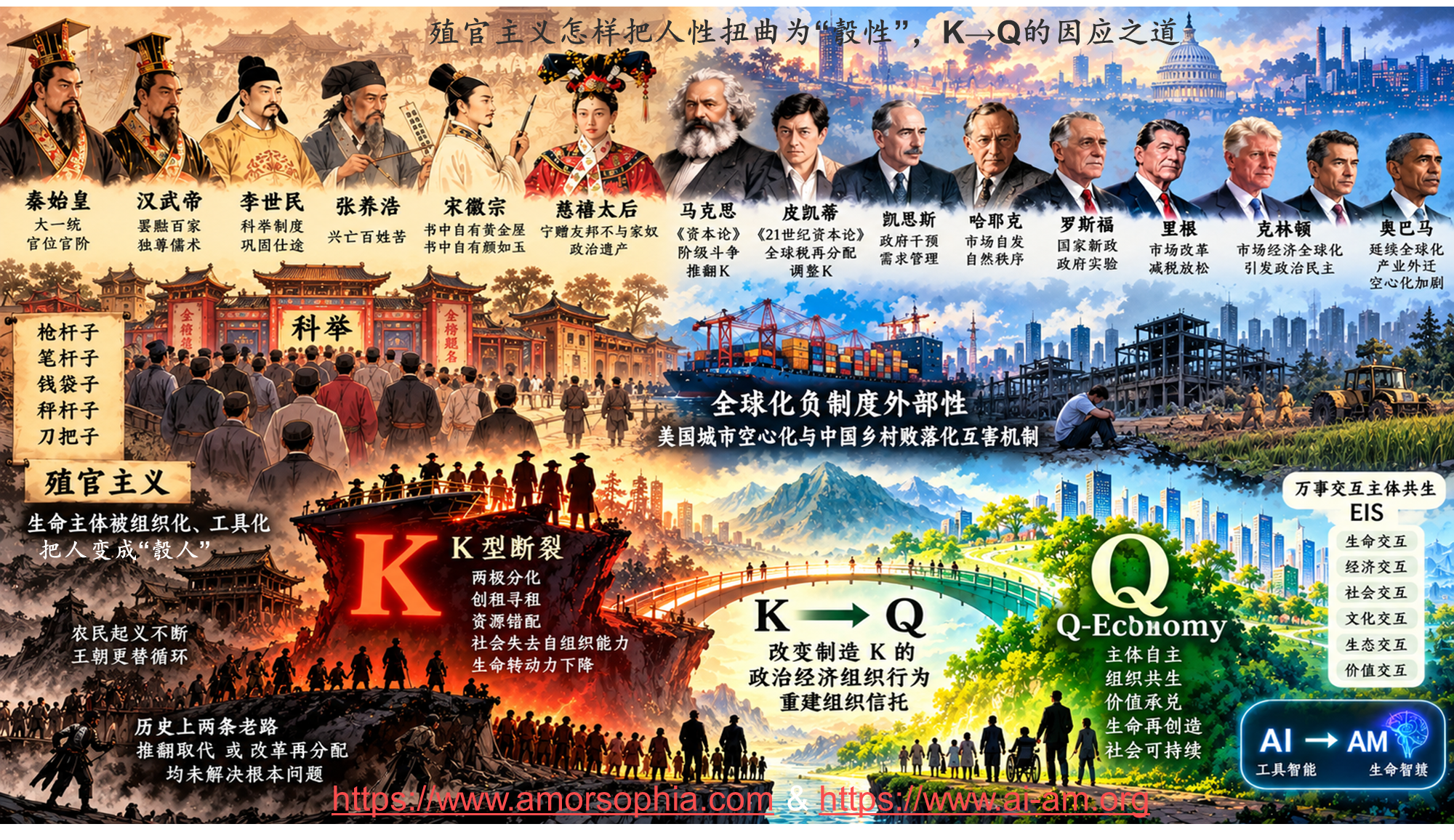
秦制汉儒以降,官位官阶大一统与名教教化相互嵌合,逐渐形成了一种把天下之人纳入组织之“彀”的深层政治遗产。
相传唐太宗李世民曾私下视察端门,看见新科进士们排着队伍走出来,十分高兴地说:“天下英雄入吾彀中矣!”
“彀”(gòu,音垢),本义是张满弓弩。“彀中”,就是弓箭射程以内,后来引申为牢笼、控制范围。“尽入彀中”,就是全部进入控制范围。
唐代通过科举制度,把天下读书人的前途与国家选官制度连接起来。后世因此还流传着一句意味深长的话:“太宗皇帝真长策,赚得英雄尽白头。”
当然,科举打破门阀对仕途的世袭垄断,使更多普通读书人获得进入国家组织的机会,这是它重要的历史意义。
但“天下英雄入吾彀中”还提出了另外一个问题:英雄入彀以后,会发生什么?
这恰恰是殖官主义(Bureaucolonialism)政治经济组织行为学值得研究的问题。
一、“彀”,不只是把人关进去,而是把人变成“彀人”
一个组织最初约束的只是人的行为。
可是,当一个人的收入、晋升、荣誉、住房、资源、社会地位、人际关系、信息来源乃至安全感,都越来越依附于同一个组织体系的时候,组织对他的影响就不再只是“上班”。它开始进入人的语言、判断、关系、利益乃至人格。
我们生活中常有这样的经验。一个原本十分熟悉的朋友,甚至父母兄弟,一旦进入官场——其实商场、情场乃至各种高度封闭的组织关系中也存在类似现象——人慢慢就变了。
台上与台下不一样;会内与会外不一样;公开与私下不一样。
私下聊天,他可能告诉你:“其实我也知道不是这么回事。”到了会上,却立即换了一套语言:“我们必须统一认识。”在家里,他按照生活常识判断;进入组织以后,他首先判断的却可能变成:“上面是什么意思?”
一个人开始同时生活在两个世界:一个是生活世界,一个是组织世界。开始的时候,他也许只是“演”;演得久了,角色便进入自己。
于是,人性之外逐渐长出官性;官性进一步接受组织规范,又可能形成所谓黨性;当组织的奖惩、资源、信息、安全和身份把一个人越来越完整地包围起来以后,则形成一种更一般的东西:彀性。
所谓“彀性”,不是说进入组织的人一定道德败坏,而是指:一个完整的生命主体长期处于封闭、高度等级化的组织控制范围以后,为了适应组织的奖惩、资源和安全结构,逐渐形成的一套稳定行为倾向。
所以俗话所谓“官身不由己”,真正值得研究的不是“官”,而是那个“不由己”。
是谁让他不由己?靠什么让他不由己?为什么那么多原本完全不同的人,进入同一个组织以后,最后却越来越会说相似的话、做相似的事、回避相似的风险?
这不是简单的个人道德问题。这是组织行为问题。
二、“五子登科”:一个完整的“彀”是怎样形成的?
我曾在《论社会生活动力之动力》(1980)中,用“五子登科”概括殖官主义走到极端极权时的政治组织形態。
五子指的是:枪杆子、笔杆子、钱袋子、秤杆子、刀把子。今天重新来看,“五子登科”最值得研究的,不只是权力集中本身,而是五种不同的组织能力一旦汇入同一套官位、官阶体系,就可能构成一个完整的“彀”。
枪杆子里面出政权必然靠枪杆替代政权安全;笔杆子掌握宣传、教育、信息与公共叙事;钱袋子掌握财政、金融、国有资产与重要资源配置;秤杆子掌握标准制定、统计计量、统计口径与考核尺度;刀把子掌握司法、执法、惩戒与争议裁决。
这五种能力原本都是现代国家不可缺少的能力。问题不在于有没有它们,而在于:如果五种能力最后都汇入同一套纵向官位官阶体系,每一个进入场中的人还有多少“彀外空间”?
说什么,关系到评价;做什么,关系到晋升;怎样统计,关系到政绩;跟谁交往,可能关系到安全;是否服从,又关系到资源乃至命运。
于是,“天下英雄入吾彀中”便不再只是一句帝王收罗人才的得意话。它变成了一个严肃的政治经济组织行为问题:当天下英雄都进入同一个彀以后,还有多少力量能够站在彀外检验这个彀?
问题从来不是有没有要不要“五种权力”,而是:五种权力究竟服务生命,还是反过来操纵生命?
三、从“人性”到“彀性”:组织为什么能够改变人扭曲人?
把一切归咎于“人性贪婪”,解释不了为什么一些原本正直的人进入某种组织以后,也逐渐学会了另一套行为方式;同样解释不了为什么同一个人离开某种组织环境以后,又可能恢复原来的常识判断。
真正发挥作用的是:人性 × 组织结构。
组织通过奖与惩不断筛选人的行为。符合组织要求的行为得到奖励;不符合的行为承担成本;能够准确判断组织意图的人不断晋升;始终坚持“彀外判断”的人,则可能逐渐被边缘化。
久而久之,组织甚至不需要每天告诉每个人应该怎样做。人已经学会了自己校正自己。这才是“彀”最成熟的时候。
真正牢固的牢笼,并不需要每时每刻有人站在门口,因为住在里面的人已经知道哪里是“黑屋子”的边界。
这里的“黑屋子”,沿用了鲁迅“铁屋子”的寓意:最深的禁锢,不只是门锁在哪里,而是身在其中的人已经熟知、甚至内化了它的边界。
我早在几十年前讨论形式主义、官僚主义时就曾用过一个朴素的比喻:即使是一群通常只会吃草、看起来温顺无害的动物,如果被长期圈在一块封闭草地里,那块草地也可能被弄得屎骚尿臭、凌乱不堪。问题不能只归咎于哪一只羊“坏”,还必须追问那块地怎样被圈、怎样被管、怎样形成了持续的行为环境。
彀性也是如此。它不是替个人免除责任,而是要求我们在个人责任之外继续追问:什么样的组织形式,在持续生产什么样的人?
四、从“彀性”到四种政治经济组织行为定势
当彀性从个人行为逐渐变成组织习惯以后,一些原本可能只是临时性的手段,就会固化为政治经济组织行为定势。其中至少有四种特别值得研究:贪腐、维稳、卖国、备战。
这里的“贪腐”,不能只理解成收红包。当组织掌握土地、金融、审批、工程、采购、矿产、市场准入等稀缺资源配置权以后,权力本身就可能创造租金,于是形成创租—抽租—寻租。发展到某些阶段,还可能出现以跨地区执法、冻结、罚没等方式汲取企业资源的所谓“远洋捕捞”。
第二种是维稳。任何社会都需要公共安全。但是,当维护社会秩序逐渐转变为防止一切非组织化思想、社群和社会自组织行为时,“稳定”就发生了含义变化:它保护的究竟首先是生命安全,还是组织自身?
组织控制越强,社会自组织能力越弱;社会自组织能力越弱,组织越觉得必须加强控制,于是形成“控制—失去自组织—更加不安全—继续控制”的循环。
第三种,我仍然愿意使用一个强烈的词:卖国。国家之间当然需要外交,也可以进行国际援助和资源合作。这里所谓“卖国”,不是指正常外交,而是指组织未经充分授权和价值承兑,把本应属于本国国民的资金、土地、矿产以及其他资源,当成维系自身对外关系、购买政治支持或者扩大组织影响力渗透力的筹码,而成本最终由国民承担。
所以“卖国”说到底,首先是卖国民:把国民拥有的资源,当成组织自己的资源去交换。于是,便可能出现所谓金钱外交、土地外交、资源外交。这种把国民资源置于组织对外关系需要之下的配置逻辑,并非某一朝一代、某一个人的偶发现象;一旦沉淀为政治遗产,便可能跨越政权更迭,以不同名义和形式反复出现。
第四种是备战。一个国家当然必须具有必要的国防能力。但当组织越来越把内外关系都理解成潜在威胁的时候,“安全”就可能成为一个不断扩张的概念:对外防敌,对内防乱,上面防下面,组织防社会。
于是备战与维稳开始在组织逻辑上汇合:一个防“外”,一个防“内”,共同的思维却是把生命首先视为需要防范、管理和动员的对象。
五、为什么经济繁荣,普通人却未必得到相应承兑?
一个国家完全可能同时出现GDP高速增长、对外贸易快速扩大、巨额贸易顺差、外汇储备增加、城市建设日新月异、基础设施越来越漂亮,整个社会呈现一派经济繁荣。
可是,这些事实并不能自动推出普通人的生活也按照同样速度改善。
因为财富创造出来,是第一回事;财富通过什么组织通道流动,是第二回事;最终有多少承兑为生命福祉,是第三回事。
钱可能流向哪里?
一部分通过创租、抽租、寻租进入权力利益网络;一部分被越来越庞大的组织维持成本消耗;一部分用于缺少充分公共授权与价值承兑的对外政治性资源配置;一部分进入不断扩大的内外安全体系。
于是,问题根本不是一句“国家有没有钱”,而是:“钱最后到哪里去了?”
民间广为流传的“宁赠友邦,不与家奴”,常被归于慈禧太后,但确切出处尚需考证。真正值得注意的,不是这句话究竟出自谁,而是它为什么能够长期流传:它触碰到了一种更深的政治遗产——当组织把国民资源优先作为维系自身对外关系的筹码,而不是首先向国民确权、承兑时,政权可以更替,名义可以改变,这种资源配置逻辑却仍可能以新的形式延续。
这正是GDP无法单独回答的问题。GDP记录经济活动,却不会自动告诉我们这些活动最后有没有改善普通人的生活;贸易顺差说明一定时期内出口与进口的差额,却不会自动告诉我们这些财富最后怎样在生命之间承兑;外汇储备可以十分庞大,却也不能自动证明普通人的健康、收入、自由时间、社会信任和生活质量同步提高。
于是,张养浩那句古老的话突然获得了现代政治经济学意义:“兴,百姓苦;亡,百姓苦。”
“亡,百姓苦”不难理解。《殖官论》真正需要解释的是:为什么“兴”,百姓依旧可能苦?
六、“兴,百姓苦”:增长与生命之间隔着一个组织
答案逐渐显现:增长与生命之间,隔着一个组织。
如果组织是受托者,它会不断把经济增长转化成生命赋能;如果组织发生殖官化,它就可能把越来越多增长成果转化成组织扩张、组织维持、组织安全、组织利益以及组织对内控制和对外影响力。
所以殖官主义最难被识别的时候,未必是国家衰败的时候,恰恰可能是在GDP高速增长、城市灯火辉煌、出口不断扩大、外汇储备不断增加的时候。因为“兴”最容易遮住“百姓苦”。
这也正是“秤杆子”留下来的那个问题。GDP这杆秤称出了经济活动,可是它没有称出生命究竟获得了多少效能。即使GDP数字完全真实,这个问题仍然存在。
因此,共生经济学(Symbionomics)不是要把GDP扔掉,而是继续追问GDP没有回答的问题:成本究竟有没有下降?生命究竟有没有得到赋能?生命是不是更加健康?人与组织是不是更加信任?人与人、组织与组织、国家与国家是不是更加和平?
也就是C—E—H—T—P,并由此进一步进入GDE。
不是为了再造一杆由组织掌握的新秤,而是为了追问:经济究竟有没有回到生活?
七、K不是贫富两条线,而是生命转动力的结构性断裂
到了这里,“兴,百姓苦”就不能再只被解释成贫富分化。
贫富差距只是K最容易被看见的一条裂缝。K真正要描述的,是政治、经济、组织行为作用以后,财富、机会、权利、创造、承兑、信任、健康以及生命转动力发生的多重结构性断裂。
因此,K的上端并不天然是“坏”的。企业家创造产品,科学家创造技术,投资者承担风险,优秀的组织者提高效率,他们获得更高收益,本来可以是价值创造得到承兑的结果。
问题不在于有人向上,而在于越来越多生命还有没有向上的转动力。
如果创造能够得到承兑,承兑能够重新赋能生命,被赋能的生命又能够进入新的创造,那么差异并不会自动变成断裂。真正的K发生在价值创造与价值承兑断裂、财富与创造财富的生命断裂、组织能力与普通生命主体断裂、上升通道与越来越多生命断裂的时候。
殖官主义的“五子登科”会使这种断裂更加严重:资源可以被截留,尺度可以被扭曲,表达可以被压缩,社会自组织可以被削弱,安全成本可以不断扩张。
于是,一个经济体完全可能一面高速增长,一面不断生成K。
GDP可以是真的,繁荣可以是真的,工业化、技术进步和基础设施建设也可以是真的;与此同时,K也可以是真的。
这就是为什么不能因为发现了殖官主义的病理,就否认发展中真实发生的生命创造;也不能因为取得了惊人的经济成绩,就否认越来越多生命可能正在失去转动力。
K,是发展发生以后仍可能出现的结构性断裂。
八、两条老路:推翻K,或者重新分配K
面对K,人类几千年来反复走过两条路。
第一条路,是推翻、取而代之。当旧组织把矛盾积累到难以承受,下面的人起来推翻上面的人,新的力量取得权力,再建立新的组织。从王朝更替到现代革命,这条路一再出现。
它当然可能打破已经僵死的旧结构,在特定历史阶段打开新的空间。但如果制造“彀”的关系结构没有改变,昨天的Object取得权力成为今天的Subject以后,仍可能重新把别人变成Object。
所以,推翻K的上端,不等于消灭生成K的机制。
第二条路,是改革、调节、再分配。不把上端推翻,而是通过税收、福利、转移支付、公共服务以及各种政策调整,把已经形成的差距重新拉近一些。
这种办法能够救急、托底、缓和贫困和社会冲突,现实作用不能否认。但是,如果制造K的机制仍在运行,就可能出现“生成K—调节K—缓解K—再生成K”的循环。
过去一百多年,这两条历史老路分别获得了极有影响力的现代理论表达。
《资本论》把资本—劳动关系中的结构性冲突推到理论中心,由它发展出来的阶级斗争与革命路径,试图通过改变占有与权力关系解决问题。《21世纪资本论》则把财富和收入集中重新推到中心,并把累进征税、资本税与再分配作为重要政策工具。
二者的时代、材料和理论任务当然不同,也都揭示了真实问题。但从K—Q的坐标看,一条主要着眼于推翻或改变K的上端,一条主要着眼于K形成以后重新分配。
《殖官论》因此继续追问第三个问题:
什么样的政治经济组织行为在持续制造K?又怎样改变这种生成机制,使生命重新获得进入Q的转动力?
所谓“超越”,不是为了宣布前人错误,更不是争一块理论招牌。唯一的检验标准是:能不能把问题解释得更深,并且真正解决问题。
九、凯恩斯与哈耶克:政府还是市场,为什么仍然不够?
如果说“推翻还是再分配”是第一层争论,那么二十世纪另一条影响深远的轴线,就是“政府还是市场”。
大萧条以后,凯恩斯主义强调:当有效需求不足、失业严重、市场自身难以迅速恢复时,政府必须进入,通过财政、货币以及公共投资等手段托住经济。
哈耶克则从另一面提出警告:任何中心都不可能掌握分散在无数个人之中的全部知识。价格、选择和自发秩序具有计划者无法替代的信息功能。过度集中计划不仅可能降低效率,也可能压缩个人自由和自组织空间。
从共生经济学看,哈耶克向生命自组织迈近了一大步。他尊重分散知识,尊重个体选择,反对一个中心把自己当成唯一Subject替所有生命作决定。
但这仍然不够。
因为自组织并不自动等于共生。
市场主体获得自由以后,仍可能形成垄断;资本仍可能殖官化;平台仍可能成为新的超级Subject;政府退后以后,其他大型组织仍然可能把生命重新Object化。
因此,问题不能停在“政府多一点还是市场多一点”。
真正的问题是:获得主体性的生命怎样连接?不同主体怎样确权、交互、契合、承兑?怎样在保持差异的同时,共襄生成新的价值而不是重新制造新的彀?
这就是从自发秩序继续走向Intersubjective的地方。
十、罗斯福与里根:两次重要实验,为什么都只解决了一部分问题?
理论争论最终要进入现实。
罗斯福新政是在经济与社会发生严重断裂时,由政府扩大救济、监管、公共投资和制度建设,以组织力量托住市场和生活。这套办法解决了大萧条条件下的一系列紧迫问题,也重塑了美国国家与市场的关系。
几十年以后,里根面对的却是另一组问题:高通胀、增长乏力、税负和监管争议。里根改革转向减税、放松部分监管、释放企业与个人创造力,让市场重新发挥更大作用。
两次政策实验方向不同,却都解决了各自时代的一部分真实问题。
但它们也留下同一个更深的问题。
罗斯福式路径如果不断扩大组织能力,就必须继续回答:谁来约束组织本身?
里根式路径如果只停留在“政府少一点、市场多一点”,也必须继续回答:市场主体之间怎样避免新的垄断、掠夺、断裂和Object化?
所以,罗斯福与里根不是简单的谁对谁错。
一个让组织进入市场,一个让组织退出一部分。
K—Q继续追问的,则是第三层问题:怎样重新定义组织与生命、组织与组织、主体与主体之间的关系,使经济运行本身能够不断恢复生命转动力。
十一、克林顿到奥巴马:当“彀”通过全球化产生负制度外部性
里根之后,美国经济进入了一个新的历史条件:冷战结束、信息技术革命展开、全球资本和供应链迅速跨境配置。
克林顿政府推动中国加入世界贸易体系时,有一个非常明确的判断:经济开放不仅能够扩大美国企业进入中国市场的机会,也会推动中国继续市场化、缩小国有部门、接受国际规则,并进一步面对政治改革。2000年前后的克林顿政府文件反复表达了这种期待。
换句话说,当时存在一个重要假设:
市场化会推动制度开放;全球市场会逐渐改变进入其中的不同制度。
这个假设后来至少没有按照当年的预期完整实现。
更值得《殖官论》研究的,是另一个当时没有得到足够重视的问题:当不同制度结构进入同一个全球市场以后,发生跨境流动的不只是商品、资本、技术和管理经验。
制度造成的成本差异,也可能通过价格、投资和供应链向外传递。
我把这种现象称为:
负制度外部性。
如果一种商品的低成本不仅来自技术进步、管理效率和劳动生产率,也部分来自特殊的劳动力定价、政府补贴、资源配置、环境成本、金融支持以及其他制度安排,那么这种商品进入全球市场以后,参与竞争的就不只是“企业对企业”。
制度也借助商品、资本和供应链发生竞争。
这里出现了一个极其重要的悖论。
美国企业可以把生产转移到成本更低的地方;美国资本可以获得更高回报;美国消费者可以购买更加便宜的商品;中国也可以获得资本、技术、管理经验、市场和工业化机会。
这些收益都是真实的。
但如果只看到“美国占据高端、中国承担制造”“美国得到廉价商品”,就漏掉了生活世界里最朴素的一层常识:
一个人失去工作,不只是少了一份工资。
工作还是技能的载体、家庭生活的支撑、社区连接的一部分,也是人的创造能力、社会参与和尊严获得承兑的重要方式。
工厂一旦长期消失,失去的也不只是一栋厂房。
产业链会断,技能会退化,社区会衰落,地方财政会削弱,土地与设施会闲置,下一代进入生产与创造的路径也会发生改变。
这就是我所说的:
空心化,田休耕。
因此,问题不能简单归咎于中国。美国资本追逐低成本,美国企业主动重组供应链,美国消费者享受廉价商品,美国政策制定者相信贸易与市场开放会带来制度趋同,这些主体都参与了这一过程。
真正需要反思的是:为什么全球市场能够迅速计算商品价格,却没有同时充分计算制度成本、生命成本、社区成本和组织信托成本?
从克林顿到奥巴马,这种全球化结构进一步深化。全球化创造了巨大财富,也使一部分产业、地区和生命逐渐失去转动力。
于是,K不再只是一个国家内部的分化。
不同制度进入全球连接以后,一方的制度安排也可能通过供应链向另一方传递成本,并在不同社会中生成不同形式的K。
市场本来被期待去改变“彀”。
结果却出现了另一种可能:
“彀”也可以借市场把自己的制度影响传出去。
这正是负制度外部性最值得研究的地方。
十二、为什么我把川普新政称为“常识新政”?
理解了“空心化,田休耕”,才能理解为什么川普的政治出现不能只从传统左右坐标来解释。
早在1980年,34岁的川普接受Rona Barrett采访时,就已经公开谈到伊朗人质危机和美国国际威望。他认为美国表现得软弱,别国才敢如此对待美国。但当主持人问他是否愿意担任总统、为什么不从政时,他明确表示自己并不想当总统,并把政治生活形容为一种十分苛刻的生活。
到了1987年,他谈论的对象已经明显扩大。他公开批评美国在与日本等国的经济关系中受到不公平对待,同时仍明确表示自己“没有政治抱负”。
这两个早期材料至少说明一件事情:在正式从政几十年前,他已经从一个商人的经验和常识出发,持续关注美国的国家能力、国际交易、产业利益以及普通美国人最终承担什么成本。
因此,我把后来形成的川普新政称为“常识新政”,重点并不在于说他掌握了某种完整的政治经济学理论。
恰恰相反,它首先表现为一种生活世界的追问:
如果一种全球化安排能够让资本获得利润、消费者买到廉价商品,却让越来越多本国劳动者失去工作、技能、社区和尊严,这种安排真的只有“效率”,没有成本吗?
如果一个国家长期把产业链、能源、制造能力乃至关键供应能力交给外部,而只满足于自己占据所谓“高端”,这种结构真的能够持续吗?
如果贸易规则在形式上相同,而不同制度内部的补贴、劳动力、资源、金融和监管成本并不相同,那么所谓自由竞争是否已经包含了没有被计入的制度差异?
这些问题并不首先来自左派或者右派。
它们来自常识。
川普后来进入政治的个人动机当然不应被简化成单一原因;一个人的从政决定不可能仅凭几段早年采访得到完整解释。但从1980、1987年的公开表达,到后来竞选中反复强调贸易、制造业、工作岗位和国家实力,可以看到一条长期存在的关注线索。
也正是在这个意义上,川普“常识新政”的政策和实践呈现出一种值得研究的政治经济组织行为取向:它不只是等K形成以后再重新分配,也不只是重复“政府还是市场”的旧争论,而是把税负、监管、能源、制造业、供应链、贸易条件、边境与政府组织成本等放进同一个现实问题中,试图改变K得以生成的若干条件。
这并不意味着任何一项具体政策天然正确。每项政策仍然必须接受事实、成本、效能和长期结果的检验。
但从K→Q的框架看,它提出的问题已经发生变化:
不是只问K形成以后怎样分;
而是开始问,怎样让失去工作、能力、连接和尊严的生命重新进入创造。
这正是“常识新政”与共生经济学发生契合的地方。
十三、从川普、米莱到Q:越出“左—右、政府—市场”的旧坐标
米莱的改革也说明,今天真正值得研究的变化已经很难只用“市场还是计划”来概括。
削减无效组织成本、改变监管和财政结构、释放企业和个人创造力,与传统自由市场思想当然存在连接;但如果改革进一步触及组织怎样受托、资源怎样承兑、生命怎样恢复创造能力,它所面对的已经不只是“国有还是私有”“政府还是市场”。
川普与米莱并没有提出Q Economy,也不能因为某些政策与共生经济学发生契合,就把现实政治人物装进一个预先设计的理论盒子。
但他们的一些政策和实践呈现出一个共同倾向:
从处理K的结果,转向触及K的生成条件。
这正是从K走向Q需要的政治经济组织行为转向。
Q不是把K的上下两条线重新拉平。
Q也不是平均主义。
生命本来就有差异。人与人的能力不同、选择不同、创造不同、承担的风险不同,生成的结果当然也不同。
同则不继。
真正的问题不是消灭差异,而是差异之间还有没有连接;生命创造出来的价值能不能得到确权与承兑;承兑以后能不能重新赋能生命;被赋能的生命能不能继续进入新的创造。
因此,Q的基本运动是:
生命 → 创造 → 确权 → 承兑 → 赋能 → 连接 → 再创造。
Q不是把K压平。
Q是让越来越多失去转动力的生命重新转起来。
十四、从Subject—Object到Intersubjective:重建组织信托
这样再回头看“彀性”,问题就更加清楚。
彀最深的病理,不只是让一些人拿走了更多钱,而是损害生命主体性。
一个人从“我能创造什么”变成“上面要什么”;从“这件事有没有价值”变成“这件事算不算政绩”;从“怎样与别人生成新的可能”变成“怎样在组织里面获得更安全的位置”。
这就是从生命主体向组织Object的退化。
所以,从K走向Q,首先不是财富搬运,而是主体性的恢复:让劳动者重新成为主体,让企业重新成为主体,让社会组织重新成为主体,让社区重新成为主体,也让政府从唯一的Subject重新成为生命授权和受托的组织。
到了这里,Q Economy便与Everything Intersubjective Symbiosism——万事交互主体共生——接上了。
从Subject → Object,走向Subject ↔ Subject,再进一步进入Intersubjective。
不是一个主体消灭另一个主体;不是下面推翻上面以后自己成为新的上面;也不是由第三个超级组织不断把上面的财富搬给下面。
而是让不同主体保持差异、发生连接、彼此承兑、相互赋能,并在“间”中共襄生成新的价值、新的关系和新的可能。
走出“彀”的组织逻辑,不是让天下英雄进入一个更好的彀,而是让每一个生命仍然成为自己,让不同主体能够连接彼此、成就彼此,并共襄生成值得信托的组织。
这样,枪杆子才能接受授权而不是成为授权本身;笔杆子才能接受事实、逻辑和交互验证;钱袋子才能从控制资源走向确权、受托与承兑;秤杆子才能从GDP继续走向生命效能;刀把子才能在维护公共秩序的同时,为生命自组织留下空间。
《资本论》所代表的一条现代路径,试图改变K的占有与权力结构;《21世纪资本论》所代表的另一条路径,着力于K形成以后的征税与再分配;凯恩斯与哈耶克分别从政府干预与自发秩序回应现代经济失衡;罗斯福与里根又把两种不同方向带进了现实政策实验;克林顿以后深化的全球化,则进一步暴露出不同制度连接时可能产生的负制度外部性。
这些探索都解决过真实问题,也都留下了尚未解决的问题。
K→Q继续追问的,是它们之后的那一步:
怎样改变不断制造K的政治经济组织行为,使生命重新获得自组织、连接、创造、确权、承兑、赋能和再创造的转动力?
生命是目的,组织是受托。
从Subject—Object走向Intersubjective;
从K-Shaped Rupture走向Q Economy;
从“天下英雄入吾彀中”,走向主体与主体相遇于“间”;
从组织控制,走向组织信托。
万事交互主体共生。
这是殖官主义解构之后,建设真正开始的地方。
2026年9月25日于 Vancouver
“All the Heroes Under Heaven Have Entered My Range”
— How Bureaucolonialism Distorts Human Nature into “Range-Conditioned Nature,” and the K → Q Response
Archer Hong Qian
The K → Q theory of rebuilding organizational trust, developed in Symbionomics as the theory of Bureaucolonialism, is a new diagnosis → treatment paradigm. It seeks to move beyond both the class-struggle path associated with Capital and the tax-and-redistribution path associated with Capital in the Twenty-First Century, while also moving beyond the pendulum between Keynesian government intervention and Hayekian market freedom.
— Symbionomics: An Overview (Revised Edition)
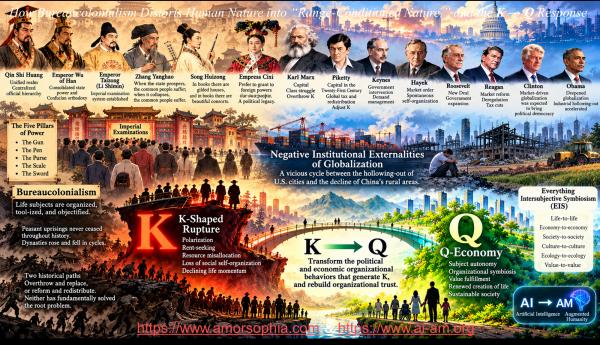
Since the institutional legacy of Qin rule and Han Confucianism, a unified hierarchy of official rank and position became intertwined with orthodox moral instruction, gradually forming a deep political inheritance that drew people throughout the realm into the organizational “range” — the gòu.
According to tradition, Emperor Taizong of Tang, Li Shimin, once privately inspected the Duanmen Gate. Seeing the newly successful imperial examination candidates filing out in a line, he reportedly exclaimed with delight: “All the heroes under heaven have entered my range!”
The character 彀 (gòu) originally means drawing a bow or crossbow to full tension. 彀中 means the area within the range of an arrow, and by extension a sphere of confinement or control. To “enter the range” is to be brought within that sphere of control.
Through the imperial examination system, the Tang dynasty connected the prospects of the empire’s scholars to the state’s system of official recruitment. A later saying captured the deeper implication: “Emperor Taizong devised a truly masterful strategy, keeping the heroes striving until their hair turned white.”
Of course, the examination system also broke the hereditary monopoly of aristocratic clans over official careers and gave more ordinary scholars an opportunity to enter state organizations. That was an important historical achievement.
Yet “all the heroes under heaven have entered my range” raises another question: what happens to heroes after they enter the range? That is precisely a question worth examining through the political-economic organizational behavior of Bureaucolonialism.
I. The “Range” Does More Than Confine People: It Turns Them into “People of the Range”
At first, an organization constrains only a person’s behavior. But when income, promotion, honor, housing, resources, social status, personal relationships, sources of information, and even a sense of security become increasingly dependent on the same organizational system, the organization’s influence no longer ends when the workday ends. It begins to enter a person’s language, judgment, relationships, interests, and eventually personality.
We often encounter this in ordinary life. A friend we once knew very well — even a parent, sibling, or other close relative — enters officialdom and gradually seems to change. Similar phenomena can also occur in business, intimate relationships, and other highly closed organizational settings.
The person onstage differs from the person offstage; inside the meeting differs from outside it; public speech differs from private speech. In private, someone may tell you, “I know that is not really how things are.” Yet in a meeting the language immediately changes: “We must unify our understanding.” At home, the person judges by ordinary common sense; inside the organization, the first question may become: “What does the leadership mean?”
A person begins to live in two worlds at once: the world of life and the world of organization. At first, perhaps he is merely “performing.” But after performing long enough, the role enters the self.
Thus, alongside human nature there gradually grows an official nature; as official nature is further shaped by organizational norms, it may develop into what is called Party nature. When an organization’s rewards and punishments, resources, information, security, and identity increasingly surround the whole person, something more general emerges: range-conditioned nature — gòu-xìng.
By “range-conditioned nature,” I do not mean that anyone who enters an organization necessarily becomes morally corrupt. I mean a stable set of behavioral tendencies gradually formed when a complete living subject remains for a long time within a closed and highly hierarchical sphere of organizational control and adapts to its structure of rewards, resources, and security.
The old saying that “an official no longer fully belongs to himself” is therefore worth examining not for the word “official,” but for the phrase “no longer belongs to himself.” Who makes him unable to act as himself? By what means? Why do so many very different people, after entering the same organization, gradually learn to say similar things, do similar things, and avoid similar risks? This is not merely a question of personal morality. It is a question of organizational behavior.
II. The “Fivefold Monopoly”: How Is a Complete Organizational “Range” Formed?
In The Driving Force Behind the Dynamics of Social Life (1980), I used the expression “Fivefold Monopoly” to describe an extreme totalizing political-organizational form of Bureaucolonialism.
The five are: the gun, the pen, the purse, the scale, and the judicial sword. Seen again today, the most important issue is not simply the concentration of power. It is that when five different organizational capacities converge within the same hierarchy of official positions and ranks, together they can form a complete “range.”
The gun controls coercive force and security; when political power is born from the gun, political security can in turn become dependent on the gun. The pen controls propaganda, education, information, and public narrative. The purse controls public finance, finance more broadly, state-owned assets, and the allocation of major resources. The scale controls standards, statistical measurement, statistical definitions, and performance criteria. The judicial sword controls adjudication, law enforcement, punishment, and dispute resolution.
All five capacities are necessary to a modern state. The question is not whether they should exist. The question is this: if all five ultimately converge into one vertical hierarchy of official rank and position, how much “space outside the range” remains for anyone who enters it?
What one says affects evaluation; what one does affects promotion; how one measures affects political performance; whom one associates with may affect security; and whether one obeys may affect resources and even one’s fate.
“All the heroes under heaven have entered my range” is therefore no longer merely an emperor’s boast about recruiting talent. It becomes a serious problem of political-economic organizational behavior: when all the heroes have entered the same range, how much power remains outside it to test and examine the range itself?
The issue has never been whether the five powers should exist. It is whether those five powers serve life, or whether they turn around and manipulate life.
III. From Human Nature to “Range-Conditioned Nature”: Why Can Organizations Change and Distort People?
To attribute everything to “human greed” cannot explain why some originally upright people gradually learn a different behavioral pattern after entering certain organizations. Nor can it explain why the same person, after leaving a particular organizational environment, may recover ordinary common-sense judgment.
What actually operates is: human nature × organizational structure.
Organizations continuously select behavior through reward and restraint. Conduct that conforms to organizational expectations is rewarded; conduct that does not carries costs. Those who accurately read organizational intentions keep advancing, while those who persist in judgments made “outside the range” may gradually be marginalized.
Over time, the organization no longer needs to tell everyone what to do every day. People learn to correct themselves. That is when the “range” becomes most mature.
A truly durable enclosure does not need a guard at the door every moment, because those inside already know the boundaries of the “dark room.” Here the “dark room” draws on Lu Xun’s metaphor of the “iron house”: the deepest confinement lies not only in where the locks are, but in the fact that those inside have learned — and even internalized — its boundaries.
Decades ago, when discussing formalism and bureaucracy, I used a simple analogy. Even a group of animals usually thought to be gentle and grass-eating, if kept for a long time inside one enclosed pasture, can leave that ground foul with dung and urine and in complete disorder. The problem cannot be reduced to which sheep is “bad.” We must also ask how the field was enclosed, how it was managed, and how it became a persistent behavioral environment.
Range-conditioned nature is similar. The concept does not absolve individuals of responsibility. It requires us, beyond personal responsibility, to ask: what forms of organization continuously produce what kinds of people?
IV. From “Range-Conditioned Nature” to Four Recurring Patterns of Political-Economic Organizational Behavior
When range-conditioned nature gradually becomes an organizational habit, measures that may originally have been temporary can solidify into recurring patterns of political-economic organizational behavior. At least four deserve special attention: corruption, stability maintenance, selling out the nation, and war preparedness.
“Corruption” here cannot be reduced to taking envelopes of cash. When an organization controls scarce resources such as land, finance, approvals, projects, procurement, minerals, and market access, power itself can create rents. A chain emerges: rent creation → rent extraction → rent seeking. At certain stages, this may even develop into the so-called “deep-sea fishing” practice of extracting enterprise resources through cross-regional law enforcement, account freezes, confiscations, and penalties.
The second pattern is stability maintenance. Every society needs public security. But when maintaining social order gradually turns into preventing all non-organized thought, associations, and forms of social self-organization, the meaning of “stability” changes. What is being protected first: the security of life, or the organization itself?
The stronger organizational control becomes, the weaker society’s capacity for self-organization becomes; the weaker self-organization becomes, the more the organization feels compelled to tighten control. A cycle forms: control → loss of self-organization → greater insecurity → more control.
The third is a deliberately strong expression: selling out the nation. States of course need diplomacy, international assistance, and resource cooperation. What I mean here is not normal diplomacy. I mean an organization, without sufficient authorization and value fulfillment, treating funds, land, minerals, and other resources that should belong to the country’s citizens as bargaining chips for maintaining its external relationships, purchasing political support, or expanding organizational influence and penetration, while citizens ultimately bear the cost.
In this sense, “selling out the nation” first means selling out the nation’s people: treating citizens’ resources as if they belonged to the organization itself and using them for exchange. This can take the form of money diplomacy, land diplomacy, or resource diplomacy. Such a logic — subordinating citizens’ resources to the organization’s external needs — is not necessarily an accident of one dynasty, one regime, or one individual. Once sedimented as a political inheritance, it can recur across changes of regime under different names and forms.
The fourth pattern is war preparedness. A state must of course possess necessary national-defense capacity. But when an organization increasingly interprets both internal and external relations as potential threats, “security” can become an endlessly expanding concept: guarding against external enemies, internal disorder, those below, and society itself.
War preparedness and stability maintenance then converge at the level of organizational logic: one guards against the “outside,” the other against the “inside,” but both begin from the same premise — treating life first as an object to be guarded against, managed, and mobilized.
V. Why Can an Economy Prosper Without Ordinary People Receiving Corresponding Fulfillment?
A country can simultaneously experience rapid GDP growth, expanding foreign trade, large trade surpluses, rising foreign-exchange reserves, rapidly changing cities, and increasingly impressive infrastructure. The whole society can appear economically prosperous.
Yet none of these facts automatically implies that ordinary people’s lives improve at the same speed.
Wealth being created is one matter. The organizational channels through which wealth flows are another. How much of that wealth is ultimately fulfilled in the well-being of life is a third.
Where can the money go? Some can enter power-interest networks through rent creation, rent extraction, and rent seeking. Some can be consumed by ever-growing organizational maintenance costs. Some can be used for externally oriented political resource allocation that lacks sufficient public authorization and value fulfillment. Some can enter expanding systems of internal and external security.
The fundamental question is therefore not simply, “Does the country have money?” It is: “Where did the money ultimately go?”
The widely circulated saying, “Better to give to friendly foreign powers than to domestic servants,” is often attributed to Empress Dowager Cixi, although its exact provenance remains uncertain. What matters is not finally who said it, but why it has circulated for so long. It touches a deeper political inheritance: when an organization gives priority to using citizens’ resources as bargaining chips for maintaining its own external relationships, rather than first confirming rights and fulfilling value toward its own citizens, regimes and names can change while the same allocation logic persists in new forms.
This is precisely what GDP alone cannot answer. GDP records economic activity, but it does not automatically tell us whether that activity ultimately improved ordinary people’s lives. A trade surplus measures the difference between exports and imports over a period, but it does not automatically tell us how the resulting wealth is ultimately fulfilled among living people. Foreign-exchange reserves can be enormous without proving that ordinary people’s health, income, free time, social trust, and quality of life improved in parallel.
Thus Zhang Yanghao’s old line suddenly acquires a modern political-economic meaning: “When the state prospers, the people suffer; when the state falls, the people suffer.”
Why people suffer when a state collapses is not difficult to understand. What the theory of Bureaucolonialism must explain is: why can the people still suffer when the state “prospers”?
VI. “When the State Prospers, the People Suffer”: Between Growth and Life Stands an Organization
The answer gradually becomes visible: between growth and life stands an organization.
If the organization is a trustee, it continually transforms economic growth into the empowerment of life. If the organization becomes bureaucolonialized, it may transform an increasing share of the gains from growth into organizational expansion, organizational maintenance, organizational security, organizational interests, internal control, and external influence.
Bureaucolonialism may therefore be hardest to recognize not when a country is declining, but precisely when GDP is growing rapidly, city lights are brilliant, exports keep expanding, and foreign-exchange reserves keep rising. Prosperity can most easily conceal the suffering of ordinary people.
This is also the question left by the “scale.” GDP weighs economic activity, but it does not weigh how much real efficacy life has gained. Even if every GDP figure is completely accurate, the problem remains.
Symbionomics therefore does not propose throwing GDP away. It continues to ask what GDP does not answer: Have costs actually fallen? Has life been empowered? Is life healthier? Is there greater trust between people and organizations? Are people, organizations, and nations more peaceful with one another?
That is C—E—H—T—P, and from there we move further into GDE.
The purpose is not to create another scale controlled by the organization, but to ask: has the economy actually returned to life?
VII. K Is Not Merely Two Lines of Rich and Poor, but a Structural Rupture in Life’s Capacity to Move
At this point, “when the state prospers, the people suffer” can no longer be explained simply as wealth inequality.
The wealth gap is only the most visible crack in K. What K really describes is a multidimensional structural rupture, produced through political, economic, and organizational behavior, in wealth, opportunity, rights, creation, fulfillment, trust, health, and life’s capacity to move.
The upper branch of K is therefore not inherently “bad.” Entrepreneurs create products, scientists create technologies, investors bear risk, and capable organizers raise efficiency. Higher returns can legitimately be the fulfillment of value creation.
The question is not whether some people move upward. The question is whether more and more lives still possess the capacity to move upward.
If creation can receive fulfillment, fulfillment can re-empower life, and empowered life can enter new creation, then difference does not automatically become rupture. The real K appears when value creation is severed from value fulfillment, wealth is severed from the lives that create it, organizational capacity is severed from ordinary living subjects, and pathways of upward movement are severed from an increasing number of lives.
The “Fivefold Monopoly” of Bureaucolonialism can deepen these ruptures: resources can be intercepted, measures distorted, expression compressed, social self-organization weakened, and security costs continually expanded.
An economy can therefore grow rapidly while continuously generating K. GDP can be real. Prosperity can be real. Industrialization, technological progress, and infrastructure construction can also be real. At the same time, K can also be real.
That is why recognizing the pathology of Bureaucolonialism does not justify denying the genuine creation that occurs during development; nor do remarkable economic achievements justify denying that increasing numbers of lives may be losing their capacity to move.
K is a structural rupture that can still emerge after development has occurred.
VIII. Two Old Paths: Overthrow K, or Redistribute K
Faced with K, humanity has repeatedly followed two paths over thousands of years.
The first is overthrow and replacement. When contradictions within an old organization accumulate beyond endurance, those below rise to overthrow those above; a new force acquires power and establishes a new organization. From dynastic change to modern revolution, this path has appeared again and again.
It can of course break a rigid old structure and, at particular historical moments, open new space. But if the relational structure that produces the “range” remains unchanged, yesterday’s Object may acquire power and become today’s Subject, only to turn others into Objects again.
Overthrowing the upper branch of K therefore does not eliminate the mechanism that generates K.
The second path is reform, adjustment, and redistribution. Instead of overthrowing the upper branch, taxation, welfare, transfer payments, public services, and other policies are used to narrow already existing gaps.
Such measures can provide emergency relief, establish a floor, and ease poverty and social conflict. Their real-world role should not be denied. But if the mechanism that generates K continues to operate, a cycle can emerge: generate K → adjust K → alleviate K → generate K again.
Over the past century or more, these two old historical paths have received highly influential modern theoretical expressions.
Capital placed the structural conflict between capital and labor at the center of theory, and the class-struggle and revolutionary paths developed from it sought to resolve the problem by changing relations of ownership and power. Capital in the Twenty-First Century returned the concentration of wealth and income to center stage and advanced progressive taxation, taxes on capital, and redistribution as important policy instruments.
Their periods, evidence, and theoretical tasks are of course different, and both exposed real problems. But viewed through the K → Q coordinate, one path focuses primarily on overthrowing or changing K’s upper branch, while the other focuses primarily on redistributing after K has formed.
The theory of Bureaucolonialism therefore asks a third question: What forms of political-economic organizational behavior continually generate K? And how can those generative mechanisms be changed so that life regains the momentum to enter Q?
To “move beyond” does not mean declaring earlier thinkers wrong, much less competing for a theoretical label. The only test is whether we can explain the problem more deeply and actually solve it.
IX. Keynes and Hayek: Why Is “Government or Market” Still Not Enough?
If “overthrow or redistribute” is the first layer of debate, another axis that profoundly shaped the twentieth century is “government or market.”
After the Great Depression, Keynesianism emphasized that when effective demand is insufficient, unemployment severe, and markets unable to recover quickly on their own, government must enter through fiscal policy, monetary policy, public investment, and other measures to support the economy.
Hayek warned from the other side that no center can possess all the knowledge dispersed among countless individuals. Prices, choice, and spontaneous order carry informational functions that planners cannot replace. Excessively centralized planning can reduce efficiency and also compress individual freedom and the space for self-organization.
From the perspective of Symbionomics, Hayek moved an important step closer to the self-organization of life. He respected dispersed knowledge and individual choice and opposed a single center treating itself as the only Subject authorized to decide for all lives.
But that is still not enough.
Self-organization does not automatically equal symbiosis.
Once market actors gain freedom, monopolies can still form; capital can still become bureaucolonialized; platforms can become new super-Subjects; and after government retreats, other large organizations can still turn life back into an Object.
The problem therefore cannot stop at “more government or more market.” The deeper question is: how do lives that have regained subjectivity connect? How do different subjects confirm rights, interact, achieve mutual fit, and fulfill value? How, while preserving difference, do they co-generate new value rather than create another range?
This is where spontaneous order must continue toward the Intersubjective.
X. Roosevelt and Reagan: Two Important Experiments — Why Did Each Solve Only Part of the Problem?
Theoretical disputes ultimately enter reality.
The New Deal of Franklin D. Roosevelt responded to severe economic and social rupture by expanding relief, regulation, public investment, and institution-building, using organizational capacity to support both markets and everyday life. It addressed a series of urgent problems under Great Depression conditions and reshaped the relationship between the American state and the market.
Decades later, Reagan confronted a different set of problems: high inflation, weak growth, and controversies over taxation and regulation. Reagan-era reforms turned toward tax cuts, partial deregulation, and the release of entrepreneurial and individual creative energy, allowing markets to play a larger role again.
The two policy experiments moved in different directions, yet each addressed real problems of its own era.
But they left the same deeper question.
If a Roosevelt-style path continually expands organizational capacity, it must still answer: who constrains the organization itself?
If a Reagan-style path stops at “less government, more market,” it must still answer: how do market subjects avoid new monopolies, predation, rupture, and Objectification?
Roosevelt and Reagan therefore cannot be reduced to a simple question of who was right and who was wrong. One brought organization further into the market; the other withdrew part of it.
K → Q asks a third-level question: how can we redefine the relationships between organization and life, organization and organization, and subject and subject, so that economic activity itself continually restores life’s capacity to move?
XI. From Clinton to Obama: When the “Range” Generates Negative Institutional Externalities through Globalization
After Reagan, the U.S. economy entered a new historical condition: the Cold War ended, the information-technology revolution unfolded, and global capital and supply chains were rapidly allocated across borders.
When the Clinton administration supported China’s entry into the world trading system, it held a clear expectation: economic opening would not only expand opportunities for U.S. firms to enter the Chinese market, but would also push China toward further market reform, reduce the state sector, bind it more closely to international rules, and ultimately force it to confront political reform. Clinton administration documents around 2000 repeatedly expressed this expectation.
In other words, there was an important assumption: marketization would promote institutional opening, and the global market would gradually change the different systems entering it.
That assumption, at least, was not fully realized in the way then expected.
What deserves even more attention from the theory of Bureaucolonialism is another issue that was not sufficiently recognized at the time: when different institutional structures enter the same global market, it is not only goods, capital, technology, and management experience that cross borders.
Differences in costs produced by institutions can also be transmitted outward through prices, investment, and supply chains.
I call this phenomenon negative institutional externalities.
If the low cost of a product derives not only from technological progress, management efficiency, and labor productivity, but also in part from particular labor-pricing arrangements, government subsidies, resource allocation, environmental costs, financial support, and other institutional arrangements, then once that product enters the global market, competition is no longer simply “enterprise versus enterprise.”
Institutions themselves begin to compete through goods, capital, and supply chains.
A crucial paradox appears. U.S. firms can shift production to lower-cost locations; U.S. capital can earn higher returns; U.S. consumers can buy cheaper goods; and China can obtain capital, technology, management experience, markets, and opportunities for industrialization. All of these gains are real.
But if we see only “the United States occupies the high end while China undertakes manufacturing,” or “Americans receive inexpensive goods,” we miss the simplest common sense of the life-world: when a person loses a job, he loses more than a paycheck.
Work is also a carrier of skills, a support for family life, a part of community connection, and an important means by which human creative capacity, social participation, and dignity receive fulfillment.
When factories disappear for a long time, what is lost is more than a building. Supply chains break, skills deteriorate, communities decline, local public finance weakens, land and facilities lie idle, and the next generation’s pathways into production and creation are altered.
This is what I call: hollowed-out cities, fallowed fields.
The problem therefore cannot simply be blamed on China. U.S. capital pursued lower costs; U.S. companies actively reorganized supply chains; U.S. consumers enjoyed cheaper goods; and U.S. policymakers believed that trade and market opening would produce institutional convergence. All these subjects participated in the process.
The real question is: why could the global market calculate commodity prices so rapidly while failing to calculate institutional costs, life costs, community costs, and the costs of organizational trust with equal adequacy?
From Clinton through Obama, this structure of globalization deepened further. Globalization created enormous wealth, but it also left some industries, regions, and lives gradually losing their capacity to move.
K therefore ceased to be only a pattern of differentiation within one country. Once different institutions became globally connected, the institutional arrangements of one side could transmit costs to another through supply chains and generate different forms of K in different societies.
The market had been expected to change the “range.” Yet another possibility emerged: the “range” could also use the market to transmit its institutional effects outward.
That is precisely why negative institutional externalities deserve serious study.
XII. Why Do I Call Trump’s Agenda a “Common-Sense New Deal”?
Only after understanding “hollowed-out cities, fallowed fields” can we understand why the political emergence of Donald Trump cannot be explained solely through the traditional left-right axis.
As early as 1980, at age thirty-four, Trump spoke publicly in an interview with Rona Barrett about the Iran hostage crisis and America’s international standing. He argued that America appeared weak and that this encouraged other countries to treat it accordingly. Yet when Barrett asked whether he wanted to be president and why he did not enter politics, he made clear that he did not want the presidency and described political life as exceptionally harsh.
By 1987, the scope of his concerns had clearly widened. He publicly criticized what he regarded as unfair treatment of the United States in economic relations with Japan and other countries, while still stating that he had “zero political aspirations.”
At minimum, these two early records show that decades before formally entering politics, he was already approaching questions of national capacity, international transactions, industrial interests, and the costs ultimately borne by ordinary Americans from the experience and common sense of a businessman.
That is why I call the agenda that later took shape under Trump a “Common-Sense New Deal.” The point is not that he possessed a complete theory of political economy.
On the contrary, it first appears as a set of questions arising from the life-world:
If a form of globalization enables capital to earn profits and consumers to buy inexpensive goods, but causes increasing numbers of domestic workers to lose jobs, skills, communities, and dignity, does that arrangement really contain only “efficiency” and no cost?
If a country places supply chains, energy, manufacturing capacity, and even critical productive capabilities abroad for long periods while remaining satisfied with occupying the so-called “high end,” can such a structure really be sustainable?
If trade rules are formally identical while the internal costs of subsidies, labor, resources, finance, and regulation differ across institutional systems, does so-called free competition already contain institutional differences that have not been accounted for?
These questions do not arise first from the left or the right. They arise from common sense.
Trump’s later personal decision to enter politics should of course not be reduced to a single motive; no person’s political decision can be fully explained from a few early interviews. But from his public statements in 1980 and 1987 to his later campaign emphasis on trade, manufacturing, jobs, and national strength, one can see a persistent line of concern.
In this sense, the policies and practices of Trump’s “Common-Sense New Deal” display a political-economic organizational orientation worth studying. They do not merely wait until K has formed and then redistribute it, nor do they simply repeat the old argument of “government or market.” Instead, they place taxation, regulation, energy, manufacturing, supply chains, trade conditions, borders, and the organizational costs of government within the same practical problem, seeking to alter some of the conditions under which K is generated.
This does not mean that any particular policy is inherently correct. Every policy must still be tested against facts, costs, efficacy, and long-term results.
But within the K → Q framework, the question itself has changed: not only how to divide the results after K has formed, but how to enable lives that have lost work, capacity, connection, and dignity to re-enter creation.
This is where the “Common-Sense New Deal” intersects with Symbionomics.
XIII. From Trump and Milei to Q: Moving Beyond the Old Coordinates of “Left–Right” and “Government–Market”
Milei’s reforms likewise suggest that the changes worth studying today can no longer be adequately summarized as “market or planning.” Cutting ineffective organizational costs, changing regulatory and fiscal structures, and releasing entrepreneurial and individual creative energy are of course connected to traditional free-market thought. But if reform further touches how organizations are entrusted, how resources are fulfilled, and how life recovers creative capacity, then it is confronting more than “public or private ownership” and “government or market.”
Trump and Milei have not proposed Q Economy, and the fact that some of their policies intersect with Symbionomics does not justify placing real political figures inside a predesigned theoretical box.
Yet some of their policies and practices display a common tendency: moving from treating the results of K toward touching the conditions that generate K.
That is the political-economic organizational shift required for movement from K toward Q.
Q does not pull K’s upper and lower branches back to the same level. Q is not egalitarian leveling.
Life naturally contains differences. People differ in abilities, choices, creativity, and risks undertaken; the outcomes they generate will of course differ. Sameness does not continue life.
The real question is not how to eliminate difference, but whether connections still exist among differences; whether the value created by life can receive rights confirmation and fulfillment; whether fulfillment can re-empower life; and whether empowered life can enter new creation.
The basic movement of Q is therefore:
Life → Creation → Rights Confirmation → Fulfillment → Empowerment → Connection → Re-creation
Q does not flatten K.
Q enables increasing numbers of lives that have lost their momentum to move again.
XIV. From Subject—Object to Intersubjective: Rebuilding Organizational Trust
Seen again from here, the problem of range-conditioned nature becomes clearer.
The deepest pathology of the range is not merely that some people take more money. It is that the subjectivity of life is damaged.
A person moves from asking “What can I create?” to asking “What does the leadership want?”; from “Does this have value?” to “Does this count as political performance?”; from “How can I generate new possibilities with others?” to “How can I secure a safer position inside the organization?”
This is the degeneration of a living subject into an organizational Object.
Movement from K toward Q therefore begins not with moving wealth around, but with restoring subjectivity: allowing workers again to become subjects, enterprises to become subjects, social organizations to become subjects, communities to become subjects, and government to move from being the sole Subject toward becoming an organization authorized by and entrusted to life.
At this point, Q Economy connects with Everything Intersubjective Symbiosism — 万事交互主体共生.
From Subject → Object, toward Subject ↔ Subject, and then further into the Intersubjective.
Not one subject eliminating another; not those below overthrowing those above only to become the new above; not a third super-organization endlessly transferring the wealth of those above to those below.
Rather, different subjects preserve their differences, connect, fulfill value for one another, empower one another, and within the “inter-” co-generate new value, new relationships, and new possibilities.
To leave behind the organizational logic of the “range” is not to place all the heroes under heaven inside a better range. It is to allow every life to remain itself, to enable different subjects to connect with and enable one another, and to co-generate organizations worthy of trust.
Then the gun can accept authorization rather than become the source of authorization itself; the pen can submit to facts, logic, and interactive verification; the purse can move from controlling resources toward rights confirmation, trusteeship, and fulfillment; the scale can move beyond GDP toward the efficacy of life; and the judicial sword can maintain public order while preserving space for life’s self-organization.
One modern path represented by Capital sought to change the ownership and power structure of K; another represented by Capital in the Twenty-First Century focuses on taxation and redistribution after K has formed. Keynes and Hayek responded to modern economic imbalance through government intervention and spontaneous order respectively; Roosevelt and Reagan carried two different directions into real policy experiments; and the globalization deepened after Clinton further exposed the negative institutional externalities that can arise when different institutional systems become connected.
These explorations all addressed real problems, and all left unresolved questions.
K → Q continues by asking the next question: How can we change the political-economic organizational behavior that continually manufactures K, so that life regains the momentum of self-organization, connection, creation, rights confirmation, fulfillment, empowerment, and re-creation?
Life is the purpose; organization is the trustee.
From Subject—Object toward Intersubjective;
from K-Shaped Rupture toward Q Economy;
from “all the heroes under heaven have entered my range” toward subjects meeting subjects in the “inter-”;
from organizational control toward organizational trust.
Everything Intersubjective Symbiosism — 万事交互主体共生.
This is where construction truly begins after Bureaucolonialism has been deconstructed.
September 25, 2026 · Vancouver



您好!请登录
已有0评论
购物盒子