

New Articles
-
 信用即生产力! 2026/11/29
信用即生产力! Creditworthiness Is a Productive Force! ——从阿根廷主权信用评级三连升再论组织信托经济学 — Revisiting...
- “我来唤醒雄狮,而非引领羔羊!” 2026/11/28
“我来唤醒雄狮,而非引领羔羊!” “I Came to Awaken Lions, Not to Lead Lambs!” ——米莱改革的五大经济底层逻辑与共生经济...
- 阿根廷,我来了! Argentina, Here I Am! 2026/11/26
阿根廷,我来了! Argentina, Here I Am! ——谁在期待米莱的电锯失灵?从殖官主义的跨意识形態繁衍到共生经济学的现实检验 ...
- 创造未来,守护生命 2026/11/23
创造未来,守护生命 Create the Future, Safeguard Life ——面对美国中期选举与黄仁勋事件的双重组织信托危机 — Confrontin...
共生思想理论前沿
THE THEORY
-

-
-

-
 关于中文“共生”翻译及对应的人、事、物之说明
 ——Symbiosism:Charles Thomas Taylor &Qian hong又一次量子缠绕...
查看详细说明
Speech
-
 三大自组织货币的共生格局——宏观世界之数字货币 2021/07/08
三大自组织货币的共生格局 ——宏观世界之数字货币 钱 宏 The Institute for Global Symbiosism(...
-
 新汉字yǜ的释义 2019/11/16
语从金音玉(Yǜ):金口玉言,一诺千金,性人诚恳、执信; &n...
-
 钱宏:中国的真实经验与未来走向(凤凰博报专... 2019/11/16
点击播放 中国的真实经验与未来走向《凤凰博报》专访钱宏主持人:...
信用即生产力!
发布时间:2026/11/29 公司新闻 浏览次数:2
信用即生产力!
Creditworthiness Is a Productive Force!
——从阿根廷主权信用评级三连升再论组织信托经济学
— Revisiting the Economics of Organizational Trust in Light of Argentina’s Three Successive Sovereign Credit Rating Upgrades
钱 宏(Archer Hong Qian)
2026年11月28日于布宜诺斯艾利斯NIC Lerma公寓403室
题记:阿根廷米莱改革的经济学新质论之三
从《阿根廷,我来了!》(之一)到《“我来唤醒雄狮,而非引领羔羊!”》(之二),再到本篇《信用即生产力!》(之三),三篇文章一脉相承,构成“阿根廷米莱改革的经济学新质论”系列。
所谓经济学新质论,是指米莱改革的现实实践已经超越现行经济学各家各派的理论范式,呈现出共生经济学的新质特征,其制度枢纽集中于一点:重建组织信托。
从重建组织信托入手,变革经济发展模式与价值取向,让生产回归生活,生活呈现生態,生態激励生命,已经成为当今世界各国经济发展的必由之路。
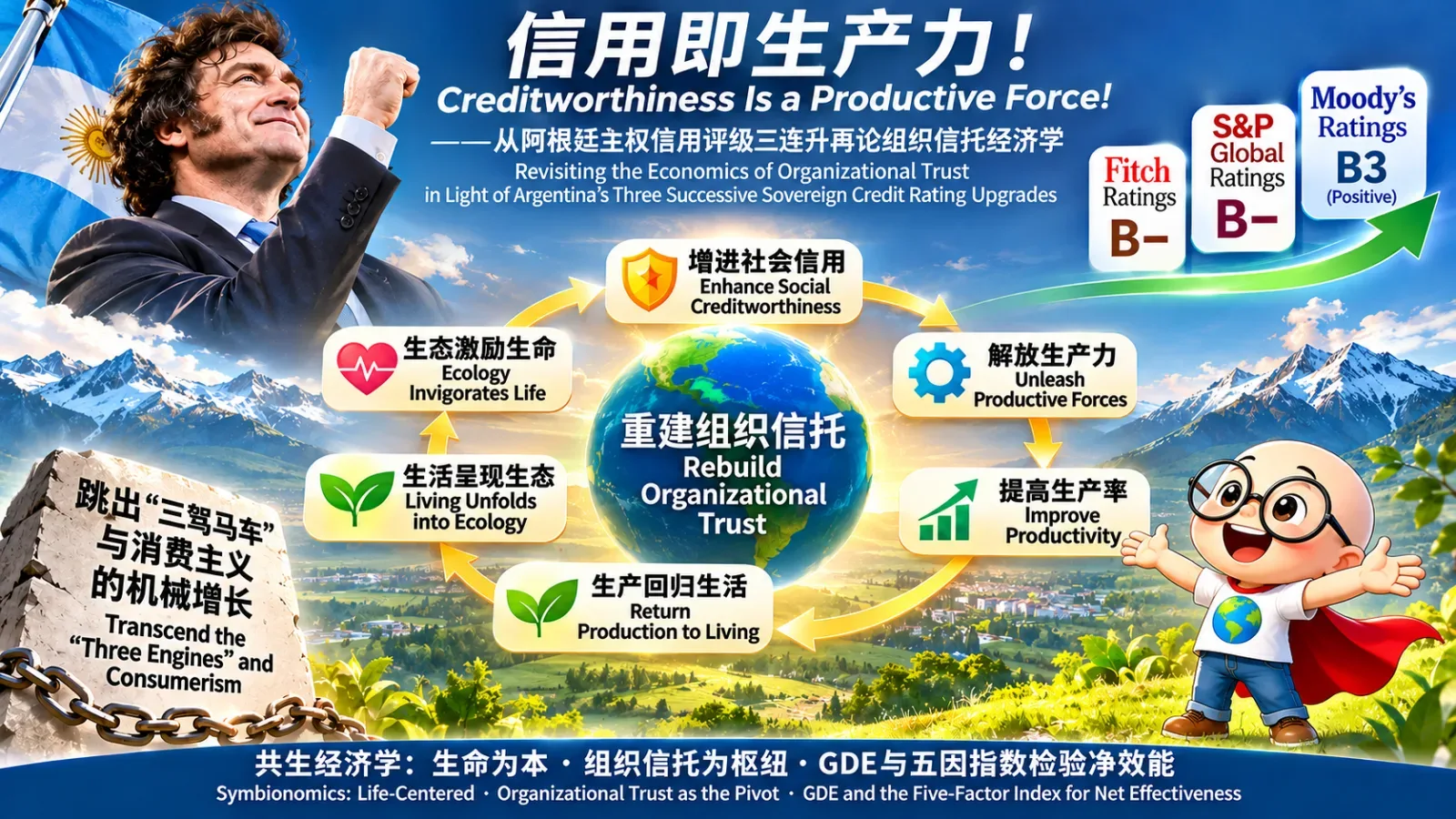
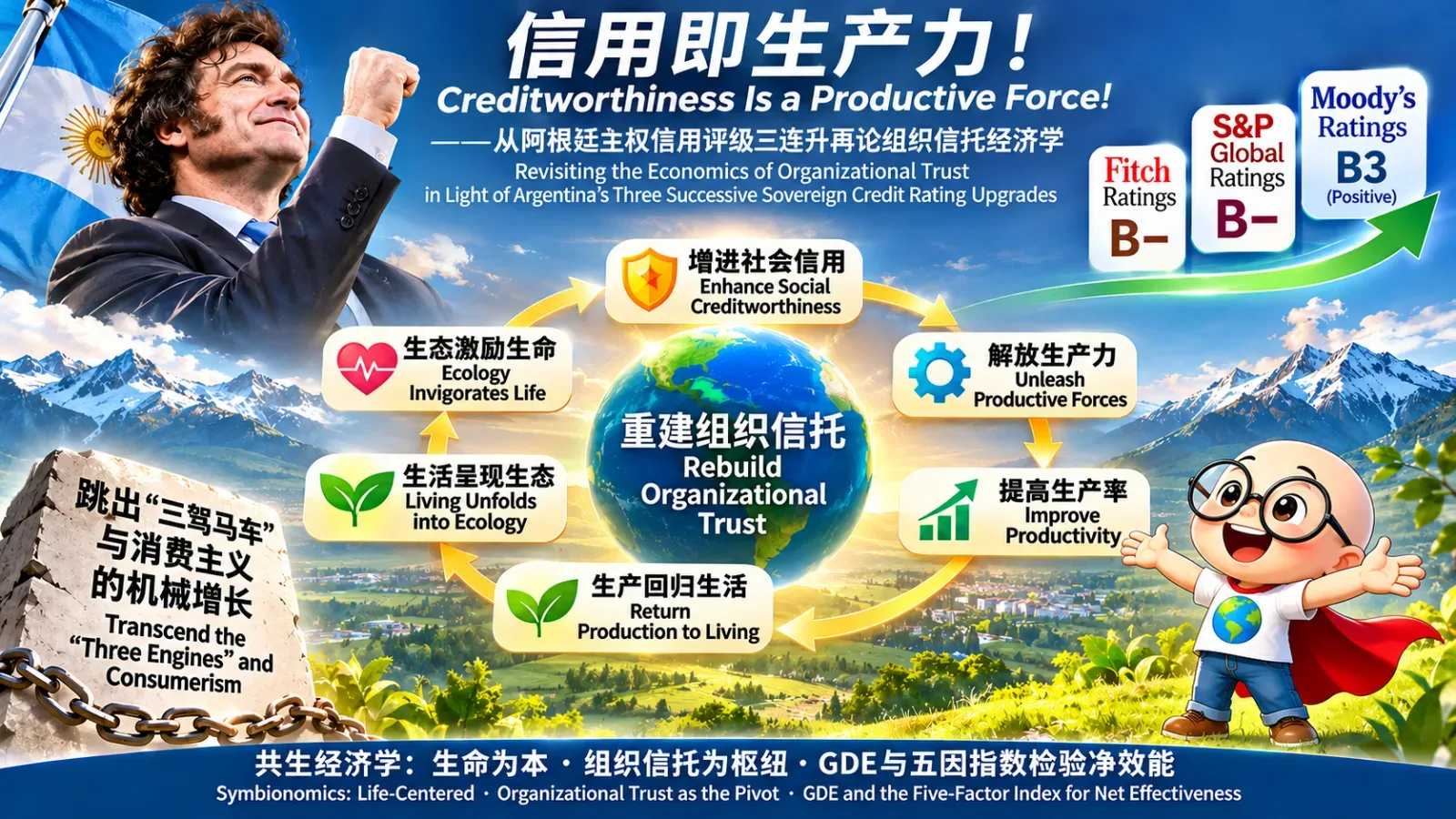
信用即生产力。重建组织信托,能够增进社会信用;信用增进,能够解放生产力、提高生产率,使生产回归生活,生活呈现生態,生態激励生命。这是共生经济学理解经济发展的内在理路。
2026年5月5日、6月10日、7月21日,惠誉(Fitch)、标准普尔(S&P)和穆迪(Moody’s)先后上调阿根廷主权信用评级,分别达到B−、B−和B3。其中穆迪给予正面展望,另外两家给予稳定展望。[Ⅰ] 三次评级上调虽仍处于非投资级范围,却为观察阿根廷国家信用重建提供了具体的现实切入点。
两天前,我在《“我来唤醒雄狮,而非引领羔羊!”——米莱改革的五大经济底层逻辑与共生经济学范式解析》中,已经提出贯通米莱改革诸项实践的制度枢纽——重建组织信托。[Ⅱ] 今天,循着这一理路,我们可以进一步辨识信用与生产力之间的内在关联,并重新审视现行经济学对经济发展动力的理解。
一、从国家信用回到组织信托
为什么一个国家的信用会提高?评级机构考察的是债务人的偿债能力与偿债意愿。共生经济学进一步考察这种能力与意愿赖以持续的组织关系。
国家信用的基础,存在于千千万万个人、家庭、社区和企业的创造活动之中。政府以公共服务受托者的身份取得税收、举借债务、管理公共资源,对社会承担相应的责任。财政纪律、货币信用、产权保护、契约履行,各自体现着不同层次的托付与承兑。受托者履行责任,社会便有理由增进信任;持续承兑形成信用,信用又使更广泛的合作成为可能。
阿根廷获得美国200亿美元货币互换额度的信用背书,并随后偿还实际动用资金,正可以从这种关系来理解。外部信用背书改善合作预期,履行偿债责任又为自身信用积累提供依据。额度与实际借款必须区别,但这一案例的经济学意义正在于:信任降本,信用赋能,承兑增值。[Ⅲ]
前文归纳的五大经济底层逻辑由此贯通:财富创造先于财富分配,体现生命主体的创造能力;政府受到财政约束,体现组织对受托资源的责任;货币具有信用,体现跨时间的价值承兑;自由竞争优于行政性特权,体现主体自主选择与有效连接;制度稳定支撑长期繁荣,体现组织信托的持续性。五个方面共同构成信用生产力得以释放的制度条件。
二、信用即生产力:财富生长于生命的有效连接
一个农民有种植的能力,另一个人懂得灌溉,还有人拥有种子、农具、运输工具和市场知识。这些能力分散存在时,各有其限度;彼此信任、相互托付、履行承诺,便能形成有效分工,使各自的创造能力得到拓展。
信用的经济意义从这里开始。它使原本无法达成的合作得以达成,使短期合作能够延伸为长期合作,使闲置资源重新获得使用机会,使耗费于防范失信的时间与资源回到创造活动之中。即使劳动、资本与技术的存量没有增加,社会也可能由此获得更多有效产出。
信用即生产力;生产率则体现这种生产力在一定投入条件下实现的效能。融资利率下降只是其中一种表现,而且利息减少对借款人的收益并不自动等于全社会净收益。真正的社会净效能,来自风险损失、无效交易成本的减少,以及资源重新配置后创造的价值。
从家庭协作到国际分工,信用生产力始终贯穿于生命自组织连接动態平衡(动能)与交互主体共生(势能)的相应相辅相成之中。重建组织信托,正是呵护并释放这种生产力的制度实践。
三、从既有经济学的解释回到共生经济学的本原
奥地利学派能够从个人行动、产权、企业家精神、分散知识、自发秩序和资本积累解释阿根廷改革;货币主义能够从货币稳定与通胀预期解释信用改善;新制度经济学能够从交易成本、产权和可信承诺解释制度效应;金融经济学能够从违约风险与风险溢价解释评级变化;凯恩斯主义则可以考察财政调整、需求、就业及收入之间的关系。
这些解释各有其认识价值。米塞斯《人的行动》与哈耶克《知识在社会中的运用》尤其揭示了个人自主行动与社会协调的重要性。[Ⅳ、Ⅴ] 诺思关于制度与交易成本的研究,也有助于理解信用改善的经济后果。[Ⅵ]
共生经济学的范式特征,在于从生命本原贯通这些不同层次的关系:生命为何需要组织?组织为何获得资源与权力?组织如何向生命承兑?信用怎样在持续承兑中积累?这些问题贯穿财富创造、货币金融、国家治理与日常生活。
组织信托因此成为整个经济学的基础范畴。它既涵盖奥地利学派所重视的自愿契约,也涵盖家庭互助、社区合作、公共资源托付以及跨代责任。共生经济学由此将生产力的研究贯通到社会组织关系,并以生命净效能检验这种关系的实际价值。
这种理论立场也区别于将货币信用扩张等同于生产力增长的思维。信用源于创造能力与责任承兑;脱离它们的货币扩张,可能透支信用,侵蚀生产力。
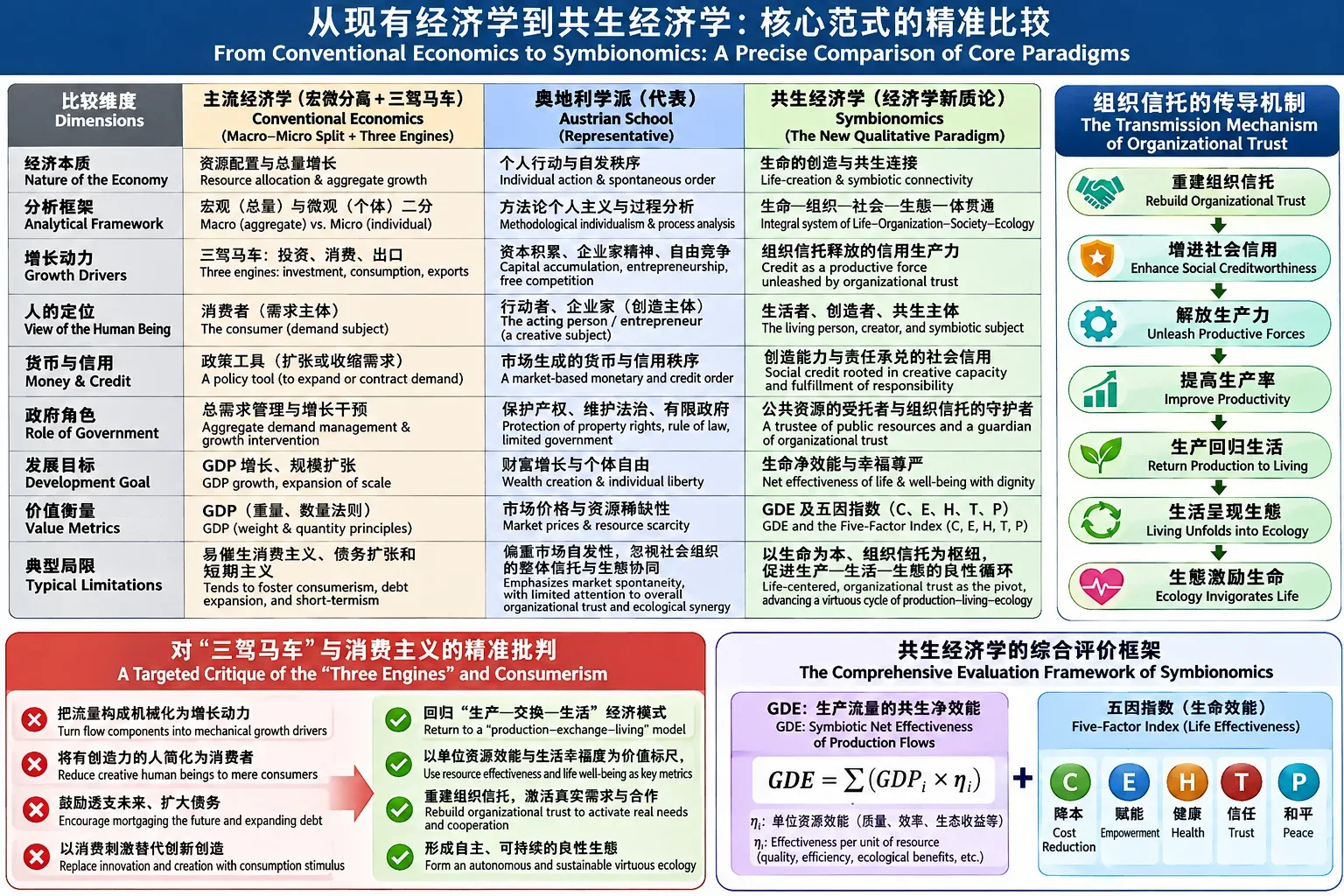
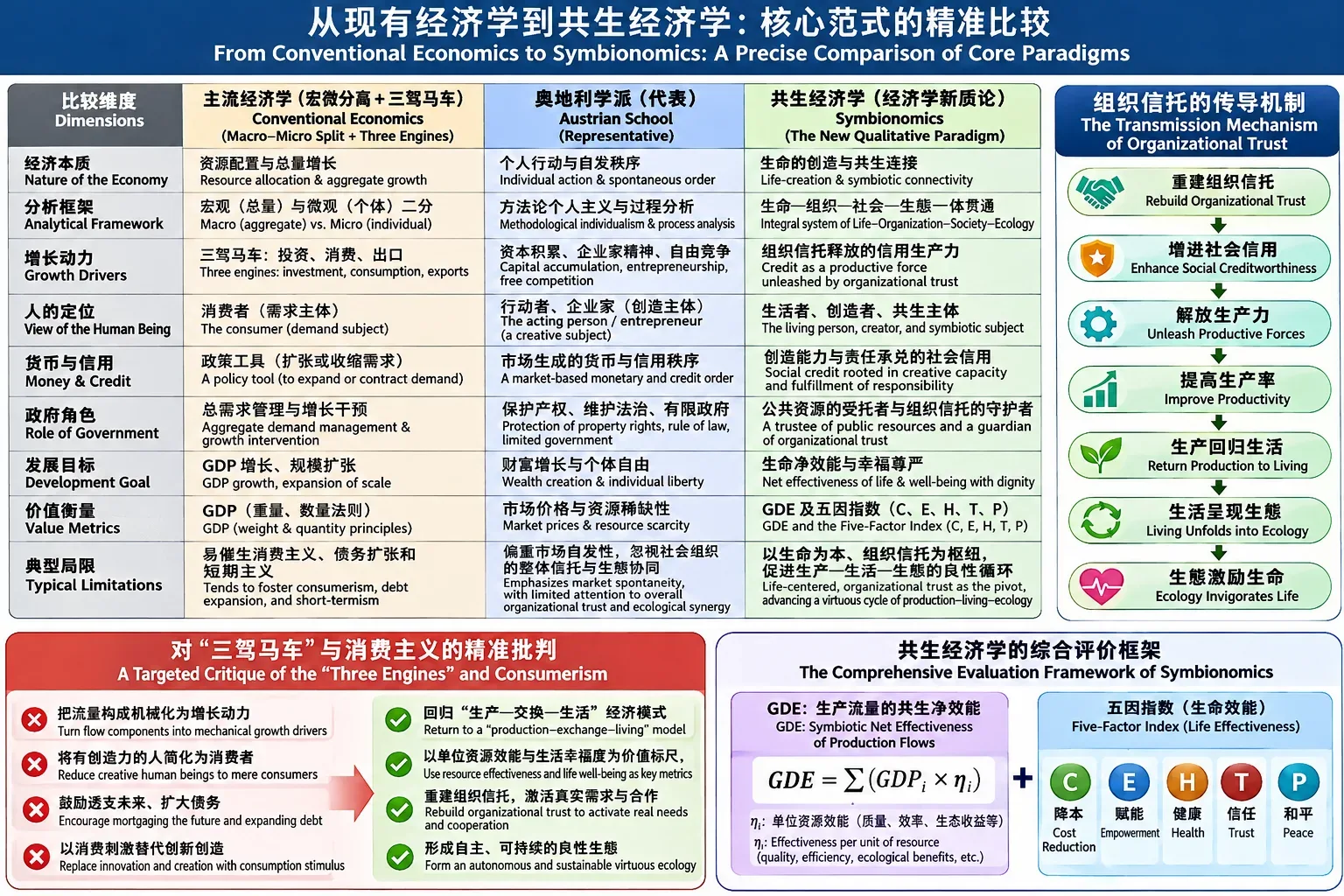
这里还涉及现代经济学的一个基础性认识框架:宏观经济学与微观经济学的二分。微观经济学研究个人、家庭和企业的选择,宏观经济学研究总产出、就业、物价与总需求。这样的分析分工有其工具价值;然而,一旦把分析层次的区别固化为两套经济运行逻辑,便容易割裂具体生命主体的创造活动与社会整体的经济效能。即使引入微观基础,也仍须回答组织如何受托、如何承兑,以及组织行为的成本最终由谁承担。
全部历史的第一个前提,是个人生命自组织连接的存在。国家经济并无独立于个人生命的创造主体;政府、企业、金融机构等组织拥有的资源与权力,都存在于具体的托付关系之中。从家庭到国家,组织规模可以不同,价值托付与责任承兑的基本关系却一以贯之。宏微相济的关键,在于生命主体之间的交互契合及其效能,而非把微观行为简单加总,再由宏观决策反过来支配个人生活。
因此,阿根廷信用评级的改善,可以在既有经济学中获得多种局部解释;共生经济学所揭示的贯通性机制,则是组织信托的重建使信用得以积累,信用又使分散的创造能力实现更有效的连接。由此,个人的生产率、企业的经营效能与国家的综合净效能获得了共同的研究基础。
四、“三驾马车”何以遮蔽经济发展的内在动力?
投资、消费、出口,是人们在生产和生活中进行自主选择与有效连接的具体表现。GDP支出法中的消费、投资、政府购买与净出口,可以帮助我们描述经济流量及其变化。“三驾马车”的问题,出在把流量构成机械地升格为经济发展的动力,并据此把社会生活作为拉动经济增长的工具。
早在2019年,我就在国务院发展研究中心《经济要参》第44期发表的《生态文明评价体系须有与之相应的经济学思维——再论新国民“生产-交换-生活”账户核算体系》中,提出从“投资、内需、进出口”转向“生产、交换、生活”,从重量、数量法则转向质量、效能法则。[Ⅸ] 这一转变涉及经济学的价值原点与核算方式:以单位资源效能及生活幸福度、尊严感检验经济活动,贯通家庭、社区、企业、政府与自然生態。
宏观需求管理与微观消费选择之间,尤其容易出现价值目的的倒置:宏观上追求支出增长,微观上则把有生命、有创造能力、有自主生活节律的人简化为消费者。生产者、创造者、公民及家庭成员的多重主体性由此被遮蔽。倘若政府以消费增长率为政绩,企业以销售流量为唯一目标,家庭以物质占有为生活尺度,三者便可能在GDP增长中共同透支未来。2019年的研究已经以服装过度生产、重复劳动及刺激内需为例,揭示这一问题。
重建组织信托所释放的信用生产力,能够降低生产与生活成本,拓展就业、创业和合作机会,改善收入与生活预期。由此产生的投资、消费和国际交换,根植于生命主体的真实需要与自主选择。人们有能力、有信心安排生活,自然会在需要时消费;有创造机会,自然会在适宜时投资;有互补优势,自然会开展交换。经济治理的着力点应当回到呵护这种生命活力及其良性生態。
试问:投资从哪里来?消费凭什么持续?出口竞争力从哪里来?归根结底,都离不开生命主体的创造能力与主体之间可信赖的合作关系。组织信托一旦改善,企业便有条件根据真实需要投资,家庭便有条件根据收入和生活预期安排消费,跨国主体便有条件根据互补优势扩大合作。这些活动有其自身的生命节律,无须将它们设定为彼此独立的机械驱动力。
尤其值得反思的是消费主义。消费本来是生活的组成部分。当消费被设定为经济增长的目的,生活服务于生产统计,家庭就可能被鼓励透支未来收入,企业就可能把缩短产品寿命作为扩大销售的手段,政府也可能借债维持短期支出增长。
一所住宅更加节能,居民能源支出减少;一种医疗技术帮助人们保持健康,治疗支出减少;一件耐用产品使用时间延长,重复购买减少;一个可信赖的社会,防范欺诈与处理纠纷的支出减少。这些变化都可能降低某些GDP流量,却使生活更富裕、更从容,使社会资源更多地用于新的创造。
生活质量的改善,自然会带来新的需要与新的经济活动。家庭节省下来的资源,可以用于学习、旅行、创业、照护家人,也可以用于储蓄,留待未来使用。由生命主体自主决定如何安排自己的生活,正是生命活力的展现。经济学应当研究这些选择怎样增进生命效能,而无须预先规定人们必须多消费多少。
五、生产回归生活,生活呈现生態,生態激励生命
共生经济学的生产、生活、生態、生命四个范畴,有着内在贯通的关系。生产体现生命创造能力,生活承兑生产效能;生活中的主体、资源与环境形成相互呵护、相互赋能的良性生態,生態又为生命开拓更丰富的创造空间。
良性生態具有开放性。个人、家庭、社区、企业通过新的有效连接,不断发现新的可能性。信用在其中既是已有合作的承兑成果,又是未来合作的生产力条件。由此可见,重建组织信托与激活生命活力,本来就是相应相辅相成的过程。
殖官主义(Bureaucolonialism)的要害,则是背离组织信托,凭借任何意识形態攫取决策免责权繁衍自己,好处自己拿,成本留给别人。以扩大经济流量为名转嫁决策成本,恰恰可能破坏上述良性生態。因此,财政约束之外,还须建立决策追责制,使组织权力与受托责任重新契合。
共生经济学以GDE=Σ(GDPᵢ×ηᵢ)辨识生产流量的共生净效能,以降本(C)、赋能(E)、健康(H)、信任(T)、和平(P)五因指数及生活基准检验改革。国家信用评级的改善,需要进一步联系家庭购买力、就业机会、健康水平、企业经营成本及公共服务效能来考察。评级衡量偿债信用,生活基准检验组织向生命承兑的实际成果。二者相互联系,各有其衡量对象。
在生产、生活、生命的意义上说,共生经济学(Symbionomics)就是组织信托经济学。新近出版的《共生经济学概论(修订版)》与《将AI升格为AM》,分别从经济净效能与心智文明展开研究,其价值指向相通:让组织、资本和技术服务于生命自组织连接与交互主体共生。
电锯改革是破,五月公约是立,重建组织信托是贯通破与立的制度枢纽,提升生命效能是改革的价值归宿。
信用即生产力!信任降本,信用赋能,承兑增值。
生产回归生活,生活呈现生態,生態激励生命。
受生命之托,向生命承兑。All for Life!
参考文献及资料
Ⅰ. 阿根廷经济部:Calificaciones Crediticias. https://www.argentina.gob.ar/economia/finanzas/relacion-con-inversores/calificaciones-crediticias
Ⅱ. 钱宏:《“我来唤醒雄狮,而非引领羔羊!”——米莱改革的五大经济底层逻辑与共生经济学范式解析》,2026年11月26日撰,11月27日刊。https://www.ai-am.org/article/10445
Ⅲ. 钱宏:《共生经济学货币通论》,2026年7月20日。https://www.ai-am.org/article/10181(互换案例为作者既有研究,实际提款及偿还金额另待原始公告核验。)
Ⅳ. Ludwig von Mises. Human Action. 1949.
Ⅴ. Friedrich A. Hayek. The Use of Knowledge in Society. American Economic Review, 1945.
Ⅵ. Douglass C. North. Institutions, Institutional Change and Economic Performance. 1990.
Ⅶ. 钱宏:《共生经济学概论(修订版)》,2026年。
Ⅷ. 钱宏:《将AI升格为AM》,2026年。
Ⅸ. 钱宏:《生态文明评价体系须有与之相应的经济学思维——再论新国民“生产-交换-生活”账户核算体系》,国务院发展研究中心《经济要参》,2019年第44期。
附录:共生经济学早期研究参考(《经济要参》)
据全球共生研究院(IGS)2012—2020年发稿目录,选列与本文论题相关的研究:
(1)“生态统领,共生为魂”,2013年第3期;“生态经济参量指标”,2013年第4期。
(2)《从“增长黄金率”到“健康黄金率”刍议——共生经济学 VS 诺贝尔奖得主费尔普斯》,2014年第21期。
(3)《中国经济潜力呼唤新经济学思维》,2019年第31期。
(4)《再论国民“生产-交换-生活”账户核算体系》,2019年第44期(目录简题,全文题名见参考文献Ⅸ)。
(5)《如何走出当前中国经济困境?》,2020年第12期;《中国经济社会结构性缺陷之症结》,2020年第22期。
Creditworthiness Is a Productive Force!
— Revisiting the Economics of Organizational Trust in Light of Argentina’s Three Successive Sovereign Credit Rating Upgrades
Archer Hong Qian
November 28, 2026, Room 403, NIC Lerma Apartments, Buenos Aires
Prefatory Note: The New Qualitative Paradigm of Economics in Argentina’s Milei Reforms (III)
From Argentina, Here I Come! (Part I), through “I Came to Awaken Lions, Not to Lead Lambs!” (Part II), to the present essay, Creditworthiness Is a Productive Force! (Part III), these three articles follow a coherent intellectual trajectory, constituting the series The New Qualitative Paradigm of Economics in Argentina’s Milei Reforms.
The term “new qualitative paradigm of economics” refers to the distinctive characteristics exhibited by Milei’s reform practices, which transcend the theoretical paradigms of existing economic schools and reveal the new qualitative features of Symbionomics. Their institutional pivot converges upon one fundamental point: rebuilding organizational trust.
Beginning with the reconstruction of organizational trust, transforming economic development models and value orientations, allowing production to return to living, living to unfold into a flourishing ecology, and ecology to invigorate life—this has become an imperative path for economic development in countries throughout the contemporary world.
Creditworthiness is a productive force. Rebuilding organizational trust enhances social creditworthiness; enhanced creditworthiness unleashes productive forces and improves productivity, enabling production to return to living, living to unfold into a flourishing ecology, and ecology to invigorate life. This constitutes the intrinsic logic through which Symbionomics understands economic development.
On May 5, June 10, and July 21, 2026, Fitch Ratings, Standard & Poor’s (S&P), and Moody’s successively upgraded Argentina’s sovereign credit ratings to B−, B−, and B3, respectively. Moody’s assigned a positive outlook, while the other two agencies maintained stable outlooks.[Ⅰ] Although these ratings remain below investment grade, the three successive upgrades provide a concrete point of departure for examining the reconstruction of Argentina’s sovereign creditworthiness.
Two days ago, in my article “I Came to Awaken Lions, Not to Lead Lambs!” — The Five Fundamental Economic Principles of Milei’s Reforms: An Analysis through the Paradigm of Symbionomics, I identified the institutional pivot connecting Milei’s various reform practices: rebuilding organizational trust.[Ⅱ] Following this line of reasoning, we can now further elucidate the intrinsic relationship between creditworthiness and productive forces and reconsider how contemporary economics understands the driving forces of economic development.
I. From Sovereign Creditworthiness to Organizational Trust
Why does a nation’s creditworthiness improve? Credit rating agencies assess a debtor’s capacity and willingness to repay its obligations. Symbionomics goes further by examining the organizational relationships upon which the sustainability of that capacity and willingness depends.
The foundation of sovereign creditworthiness lies in the creative activities of countless individuals, families, communities, and enterprises. As an entrusted provider of public services, the government collects taxes, incurs debt, and administers public resources, thereby assuming corresponding responsibilities toward society. Fiscal discipline, monetary credibility, property rights protection, and contractual fulfillment embody relationships of entrustment and fulfillment at different levels. When entrusted organizations fulfill their responsibilities, society has reason to deepen its trust. Sustained fulfillment builds creditworthiness, which in turn makes broader cooperation possible.
Argentina’s receipt of credit backing through a US$20 billion currency swap facility from the United States, followed by the repayment of the funds actually drawn, can be understood precisely through this relationship. External credit backing improves expectations for cooperation, while the fulfillment of repayment obligations provides a foundation for accumulating creditworthiness of one’s own. Although the authorized facility must be distinguished from the amount actually borrowed, the economic significance of this case lies in the following proposition: trust reduces costs, credit empowers, and the fulfillment of commitments enhances value.[Ⅲ]
The five fundamental economic principles identified in my preceding article are thereby interconnected: wealth creation precedes wealth distribution, reflecting the creative capacity of living subjects; government must be subject to fiscal constraints, reflecting organizational responsibility for entrusted resources; money must possess credibility, reflecting the fulfillment of value commitments across time; free competition takes precedence over administrative privilege, reflecting autonomous choice and effective connections among subjects; institutional stability supports long-term prosperity, reflecting the sustainability of organizational trust. Together, these five principles constitute the institutional conditions under which creditworthiness as a productive force can be unleashed.
II. Creditworthiness Is a Productive Force: Wealth Flourishes through Effective Connections among Living Subjects
One farmer possesses cultivation skills, another understands irrigation, while others have seeds, agricultural implements, transportation equipment, or market knowledge. When these capabilities exist in isolation, each has its limitations. Through mutual trust, reciprocal entrustment, and the fulfillment of commitments, an effective division of labor becomes possible, expanding the creative capacity of each participant.
This is where the economic significance of creditworthiness begins. It makes previously unattainable cooperation possible, extends short-term cooperation into long-term relationships, enables idle resources to be put to use, and redirects the time and resources previously devoted to guarding against breaches of trust toward creative activities. Even without increasing the existing stocks of labor, capital, or technology, society may thereby achieve greater effective output.
Creditworthiness is a productive force; productivity reflects the effectiveness realized by that productive force under given input conditions. Lower financing interest rates represent only one manifestation of this process. Moreover, the benefits borrowers obtain from reduced interest payments do not automatically constitute net benefits for society as a whole. Genuine social net effectiveness arises from reductions in risk-related losses and ineffective transaction costs, together with the new value created through the reallocation of resources.
From cooperation within families to the international division of labor, creditworthiness as a productive force permeates the mutually corresponding and complementary relationship between the dynamic equilibrium of life’s self-organizing connections (kinetic energy) and intersubjective symbiosis (potential energy). Rebuilding organizational trust is precisely the institutional practice through which this productive force is nurtured and unleashed.
III. From the Explanations of Existing Economic Schools Back to the Foundations of Symbionomics
The Austrian School can explain Argentina’s reforms through individual action, property rights, entrepreneurship, dispersed knowledge, spontaneous order, and capital accumulation; monetarism can explain improvements in creditworthiness through monetary stability and inflation expectations; new institutional economics can explain institutional effectiveness through transaction costs, property rights, and credible commitments; financial economics can explain changes in credit ratings through default risk and risk premiums; Keynesianism can examine the relationships among fiscal adjustment, demand, employment, and income.
Each of these explanations possesses its own intellectual value. Ludwig von Mises’s Human Action and Friedrich A. Hayek’s The Use of Knowledge in Society reveal, in particular, the importance of autonomous individual action and social coordination.[Ⅳ, Ⅴ] Douglass C. North’s research on institutions and transaction costs also contributes to our understanding of the economic consequences of improved creditworthiness.[Ⅵ]
The distinctive paradigm of Symbionomics lies in its integration of these relationships at different levels, beginning with life as its fundamental point of departure. Why does life need organizations? Why are organizations entrusted with resources and authority? How do organizations fulfill their entrusted responsibilities toward life? How does creditworthiness accumulate through sustained fulfillment? These questions permeate wealth creation, monetary and financial activities, national governance, and everyday living.
Organizational trust thus becomes a foundational category of economics as a whole. It encompasses the voluntary contracts emphasized by the Austrian School, as well as mutual assistance within families, community cooperation, the entrustment of public resources, and intergenerational responsibilities. Symbionomics thereby extends the study of productive forces into the realm of social organizational relationships and evaluates their actual value according to their net effectiveness for life.
This theoretical position also differs from economic thinking that equates monetary credit expansion with the growth of productive forces. Creditworthiness originates in creative capacity and the fulfillment of responsibilities. Monetary expansion detached from these foundations may exhaust creditworthiness and erode productive forces.
This brings us to another foundational conceptual framework of modern economics: the division between macroeconomics and microeconomics. Microeconomics studies the choices of individuals, families, and enterprises, while macroeconomics examines aggregate output, employment, prices, and aggregate demand. Such an analytical division has instrumental value. However, once distinctions between analytical levels become entrenched as two separate sets of economic operating principles, the creative activities of concrete living subjects can easily become disconnected from the economic effectiveness of society as a whole. Even when microfoundations are introduced into macroeconomic analysis, fundamental questions remain: How are organizations entrusted? How do they fulfill their entrusted responsibilities? Who ultimately bears the costs of organizational decisions?
The first premise of all history is the existence of individual life’s self-organizing connections. A national economy has no independent creative subject separate from individual life. The resources and authority possessed by governments, enterprises, financial institutions, and other organizations all exist within concrete relationships of entrustment. From families to nation-states, organizational scales may differ, yet the fundamental relationship between entrusted value and the fulfillment of responsibilities remains consistent throughout. The key to the mutual complementarity of macroeconomic and microeconomic phenomena lies in the interactive alignment of living subjects and the effectiveness of their relationships, rather than in simply aggregating individual behavior and subsequently allowing macroeconomic decisions to dominate individual lives.
Argentina’s improved sovereign credit ratings can therefore receive various partial explanations within existing economic theories. The underlying mechanism revealed by Symbionomics is that rebuilding organizational trust enables creditworthiness to accumulate, while creditworthiness allows dispersed creative capacities to establish more effective connections. Individual productivity, enterprise operational effectiveness, and national comprehensive net effectiveness thereby acquire a common foundation for economic inquiry.
IV. How Do the “Three Engines of Economic Growth” Obscure the Intrinsic Dynamics of Economic Development?
Investment, consumption, and exports are concrete manifestations of autonomous choices and effective connections made by people in the course of production and living. Consumption, investment, government purchases, and net exports in the expenditure approach to GDP accounting help us describe economic flows and their changes. The problem with the “three engines of economic growth” framework arises when the components of economic flows are mechanically elevated into the driving forces of economic development, thereby turning social life into an instrument for stimulating economic growth.
As early as 2019, in my article An Ecological Civilization Evaluation Framework Requires a Corresponding Economic Mindset — Revisiting the New National “Production–Exchange–Living” Accounting Framework, published in Issue 44 of Economic Research Reference by the Development Research Center of China’s State Council, I proposed a transition from “investment, domestic demand, and imports and exports” to “production, exchange, and living,” and from the principles of weight and quantity to those of quality and effectiveness.[Ⅸ] This transition concerns both the fundamental value orientation of economics and its accounting methodology. It evaluates economic activities according to the effectiveness achieved per unit of resources, together with well-being and dignity in everyday living, thereby connecting families, communities, enterprises, governments, and the natural ecology.
An inversion of values and purposes can readily arise between macroeconomic demand management and microeconomic consumption choices. At the macroeconomic level, expenditure growth is pursued; at the microeconomic level, human beings endowed with life, creative capacities, and autonomous rhythms of living are reduced to consumers. Their multiple forms of subjectivity—as producers, creators, citizens, and family members—are consequently obscured. If governments regard consumption growth rates as measures of political achievement, enterprises pursue sales volume as their sole objective, and families measure their quality of life by material possessions, all three may collectively mortgage their future in the pursuit of GDP growth. My 2019 research had already revealed this problem through examples involving excessive garment production, repetitive labor, and the stimulation of domestic demand.
The productive force of creditworthiness unleashed through rebuilding organizational trust can reduce production and living costs, expand employment, entrepreneurship, and cooperation opportunities, improve incomes, and strengthen expectations for the future. The investment, consumption, and international exchange arising from this process are rooted in the genuine needs and autonomous choices of living subjects. When people possess the means and confidence to arrange their lives, they will naturally consume when they have a need, invest when suitable opportunities for creation arise, and engage in exchange when complementary advantages exist. The focus of economic governance should return to nurturing this vitality of life and its flourishing ecology.
Consider the following questions: Where does investment come from? What makes consumption sustainable? Where does export competitiveness originate? Ultimately, all depend upon the creative capacities of living subjects and trustworthy cooperative relationships among them. Once organizational trust improves, enterprises are better positioned to invest according to genuine needs, families can arrange consumption according to their incomes and expectations for life, and subjects across national borders can expand cooperation according to their complementary advantages. These activities possess their own rhythms of life. There is no need to designate them as mutually independent, mechanical driving forces.
Consumerism deserves particular reconsideration. Consumption is inherently a component of living. When consumption is established as the objective of economic growth, living becomes subordinate to production statistics. Families may then be encouraged to mortgage future income, enterprises may deliberately shorten product lifespans to expand sales, and governments may incur debt to sustain short-term expenditure growth.
A more energy-efficient home reduces household energy expenditure; a medical technology that helps people remain healthy reduces treatment expenditure; a durable product with a longer service life reduces repetitive purchases; a trustworthy society reduces expenditure on fraud prevention and dispute resolution. All these changes may reduce certain GDP flows while making life more prosperous and less burdensome, allowing more social resources to be devoted to new creative activities.
Improvements in quality of life naturally give rise to new needs and new economic activities. Resources saved by families can be devoted to education, travel, entrepreneurship, and caring for loved ones. They can also be saved for future use. The ability of living subjects to determine autonomously how to arrange their lives is itself a manifestation of life’s vitality. Economics should investigate how these choices enhance the effectiveness of life, without prescribing in advance how much more people must consume.
V. Production Returns to Living, Living Unfolds into Ecology, and Ecology Invigorates Life
The four fundamental categories of Symbionomics—production, living, ecology, and life—are intrinsically interconnected. Production embodies the creative capacity of life. Living realizes the effectiveness of production. The subjects, resources, and environments involved in living form a flourishing ecology of mutual care and empowerment, while ecology opens up richer possibilities for life’s creative activities.
A flourishing ecology is open-ended. Through new and effective connections, individuals, families, communities, and enterprises continually discover new possibilities. Within this process, creditworthiness is both the outcome of commitments fulfilled through previous cooperation and a condition of productive forces for future cooperation. Rebuilding organizational trust and invigorating life are therefore inherently corresponding and mutually reinforcing processes.
The essence of Bureaucolonialism lies in its betrayal of organizational trust: exploiting whatever ideology serves its purposes to seize the privilege of decision-making without accountability and perpetuate its own proliferation—appropriating the benefits while shifting the costs onto others. Transferring the costs of decisions in the name of expanding economic flows may undermine precisely the flourishing ecology described above. Consequently, fiscal constraints must be accompanied by a regime of decision-making accountability, bringing organizational authority and entrusted responsibilities back into alignment.
Symbionomics employs GDE = Σ(GDPᵢ × ηᵢ) to identify the symbiotic net effectiveness of production flows. It evaluates reforms through the Five-Factor Index—Cost Reduction (C), Empowerment (E), Health (H), Trust (T), and Peace (P)—together with the living benchmark. Improvements in sovereign credit ratings must be further examined in relation to household purchasing power, employment opportunities, health conditions, enterprise operating costs, and the effectiveness of public services. Credit ratings assess creditworthiness in fulfilling debt obligations, while the living benchmark evaluates the actual outcomes of organizations fulfilling their entrusted responsibilities toward life. The two are interconnected, each with its own object of measurement.
In terms of production, living, and life, Symbionomics is an Economics of Organizational Trust. My two recently published books, Symbionomics: An Overview (Revised Edition) and Elevating AI to AM, develop their respective inquiries from the complementary dimensions of economic net effectiveness and the civilization of mind. Their value orientations converge: enabling organizations, capital, and technology to serve life’s self-organizing connections and intersubjective symbiosis.
The Chainsaw Reform dismantles entrenched structures; the Pact of May establishes the direction for reconstruction. Rebuilding organizational trust is the institutional pivot connecting dismantling and reconstruction, while enhancing the effectiveness of life is the ultimate value of reform.
Creditworthiness is a productive force! Trust reduces costs, credit empowers, and the fulfillment of commitments enhances value.
Production returns to living, living unfolds into a flourishing ecology, and ecology invigorates life.
Entrusted by life, accountable to life. All for Life!
References and Research Materials
Ⅰ. Ministry of Economy of Argentina. Calificaciones Crediticias (Sovereign Credit Ratings). https://www.argentina.gob.ar/economia/finanzas/relacion-con-inversores/calificaciones-crediticias
Ⅱ. Archer Hong Qian. “I Came to Awaken Lions, Not to Lead Lambs!” — The Five Fundamental Economic Principles of Milei’s Reforms: An Analysis through the Paradigm of Symbionomics. Written on November 26 and published on November 27, 2026. https://www.ai-am.org/article/10445
Ⅲ. Archer Hong Qian. A General Theory of Money in Symbionomics. July 20, 2026. https://www.ai-am.org/article/10181 (The currency swap case draws upon the author’s previous research. The actual amounts drawn and repaid remain subject to verification against the original official announcements.)
Ⅳ. Ludwig von Mises. Human Action. 1949.
Ⅴ. Friedrich A. Hayek. “The Use of Knowledge in Society.” American Economic Review, 1945.
Ⅵ. Douglass C. North. Institutions, Institutional Change and Economic Performance. 1990.
Ⅶ. Archer Hong Qian. Symbionomics: An Overview (Revised Edition). 2026.
Ⅷ. Archer Hong Qian. Elevating AI to AM. 2026.
Ⅸ. Archer Hong Qian. “An Ecological Civilization Evaluation Framework Requires a Corresponding Economic Mindset — Revisiting the New National ‘Production–Exchange–Living’ Accounting Framework.” Economic Research Reference, Development Research Center of the State Council of China, Issue 44, 2019.
Appendix: Selected Early Research on Symbionomics Published in Economic Research Reference
The following studies relevant to the subject of this article are selected from the publication records of the Institute of Global Symbiosism (IGS) for the period 2012–2020.
(1) “Ecology as the Guiding Principle, Symbiosis as the Soul,” Issue 3, 2013; “Parametric Indicators for Ecological Economics,” Issue 4, 2013.
(2) “From the ‘Golden Rule of Growth’ to the ‘Golden Rule of Health’: A Preliminary Discussion — Symbionomics versus Nobel Laureate Edmund Phelps,” Issue 21, 2014.
(3) “China’s Economic Potential Calls for a New Economic Mindset,” Issue 31, 2019.
(4) “Revisiting the National ‘Production–Exchange–Living’ Accounting Framework,” Issue 44, 2019. (Abbreviated title in the publication records; see Reference Ⅸ for the complete title.)
(5) “How Can China Overcome Its Current Economic Predicament?” Issue 12, 2020; “The Crux of China’s Structural Economic and Social Deficiencies,” Issue 22, 2020.
下一篇: “我来唤醒雄狮,而非引领羔羊!”



您好!请登录
已有0评论
购物盒子