

New Articles
-
 文明在创造中前行 2026/10/10
文明在创造中前行 Civilization Advances Through Creation 从现代世界的确权、制权、创富、自序,到AI—SI时代的组...
- 殖官主义:享受决策的好处,把代价留给他人 2026/10/09
殖官主义:享受决策的好处,把代价留给他人Bureaucolonialism / Reproductive Officialdom: Enjoying the Benefits of De...
- K为什么大腹便便? 2026/10/08
K为什么大腹便便? Why Is K So Big-Bellied? ——从K-Economy病型学到K→Q经济诊疗 —From K-Economy Typology to K→Q Econom...
- 中国K ?——从“繁荣与收缩并存”到共生经济学的... 2026/10/07
中国K ? ——从“繁荣与收缩并存”到共生经济学的K→Q经济诊疗学 钱 宏(Archer Hong Qian) “K型分化”正在成为解释中国经济结...
共生思想理论前沿
THE THEORY
-
-
-
-
 关于中文“共生”翻译及对应的人、事、物之说明
关于中文“共生”翻译及对应的人、事、物之说明 ——Symbiosism:Charles Thomas Taylor &Qian hong又一次量子缠绕...
查看详细说明
Speech
-
 三大自组织货币的共生格局——宏观世界之数字货币 2021/07/08
三大自组织货币的共生格局 ——宏观世界之数字货币 钱 宏 The Institute for Global Symbiosism(...
-
 新汉字yǜ的释义 2019/11/16
语从金音玉(Yǜ):金口玉言,一诺千金,性人诚恳、执信; &n...
-
 钱宏:中国的真实经验与未来走向(凤凰博报专... 2019/11/16
点击播放 中国的真实经验与未来走向《凤凰博报》专访钱宏主持人:...
不同语言使用字词(符记)的互证意涵
发布时间:2026/08/25 公司新闻 浏览次数:64
不同语言使用字词(符记)的互证意涵
The Mutual Illumination of Words and Signs Across Languages
钱 宏(Archer Hong Qian)
由于我们对人事物的感知,不断发生变化,或拓宽,或更细腻入微了,因而采用一些不同符记,如文字,记录和固定这些变化,是件很自然的事。所以,我很冒昧地在过去三十年间,造了二十一个新汉字或华语新字。甚至2023年6月25日在西雅图歌剧院举办了一小型的“新汉字艺术展”。
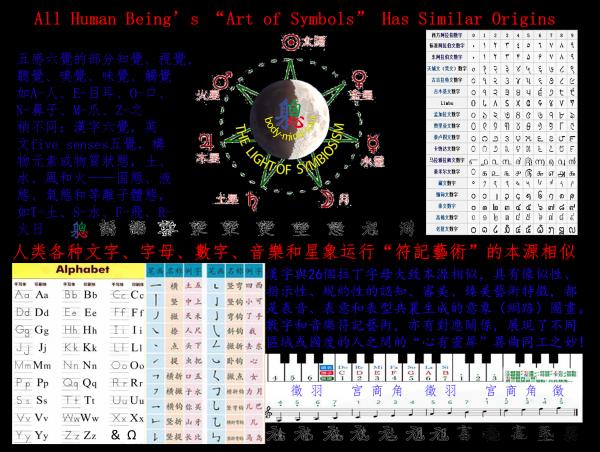
这些新汉字当然也有语言互证意义,但我今天讲的语言互证意识中提到的汉字,孞、態、恊、愛都是原来就有的现成语言符记。
语言不只是给已经存在的世界贴上名称。人通过语言辨认世界,也通过语言形成对世界的感受、理解、判断与关系。一个字、一个词、一个符记(sign),既留下历史,也参与当下的意义生成。
从我的时空意间观来看,语言尤其发生在这个“意间”之中。
人生活于时间与空间,却从来不是作为没有感受、没有意识、没有意向的物体存在于时空之中。时间与空间进入人的生命经验,总要经过感知、记忆、想象、判断、意向以及人与人之间的交互,才成为我们实际生活着的世界。因此,在时间与空间之间,还有一个不能被忽略的“意间”:意义在这里发生,关系在这里连接,选择在这里形成,人的过去、现在与可能的未来也在这里交互。
语言正是“意间”最重要的生命表征之一。
由此重新观察英语与华语,我越来越注意到一个有意思的现象:两种文字体系在表达一些最基本的精神与关系概念时,虽然使用了完全不同的符记方式,却经常指向共同的生命经验。
这使我产生了一种越来越明确的意识:
语言之间不仅可以翻译,还可以互证。
而这种互证,并不要求两种语言具有相同的字形、词源和语法。恰恰由于它们各自从不同方向进入人的生命经验,一种语言中隐含的东西,有时会在另一种语言中显现;一种语言已经习以为常的意义,又可能因为另一种语言的照见而重新变得清晰。
我把它称为:语言使用字词(符记)的互证意识。
这里的关键,不在“对应”,而在“互证”。互证不是词源学证明:Faith 与孞仰不必同源;互证也不是字形对应:Trust 与孞任不必同形。真正的互证,是不同符记系统从各自的历史与结构出发,在交互照见中抵达相通的生命经验。英语把“心”留在语义与语境里,华语可以让“心”进入字形;一隐一显,彼此成为镜子,也由此打开新的意义生成。
一、英语没有把“心”写出来,“心”却一直在场
英语中的 faith, belief, integrity, reliance, trust, cooperation, attitude, love, humility,从词形来看,并没有像汉字那样直接出现“心”。
但如果进入这些词实际表达的生命经验,就会发现:它们几乎都离不开心(heart & mind)的参与。
这里需要特别说明,我所说的“蕴含着心”,并不是说这些英语词在词源学上都来自 heart 或 mind。那样的说法既没有必要,也不准确。我所关注的是:这些概念一旦进入人的真实生活,其发生本身便离不开心智、情感、意向、判断、关系与行动。
Faith 与 belief,不能被还原成一个纯粹的信息判断。一个人“知道”某件事情,与一个人“相信”某件事情,并不是同一回事。信仰尤其意味着生命有所归向,有所承诺,有所托付。
Integrity 也不仅是遵守某种外部规范。它意味着一个人的内在认同与外在行为保持完整和一致。所谓诚实、正直、一贯,最终都要回到一个人的心口、心行能否相契。
Reliance 与 trust 更明显地涉及人与人之间的托付。信任当然可以参考经验,可以进行理性判断,却不可能完全由概率计算替代。真正的 trust 一旦发生,就意味着我愿意把某种不确定性交付给另一个人、一个组织、一种关系。
Cooperation 也不只是两个执行机构之间的机械配合。真正持续的合作,需要理解对方、感受对方、调整自己,并在交互中形成可以共同继续行动的关系。
Attitude 则直接表现一个人如何面对世界。它既包含认知,也包含情感、价值倾向和行动准备,可以说就是某种意义上的“心之姿态”。
Love 更无需多言。无论东西方,人们都很自然地把爱与心联系起来。
Humility 同样不是一种外部姿势。真正的谦卑发生在人对自身限度、他者存在以及更大世界有所体认之后。它首先是一种内在生命状态,然后才可能表现为外部行为。
因此,英语虽然没有把“心”直接写进这些词的形体,heart & mind 却始终存在于它们的意义发生之中。
英语更多地把“心”留在语义、语境和生命经验里。
二、为什么我坚持用 heart & mind,而不是只有 heart
这里还有一个值得注意的语言互证现象。
汉语传统中的“心”,并不完全等于现代英语中的 heart,也不完全等于 mind。
“心”会感受,也会思虑;会生情,也会判断;会记忆,也会意向;会爱,会怕,会信,会疑,会思,会念。
中国古代所谓“心”,就是孟子说的“心之官则思”(心的功能是用来超越感官进入思考状態),从来没有被彻底分割成一个只负责感情的 heart 和一个只负责思维、理性、意志、意念的 mind。
因此,当我用英语解释这里的“心”时,我更愿意写作:
心(heart & mind)
两个英文词同时出现,反而更接近一个汉字“心”所包含的生命整体。
这本身就是语言互证。
英语的区分,帮助华语重新辨认“心”的丰富层次;华语的“心”,又提醒英语世界:人的情感与理智、感知与判断、意愿与行动,原本发生于同一个活的生命之中,并不像概念分类那样彼此割裂。 因而,坚持使用 heart & mind 本身就是一次语言互证的实践:英语的分析性帮助我重新看见“心”的层次,华语的整体性则提醒我,感知、判断、意向与行动原本发生于同一个活的主体。
三、华语的特别之处:心可以进入字形
与拼音文字不同,汉字保存了一种非常特别的形义关系。
“心”不仅可以作为一个独立概念存在,还能够进入其他字的形体结构。
思、念、感、情、意、慈、悲、恥、懼、態、愛……
这些字让人看见:许多思想、情感、意志、伦理和生命状态,本来就与“心”相连。
这也是我重新使用“孞”的重要原因。
“孞”不是我今天凭空造出来的一个符号。这个曾经存在于汉字传统中的字,使“信之有心”直接呈现在人的眼前。
因此,我逐渐形成了一套选字造句的语言使用方式:
| English | 通常华语 | 我的表达 | 心之意涵 |
| Faith | 信仰 | 孞仰 | 心有所向 |
| Belief | 信念 | 孞念 | 心有所念、有所认定之態 |
| Integrity | 诚信 | 诚孞 | 心口、心行相契 |
| Reliance | 信靠 | 孞靠 | 心有所托 |
| Trust | 信任 | 孞任 | 以心相托,并承担受托之责 |
| Cooperation | 协作 | 恊作 | 交互之中有心参与 |
| Attitude | 态/态度 | 態 | 心能关系在行动中的状态 |
| Love | 爱 | 愛 | 心居爱中 |
| Faith / Confidence / Trust | 信心 | 孞心 | 心有所信、生命有所守持 |
这不是简单地恢复繁体字,也不是为了制造视觉上的古雅。
我真正关心的是:
当一个概念本来就必须由生命主体发出、由心承载、在人与人的交互中实现时,为什么不让这个“心”重新显现出来?
四、孞、恊、態、愛:让被隐藏的心重新显形
从这个角度看,我使用孞仰、孞念、诚孞、孞靠、孞任、恊作、態、愛、孞心,便有了一个共同的语言学方向:
让心重新进入符记。
其中尤其值得注意的是“孞”。
“信”在现代社会已经高度工具化。信用评分、信用等级、信用记录、金融信用、商业信用,都可以被数字化、指标化甚至算法化。
这些当然有实际价值。
然而,人与人之间真正的“孞”,从来不只是一个可以计算出来的风险概率。
当一个人把事情托付给另一个人,当生命把某种权利交给一个组织,当社会把公共权力托付给政府,当人类把越来越多的信息、判断乃至行动能力交付给AI,其中发生的都不仅是信息交换。
这里有托付,也有受托;有期待,也有责任;有判断,也有承担。
所以我越来越坚持使用“组织孞托”。
因为 Trust 一旦进入组织关系,就不能只剩下制度、程序、合约和算法。组织之所以能够成为生命的受托者(Trustee),恰恰因为其中必须有对生命的感知、尊重和责任。
一个“心”字,在这里重新获得了现代意义。制度、程序、合约和算法可以支撑孞托,却不能替代孞托发生时对生命的感知与责任。数位—量子时代越是能够把信用、行为和风险转换为数据,这一点越需要被重新看见。
五、英语“意在形外”,华语可以“形意相照”
由此再看英语与华语,两种语言呈现出非常有意思的互补关系。
英语大量依靠词义、语境、搭配和概念关系来展开意义。心虽然没有写在 faith, trust, love, integrity 的字母结构中,却活在这些词实际发生的生命关系中。
我把这种现象称为:
意在形外。
华语则具有另一种可能。
它不仅能够通过语义表达,还可以让意义进入文字形体,让人一眼看见“心”仍然在其中。
这可以称为:
形意相照。
一个偏于隐,一个可以显形。
隐与显之间并不存在高下之分。恰恰因为两种语言采用不同的符记方式,它们才具有互相照见的可能。
英语帮助我从语义中辨析“心”;华语帮助我从字形中看见“心”。
这就是我所说的互证意义和意识。
六、语言互证不是证明语言相同,而是发现生命相通
因此,“互证”不能被理解为用一种语言证明另一种语言,也不是把两种语言强行寻找一一对应关系。
不同语言有不同的历史、词源、语法和文化经验。这些差异应当受到尊重。
真正值得寻找的是:
不同语言经过不同道路,是否抵达了某些相通的生命经验?
Faith 与孞仰不必拥有相同词源,才可以互证。
Trust 与孞任不必拥有相同字形,才可以互证。
Love 与愛更不需要证明谁比谁更接近爱的本质。
它们真正能够互证的,是人在爱的时候有心,在信的时候有心,在托付的时候有心,在合作的时候有心,在谦卑的时候仍然有心。
如果把 heart & mind 完全抽离出去,faith 可以退化为口号,integrity 可以成为表演,trust 可以缩减为计算,cooperation 可以成为利益交换,attitude 可以变成姿态,love 甚至可以成为一个空洞符号。
符记不同,生命相通。
这才是语言互证真正值得关注的地方。
顺便说一下,我把“时空意间观”译为 Spatio-Temporal Mindedness View,并非今天为了本文重新寻找的对应词。早在2008年的《共生场——行将来临的革命》中,我就已经这样对译“时空意间观”,并将“意间”表述为 Mind Interstitial。 2021年,应加拿大列治文浸信会邀请撰写一篇带有自传性质的生命自述时,我又以 Mindedness 为题;2023年《共生经济学》概念对照表中,“时空意间观”继续沿用了 Spatio-Temporal Mindedness View。
今天重新讨论“心(heart & mind)”与语言互证,我反而更加清楚地看到了这个译法的意味。一个沿用了多年的英文词,今天又反过来照亮了我用中文提出的“意间”;而中文“意间”,也使我重新看见 Mindedness 所能承载的心智在场、心有所感、心有所思、心有所向以及生命经历中的心路展开。
这并不是事后的词义附会。早在《共生场》中,我讨论中国古人所谓的“心”时,就已经特别指出:这里的“心”是 Mind,不只是 Heart,而是“身心灵”的生命体现。 今天将它进一步表达为 heart & mind,恰恰使两种语言在二十年的思想演进中重新相遇。
语言互证由此不只是两种语言之间的横向互照,也可以发生在一个人的思想生长与语言使用之间:过去使用的符记,在新的生命经验中重新显义;今天获得的理解,又反过来照亮过去尚未充分展开的意义。
这里恰好发生了一次本文所讨论的语言互证。
中文创造“意间”,使英语现成词汇难以完全容纳的一层生命经验获得了自己的符记;英语 Mindedness 又反过来照亮中文“意”中原本包含的心智在场、心之趋向与心路展开。两种语言无需逐字对应,却能够彼此照见,使原本隐藏在各自语言内部的意义重新显现。
这正是语言互证:不是寻找两个相同的词,而是让不同语言进入彼此尚未充分显现的可能世界。
三十年前,我从造新字进入“符记艺术”;今天回望才发现,不同符记彼此照见之处,正敞开着语言的第三重可能世界。
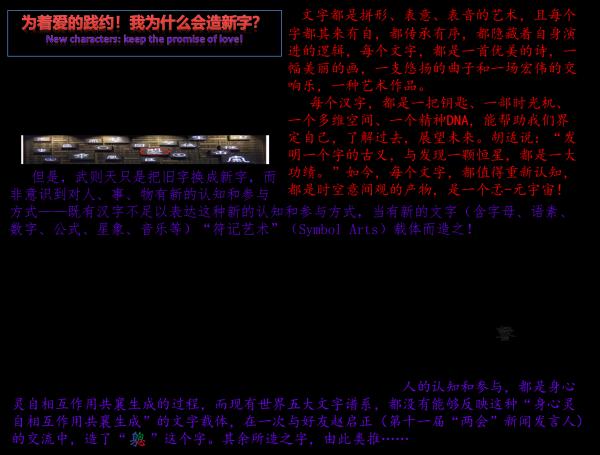
七、三重可能世界:语言互证如何打开新的意义空间
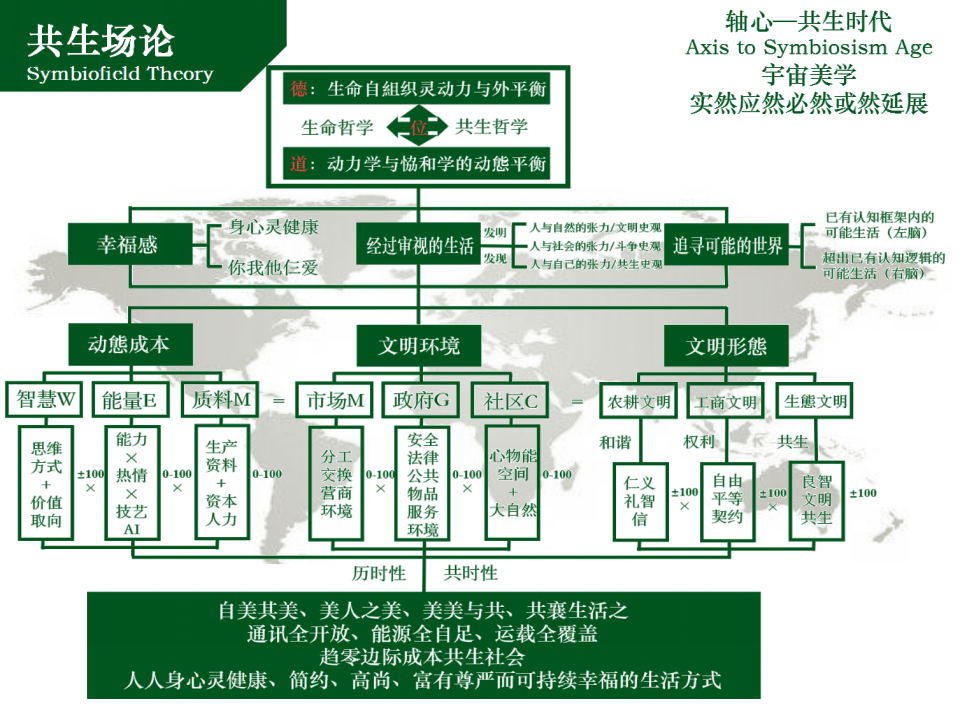
把语言互证放进我所说的“三重可能世界”,它的生成意义会更加清楚。
第一重可能世界,是已经被发现、命名、分类并进入既有逻辑、语言和符记阈值的世界。字典、语法、词源、约定俗成的字形与概念,都属于这一重可能世界的重要积累。Faith、trust、love,以及信、任、爱等既有表达,使人类能够稳定地辨认和传递经验。AI尤其擅长在这一重世界中进行检索、统计、组合、翻译与展开。
第二重可能世界,是既有语言尚未发现、尚未命名,或者已经被习惯用法遮蔽的可能。一个符记并没有穷尽它所指向的生命经验;一种语言的现成分类,也没有穷尽人能够感知和生成的意义。英语词形中没有显现的“心”,可以在华语形体中重新被看见;现代简化书写中淡出的“心”,也可以因为孞、恊、態、愛的重新使用而重新进入意识。这不是离开语言任意想象,而是从既有符记的边界处发现尚未显现的生命内容。
第三重可能世界,则发生在第一重与第二重之间的交互中。既有语言提供可理解、可交流的基础,尚未显现的生命经验提出新的需要;不同语言、不同符记、不同文化经验彼此照见,新的表达由此共襄生成,并进一步进入生活。Heart 与 mind 并置来解释“心”,就是一个很小却很典型的例子:英语的分析性使“心”的层次更加清楚,华语的整体性又使 heart 与 mind 重新被放回同一个活的生命主体。孞的重新启用也是如此:它来自既有汉字资源,却在数位—量子时代获得了新的组织孞托、生命受托与AI责任意涵。
因此,语言互证本身就是第三重可能世界的一种发生方式。它既不把第一重世界的词源、语法和规范推倒重来,也不把第二重世界变成无边界的任意造义;它让已经发现的语言资源与尚待发现的生命经验发生交互,使新的符记、新的理解、新的关系进入现实。语言由此不只是保存过去的容器,也成为发现可能世界、生成可能世界的生命活动。
从这一意义上说,我把这些写法视为一种思想实验。思想实验的价值不在要求所有人立即采用同样的符记,而在于让被习惯遮蔽的问题重新可见:当“信”进入信用评分,当trust进入算法模型,当cooperation进入平台协议,当love成为数据标签时,生命之心是否还在场?孞、恊、態、愛所做的,是把这个问题直接写进符记本身。
八、从“语言的边界”进入语言的连接
维特根斯坦关于语言与世界边界的提醒给了现代哲学深刻启示。但到了数位—量子共生时代,我更关心边界之后的另一个问题:
不同语言的边界之间,能不能发生连接?
如果一种语言只能在自身内部循环,它所打开的世界仍然受到自身结构的限制。
当英语与华语相互照见,情况便发生了变化。
Heart 让我重新看见“心”的情感维度,mind 让我重新看见“心”的认知与意识维度;而一个汉字“心”,又让我看见 heart 与 mind 原本可能属于同一个不可分割的生命发生。
同样,trust 让我辨析制度信任、关系信任、托付与可靠性;“孞”则提醒我:所有这些制度关系最终都不能把生命之心排除在外。
于是语言不再只是边界,也成为连接。
一种语言照见另一种语言,一种符记唤醒另一种符记,一种文化经验进入另一种文化经验没有显现出来的地方。
语言由此产生新的可能世界。
九、时空意间:语言发生于生命之间
这也使我重新回到“时空意间”。
如果世界只有时间与空间,那么文字可以被理解为信息编码,语言可以被理解为信息传输,AI甚至可能把语言完全处理为 token、概率与计算。
然而,人类真实的语言从来不只发生在信息之间。
一句“我相信你”,其意义并不等于这四个字的信息量。
一句“I trust you”,也无法还原为若干 token 之间的统计关系。
因为说这句话的人是谁,对谁说,在什么时间说,在怎样的关系中说,经历过什么,准备承担什么——这些共同进入了这句话的意义。
意义发生在生命之间。
这就是“意间”。
从这一点回望孞、恊、態、愛,我看到的已经不只是几个汉字。
它们提示着一种语言意识:
心不可从意义中删除,生命不可从语言中删除,关系不可从世界中删除。
因此,我所谓“语言使用字词(符记)的互证意识”,最终并不是一种文字复古主张,也不是一种东西方语言优劣比较。
它所追寻的是一种新的语言自觉:
英文之义与华文之形可以互证;语言之异与生命之同可以互见。
英语中的 faith, belief, integrity, reliance, trust, cooperation, attitude, love, humility,虽然没有把 heart & mind 写在词形上,其真实发生却始终有心参与。
华语则可以借助自身独特的形义资源,让这个“心”重新进入符记:
孞仰、孞念、诚孞、孞靠、孞任、恊作、態、愛、孞心。
这不是要求所有人都采用同样的写法。
它首先是我的一种语言选择,也是一种思想实验。
我希望借此提醒自己,也邀请不同语言的使用者共同发现:
语言不仅命名世界,也参与世界的生成。
英语把心藏在意里,华语可以让心显于形中;形与意彼此照见,语言与语言彼此互证。
而在这一显一隐、一形一意之间,我所寻找的,仍然是那个最朴素的生命原点:
两种语言在这里不再只是各自的边界,而成为彼此进入可能世界的连接:华语的形义资源照见英语词义背后的生命经验,英语的概念分析又帮助我重新澄清汉字“心”的整体性。互证由此不是静态比较,而是生成;不是寻找表面的相同,而是在差异中发现生命相通,并在交互中让新的意义成为现实。
有心(heart & mind)在场。
The Mutual Illumination of Words and Signs Across Languages
Archer Hong Qian
The Mutual Illumination of Words and Signs Across Languages
Archer Hong Qian
As our perceptions of people, events, and things continually change—sometimes broadening, sometimes becoming more subtle and refined—it is natural that we adopt different signs, including written characters, to record and stabilize those changes. Over the past thirty years, I have therefore taken the liberty of creating twenty-one new Chinese characters or new written forms in the Chinese language. On June 25, 2023, I even held a small “New Chinese Character Art Exhibition” at the Seattle Opera.
Those newly created characters certainly also have significance for linguistic mutual illumination. Yet the Chinese characters discussed here—孞, 態, 恊, and 愛—are not my inventions; they are existing signs inherited from the Chinese written tradition.
Language does more than attach names to an already existing world. Through language, human beings distinguish the world and form their feelings, understandings, judgments, and relationships toward it. A character, a word, a sign preserves history while also participating in the generation of meaning in the present.
From the perspective of my Spatio-Temporal Mindedness View, language occurs especially within this “Mindedness Interstitial.”
Human beings live in time and space, yet never as objects devoid of feeling, consciousness, or intention. Time and space enter lived human experience through perception, memory, imagination, judgment, intention, and interaction among people; only then do they become the world we actually inhabit. Between time and space, therefore, there is another dimension that cannot be ignored—an interstitial realm of mindedness: meaning arises here, relationships connect here, choices take shape here, and the human past, present, and possible future interact here.
Language is one of the most important living expressions of this interstitial realm.
Seen in this light, English and Chinese reveal a striking phenomenon. When the two languages express some of the most fundamental spiritual and relational concepts, they use very different sign systems, yet often point toward shared experiences of life.
This has led me to an increasingly clear awareness: languages can do more than translate one another; they can mutually illuminate one another.
Such mutual illumination does not require identical written forms, etymologies, or grammars. Precisely because languages enter human experience from different directions, what remains implicit in one language may become visible in another; meanings that have become habitual in one language may regain clarity when illuminated by another.
I call this an awareness of the mutual illumination of words and signs across languages.
The key lies not in “correspondence,” but in “mutual illumination.” Mutual illumination is not an etymological proof: Faith and 孞仰 need not share an origin. Nor is it a correspondence of written forms: Trust and 孞任 need not look alike. Genuine mutual illumination occurs when different sign systems, proceeding from their own histories and structures, illuminate one another in interaction and arrive at resonant experiences of life. English leaves “heart” within semantics and context; Chinese can let “heart” enter the written form. One is implicit and the other explicit; each becomes a mirror for the other, thereby opening new possibilities for the generation of meaning.
I. English Does Not Write “Heart” into the Word, Yet Heart Remains Present
English words such as faith, belief, integrity, reliance, trust, cooperation, attitude, love, and humility do not visibly contain “heart” in their written forms as Chinese characters sometimes do.
Yet when we enter the lived experiences these words actually express, we find that almost none of them can occur without the participation of 心—heart & mind.
This needs to be stated carefully. To say that these English words “contain heart” does not mean that they all derive etymologically from heart or mind. Such a claim would be unnecessary and inaccurate. My concern is that once these concepts enter real human life, their occurrence itself is inseparable from mind, emotion, intention, judgment, relationship, and action.
Faith and belief cannot be reduced to purely informational judgments. To “know” something and to “believe” something are not the same. Faith in particular means that life has a direction, a commitment, and something to which it entrusts itself.
Integrity is likewise more than compliance with an external norm. It means maintaining wholeness and consistency between inward conviction and outward conduct. Honesty, uprightness, and consistency ultimately return to whether one’s heart, words, and actions remain in accord.
Reliance and trust involve entrustment even more directly. Trust can draw on experience and rational judgment, but it cannot be completely replaced by probability calculation. When genuine trust occurs, I am willing to place some uncertainty in another person, an organization, or a relationship.
Cooperation is more than mechanical coordination between two executing units. Enduring cooperation requires understanding others, sensing them, adjusting oneself, and forming through interaction a relationship in which action can continue together.
Attitude directly expresses how a person faces the world. It includes cognition, emotion, value orientation, and readiness for action. In this sense, attitude is a “posture of the heart & mind.”
Love hardly requires explanation. Across East and West, people naturally associate love with the heart.
Humility, too, is not merely an outward posture. Genuine humility arises when a person recognizes one’s own limits, the existence of others, and a world larger than oneself. It is first an inward state of life and only then an outward mode of conduct.
Thus, although English does not write “heart” directly into the forms of these words, heart & mind remain present in the very occurrence of their meanings.
English more often leaves “heart” within semantics, context, and lived experience.
II. Why I Insist on heart & mind, Rather Than heart Alone
Here we encounter another revealing instance of linguistic mutual illumination.
The traditional Chinese 心 does not correspond completely to modern English heart, nor completely to mind.
心 feels and thinks; it gives rise to emotion and makes judgments; it remembers and intends; it loves, fears, trusts, doubts, reflects, and holds thoughts.
The classical Chinese 心 is what Mencius described in the phrase “心之官则思”—the function of the heart-mind is to think, to move beyond the senses into reflection. It was never fully divided into a heart responsible only for emotion and a mind responsible only for thought, reason, will, and intention.
For this reason, when I explain 心 in English, I prefer to write: 心 (heart & mind).
The two English words together come closer to the living wholeness contained in the single Chinese character 心.
This is itself an act of linguistic mutual illumination.
English differentiation helps Chinese rediscover the rich layers of 心; the Chinese 心, in turn, reminds the English-speaking world that emotion and reason, perception and judgment, intention and action arise within the same living being and are not as neatly divided as conceptual classifications may suggest. Insisting on heart & mind is therefore itself a practice of linguistic mutual illumination: the analytical quality of English helps me see the layers of 心 anew, while the integrative quality of Chinese reminds me that perception, judgment, intention, and action arise within one living subject.
III. A Distinctive Feature of Chinese: Heart Can Enter the Written Form
Unlike alphabetic writing, Chinese characters preserve a distinctive relationship between form and meaning.
心 can exist as an independent concept, but it can also enter the visible structure of other characters.
思、念、感、情、意、慈、悲、恥、懼、態、愛……
These characters make visible the fact that many forms of thought, emotion, will, ethics, and states of life have long been connected with 心.
This is also an important reason why I have resumed using 孞.
孞 is not a sign I invented today. It is a character inherited from the Chinese written tradition, and it makes “trust with heart” directly visible.
I have therefore gradually developed a deliberate way of choosing characters and forming expressions:
| English | Common Chinese | My Expression | Meaning of Heart |
| Faith | 信仰 | 孞仰 | The heart has a direction |
| Belief | 信念 | 孞念 | The heart holds a thought and a settled conviction |
| Integrity | 诚信 | 诚孞 | Heart, word, and action remain in accord |
| Reliance | 信靠 | 孞靠 | The heart has something to rely upon |
| Trust | 信任 | 孞任 | To entrust with heart and assume the responsibility of trusteeship |
| Cooperation | 协作 | 恊作 | Heart participates within interaction |
| Attitude | 态/态度 | 態 | The state of heart & mind in relationship and action |
| Love | 爱 | 愛 | Heart dwells within love |
| Faith / Confidence / Trust | 信心 | 孞心 | The heart holds faith; life has something to uphold |
This is not simply an attempt to restore traditional forms, nor is it intended to create visual archaism.
My real concern is this: when a concept must arise from a living subject, be borne by the heart, and become real through interaction among people, why should that “heart” not be allowed to become visible again?
IV. 孞, 恊, 態, 愛: Bringing the Hidden Heart Back into the Sign
From this perspective, my use of 孞仰, 孞念, 诚孞, 孞靠, 孞任, 恊作, 態, 愛, and 孞心 shares one linguistic direction: let the heart re-enter the sign.
孞 deserves particular attention.
In modern society, 信 has become highly instrumentalized. Credit scores, credit ratings, credit histories, financial credit, and commercial credit can all be digitized, quantified, and even algorithmically modeled.
These practices certainly have practical value.
Yet genuine 孞 between people is never merely a calculable probability of risk.
When one person entrusts something to another, when life entrusts certain rights to an organization, when society entrusts public power to government, or when humanity entrusts ever more information, judgment, and even capacities for action to AI, what occurs is more than an exchange of information.
There is entrustment and trusteeship; expectation and responsibility; judgment and accountability.
This is why I increasingly insist on the expression “organizational 孞-trust.”
Once Trust enters organizational relations, it cannot be reduced to institutions, procedures, contracts, and algorithms. An organization can become a Trustee of life precisely because it must retain perception of, respect for, and responsibility toward life.
The character 心 thus acquires renewed contemporary significance. Institutions, procedures, contracts, and algorithms can support 孞-trust, but they cannot replace the perception of and responsibility toward life through which 孞-trust actually occurs. The more the Digital–Quantum Age converts credit, behavior, and risk into data, the more urgently this must be seen again.
V. English: “Meaning Beyond Form”; Chinese: “Form and Meaning Illuminate Each Other”
Seen again from this perspective, English and Chinese reveal a remarkable complementarity.
English relies heavily on semantics, context, collocation, and conceptual relations to unfold meaning. The heart is not written into the letter-forms of faith, trust, love, or integrity, yet it lives within the relationships in which those words actually occur.
I call this: Meaning Beyond Form.
Chinese offers another possibility.
It can express through semantics while also allowing meaning to enter the visible form of the character, enabling us to see at a glance that the heart is still there.
I call this: Form and Meaning Illuminate Each Other.
One tends toward the implicit; the other can make the implicit visible.
There is no hierarchy between concealment and manifestation. Precisely because the two languages use different sign systems, they can illuminate each other.
English helps me distinguish the heart through meaning; Chinese helps me see the heart through form.
This is what I mean by the significance and awareness of mutual illumination.
VI. Linguistic Mutual Illumination Does Not Prove Languages Identical; It Reveals Life in Common
“Mutual illumination” should not be understood as using one language to prove another, nor as forcing two languages into one-to-one correspondence.
Different languages have different histories, etymologies, grammars, and cultural experiences. Those differences deserve respect. The more important question is whether different languages, traveling by different paths, can illuminate resonant experiences of life.
Faith and 孞仰 need not share the same etymology in order to illuminate one another. Trust and 孞任 need not share the same written form. Love and 愛 need not compete over which comes closer to the essence of love.
What they can illuminate in one another is something more fundamental: there is heart when we love, heart when we trust, heart when we entrust, heart when we cooperate, and heart even when we are humble. If heart & mind are removed altogether, faith can degenerate into a slogan, integrity into performance, trust into calculation, cooperation into an exchange of interests, attitude into posture, and love into an empty sign.
Signs differ; life resonates.
This is what makes linguistic mutual illumination truly worth attending to.
Incidentally, my translation of “时空意间观” as Spatio-Temporal Mindedness View is not a correspondence newly sought for this essay. As early as 2008, in Symbiotic Field: The Coming Revolution, I was already using Spatio-Temporal Mindedness View for “时空意间观,” while rendering “意间” as Mind Interstitial. In 2021, when I was invited by Richmond Baptist Church in Canada to write an autobiographical reflection on life, I again used Mindedness as its title. In the 2023 Chinese–English glossary of Symbionomics, “时空意间观” continued to appear as Spatio-Temporal Mindedness View.
Returning today to the relation between “心 (heart & mind)” and linguistic mutual illumination, I have come to see more clearly what this long-standing translation carries.
Mindedness cannot simply be translated into Chinese as “心路历程,” or the journey of the heart-mind, although it does contain something of that sense. It carries the presence of heart & mind: what the heart-mind feels, thinks, perceives, and is directed toward, as well as its unfolding through lived experience and time. In this respect, it comes closer to what I mean by “意” than Intentionality does in its standard philosophical usage.
I also use Intentionality, and it remains an important concept. It can express the directedness of consciousness. Yet the “意” in “意间” is not exhausted by directedness. It also involves perception, consciousness, thought, intention, judgment, choice, orientation, and the states and tendencies of heart & mind formed through lived experience.
Spatio-Temporal Mindedness View, therefore, is not an English phrase assembled by taking “时、空、意、间” apart and translating the four characters one by one. It seeks to express something whole: life exists in time and space with heart & mind always present; and in this perceptive, thinking, feeling, intentional, and oriented state of being, life enters into relationships and, through interaction, generates new meaning and new possibilities.
Here something especially interesting happens.
An English word I have used for many years now illuminates, in return, the Chinese concept “意间” that I proposed; and “意间,” in turn, allows me to see anew what Mindedness has been carrying all along: the presence of heart & mind, what the heart-mind feels, thinks, and is directed toward, and its unfolding journey through lived experience.
This is not an interpretation retroactively imposed upon an old term. As early as Symbiotic Field, when discussing what ancient Chinese thought meant by “心,” I explicitly wrote that this “心” was Mind, not merely Heart, but an expression of life as body, mind, and spirit. To render it today more fully as heart & mind allows the two languages to meet again across nearly two decades of my own intellectual development.
The Chinese concept “意间” gives a sign to a dimension of lived experience that existing English vocabulary cannot fully contain; English Mindedness, in turn, illuminates the presence of heart & mind, its orientation, and its unfolding already implicit in the Chinese “意.” The two languages need not correspond word for word. They can illuminate one another, allowing meanings latent within each language to become visible again.
Linguistic mutual illumination, then, does not occur only horizontally between two languages. It can also occur across time, through the growth of thought and the history of one’s own language use. Signs used in the past can disclose new meaning through later lived experience; understanding gained today can, in turn, illuminate meanings that had not yet fully unfolded in the past.
This is linguistic mutual illumination: not the search for two identical words, but the opening through which different languages enter possibilities not yet fully manifested in one another.
Thirty years ago, I entered the “Art of Symbols” by creating new characters. Looking back today, I can see that where different signs illuminate one another, the Third World of Possibility in language begins to open.
VII. The Three Worlds of Possibility: How Linguistic Mutual Illumination Opens New Spaces of Meaning
Placed within what I call the “Three Worlds of Possibility,” the generative significance of linguistic mutual illumination becomes clearer.
The First World of Possibility is the world already discovered, named, classified, and brought within existing thresholds of logic, language, and signs. Dictionaries, grammar, etymology, conventional forms, and established concepts are important accumulations of this world. Existing expressions such as Faith, trust, love, 信, 任, and 爱 enable human beings to recognize and transmit experience with stability. AI is especially capable of retrieval, statistics, combination, translation, and elaboration within this first world.
The Second World of Possibility consists of possibilities not yet discovered or named by existing language, or possibilities obscured by habitual usage. A sign never exhausts the lived experience toward which it points; nor do the ready-made classifications of a language exhaust the meanings human beings can perceive and generate. The “heart” that does not appear in the written form of an English word can become visible again in Chinese form; the heart that has faded from some simplified modern written forms can re-enter awareness through renewed use of 孞, 恊, 態, and 愛. This is not arbitrary invention outside language. It is the discovery, at the boundary of existing signs, of living content that has not yet become visible.
The Third World of Possibility arises through interaction between the First and Second. Existing language provides a basis for understanding and communication; still-unrevealed lived experience creates new needs. Different languages, signs, and cultural experiences illuminate one another, and new expressions are thereby co-generated and brought into life. Placing heart and mind together to explain 心 is a small but representative example: the analytical quality of English clarifies the layers of 心, while the integrative quality of Chinese returns heart and mind to the same living subject. The renewed use of 孞 works in the same way: it comes from an existing Chinese resource, yet in the Digital–Quantum Age it acquires new meanings involving organizational 孞-trust, the trusteeship of life, and responsibility in AI.
Linguistic mutual illumination is therefore itself one way in which the Third World of Possibility comes into being. It neither overturns the etymologies, grammars, and norms of the First World nor turns the Second World into limitless arbitrary meaning-making. It brings discovered linguistic resources into interaction with still-to-be-discovered lived experience, allowing new signs, new understandings, and new relationships to enter reality. Language thus becomes more than a vessel preserving the past; it becomes a living activity for discovering and generating possible worlds.
In this sense, I regard these forms as a thought experiment. The value of a thought experiment does not lie in requiring everyone immediately to adopt the same signs. It lies in making visible again what habitual usage has obscured: when 信 becomes a credit score, when trust enters an algorithmic model, when cooperation becomes a platform protocol, and when love becomes a data label, is the heart of life still present? 孞, 恊, 態, and 愛 write that question directly into the sign itself.
VIII. From the “Boundary of Language” to the Connection of Languages
Wittgenstein’s reflections on language and the boundaries of the world gave modern philosophy a profound insight. Yet in the Digital–Quantum Symbiotic Age, I am increasingly concerned with another question beyond the boundary: can the boundaries of different languages connect?
If a language can only circulate within itself, the world it opens remains constrained by its own structure.
When English and Chinese illuminate one another, the situation changes.
Heart helps me see again the emotional dimension of 心; mind helps me see its cognitive and conscious dimensions; the single Chinese character 心, in turn, lets me see that heart and mind may belong to one indivisible occurrence of life.
Likewise, trust helps me distinguish institutional trust, relational trust, entrustment, and reliability; 孞 reminds me that none of these institutional relationships can ultimately exclude the heart of life.
Language thereby becomes connection as well as boundary.
One language illuminates another; one sign awakens another; one cultural experience enters what another cultural experience has left unmanifest.
Language thereby generates new possible worlds.
IX. Spatio-Temporal Mindedness: Language Occurs Between Living Beings
This brings me back to Spatio-Temporal Mindedness.
If the world consisted only of time and space, writing could be understood as information encoding, language as information transmission, and AI might even reduce language entirely to tokens, probabilities, and computation.
Yet human language in lived reality never occurs only between pieces of information.
The meaning of “我相信你” is not equal to the information content of those four Chinese characters.
Nor can “I trust you” be reduced to statistical relations among several tokens.
Who speaks, to whom, at what time, within what relationship, after what experience, and with what willingness to bear responsibility—all of these enter into the meaning of the sentence.
Meaning occurs between living beings.
This is “意间”—the interstitial realm of mindedness.
From this perspective, when I look again at 孞, 恊, 態, and 愛, I no longer see only several Chinese characters.
They point toward an awareness of language: heart cannot be deleted from meaning; life cannot be deleted from language; relationship cannot be deleted from the world.
Thus, what I call an awareness of the mutual illumination of words and signs across languages is ultimately neither a program of textual archaism nor a comparison of linguistic superiority between East and West.
It seeks a new linguistic self-awareness: English meaning and Chinese form can illuminate each other; differences between languages can reveal what life holds in common.
English words such as faith, belief, integrity, reliance, trust, cooperation, attitude, love, and humility do not write heart & mind into their visible forms, yet heart participates whenever their meanings truly occur.
Chinese, meanwhile, can draw on its distinctive resources of form and meaning to let this heart re-enter the sign: 孞仰, 孞念, 诚孞, 孞靠, 孞任, 恊作, 態, 愛, 孞心.
This does not demand that everyone adopt the same forms.
It is first of all my linguistic choice and a thought experiment.
Through it, I hope to remind myself—and invite users of different languages to discover together—that language not only names the world; it participates in the generation of the world.
English can keep the heart within meaning; Chinese can make the heart visible in form. Form and meaning illuminate each other, and languages mutually illuminate one another.
Between the implicit and the explicit, between form and meaning, I continue to seek the simplest living point of origin.
Here the two languages cease to be merely separate boundaries. They become connections through which each can enter possible worlds: the resources of Chinese form and meaning illuminate the lived experience behind English words, while English conceptual analysis helps me clarify anew the integrative character of the Chinese 心. Mutual illumination is therefore not static comparison but generation; it does not seek superficial sameness, but discovers resonant life within difference and allows new meaning to become reality through interaction.
Heart & mind are present.
上一篇: 剔除冗余,彰显新美
下一篇: 北美自由贸易区,先把“边界”讲清楚


您好!请登录
已有0评论
购物盒子