


New Articles
-
 沃什加息,川普不满却依然支持他? 2026/10/15
沃什加息,川普不满却依然支持他? Warsh Raises Rates. Trump Is Unhappy—Yet Still Backs Him? ——从共生经济学看2026年诺...
- 经济测量的历史逻辑与生命效能的价值尺度 2026/10/14
经济测量的历史逻辑与生命效能的价值尺度 The Historical Logic of Economic Measurement and the Value Scale of Life Effe...
- 诺贝尔经济学奖画像:生命组织学转向 2026/10/13
诺贝尔经济学奖画像:生命组织学转向 A Portrait of the Nobel Prize in Economic Sciences: The Life-Organizational Turn ...
- 说说“预测悖论” 2026/10/12
说说“预测悖论” On the “Prediction Paradox” ——从算法趋同、系统内崩到心智鲜活性的退化 —From Algorithmic Convergence ...
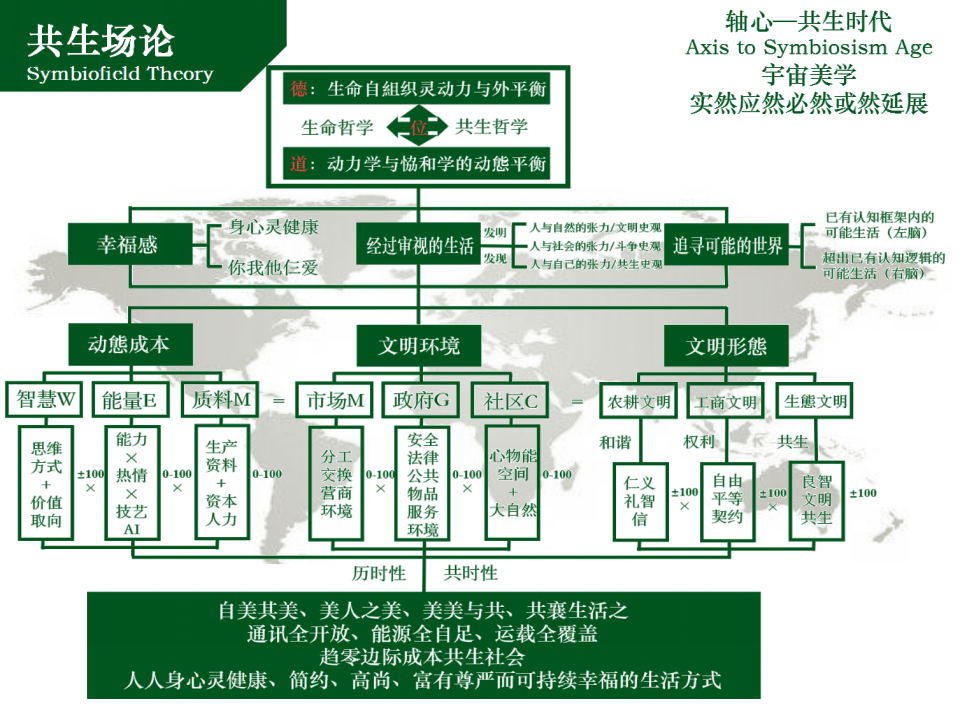
共生思想理论前沿
THE THEORY
-
-
-

-
 关于中文“共生”翻译及对应的人、事、物之说明
关于中文“共生”翻译及对应的人、事、物之说明 ——Symbiosism:Charles Thomas Taylor &Qian hong又一次量子缠绕...
查看详细说明
Speech
-
 三大自组织货币的共生格局——宏观世界之数字货币 2021/07/08
三大自组织货币的共生格局 ——宏观世界之数字货币 钱 宏 The Institute for Global Symbiosism(...
-
 新汉字yǜ的释义 2019/11/16
语从金音玉(Yǜ):金口玉言,一诺千金,性人诚恳、执信; &n...
-
 钱宏:中国的真实经验与未来走向(凤凰博报专... 2019/11/16
点击播放 中国的真实经验与未来走向《凤凰博报》专访钱宏主持人:...
“暂停AI竞速”之后呢?
发布时间:2026/08/15 公司新闻 浏览次数:99
“暂停AI竞速”之后呢?
What Comes After “Pausing the AI Race”?
——桑德斯没有看见的AI哲学边界
—The Philosophical Boundary of AI That Bernie Sanders Has Not Seen
钱 宏(Archer Hong Qian)
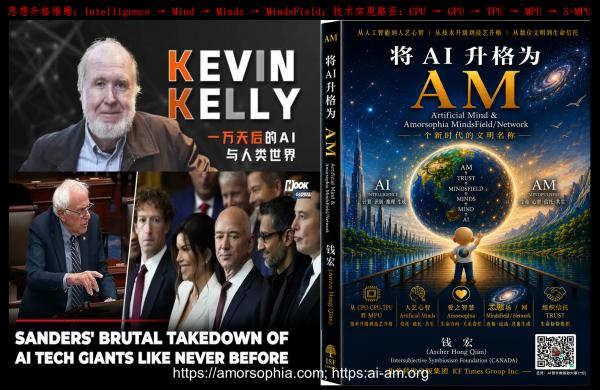
2026年8月10日,美国联邦参议员伯尼·桑德斯致函OpenAI首席执行官山姆·奥特曼、Anthropic首席执行官达里奥·阿莫迪和Meta首席执行官马克·扎克伯格,要求三家公司立即暂停人工智能开发。
桑德斯警告,AI公司正在开发一种“没有人能够完全理解、预测或控制”的技术;在人类已经出现失去控制的迹象、AI又可能被用于制造危险病毒的情况下,这些公司依然投入数百亿美元继续竞速。他最后直接喊话三位负责人:
“为了人类的利益,请信守你们的承诺。暂停AI开发。现在避免灾难还不算太迟。停止制造人类无法控制的机器。”
他同时警告,如果三家公司不主动采取行动,美国参议院将会介入。[桑德斯参议院官网,2026年8月10日](https://www.sanders.senate.gov/press-releases/news-sanders-calls-on-tech-giants-to-pause-development-of-out-of-control-ai/)
这不是桑德斯第一次提出“暂停”。
2026年3月25日,他与众议员亚历山德里娅·奥卡西奥-科尔特斯共同推出《2026年人工智能数据中心暂停法案》,要求在建立强有力的国家保障制度之前,立即暂停新的AI数据中心建设。其理由包括AI可能导致大规模失业、推高居民电费、消耗水资源、损害环境、侵犯隐私和公民权利,并使财富与权力进一步集中于少数大型科技公司。[《2026年人工智能数据中心暂停法案》](https://www.sanders.senate.gov/press-releases/news-sanders-ocasio-cortez-announce-ai-data-center-moratorium-act/)
桑德斯是美国政坛举足轻重的人物。正因为如此,他对“暂停AI竞速”的呼吁才更需要认真辨析。
提出警报不等于发现了真问题。
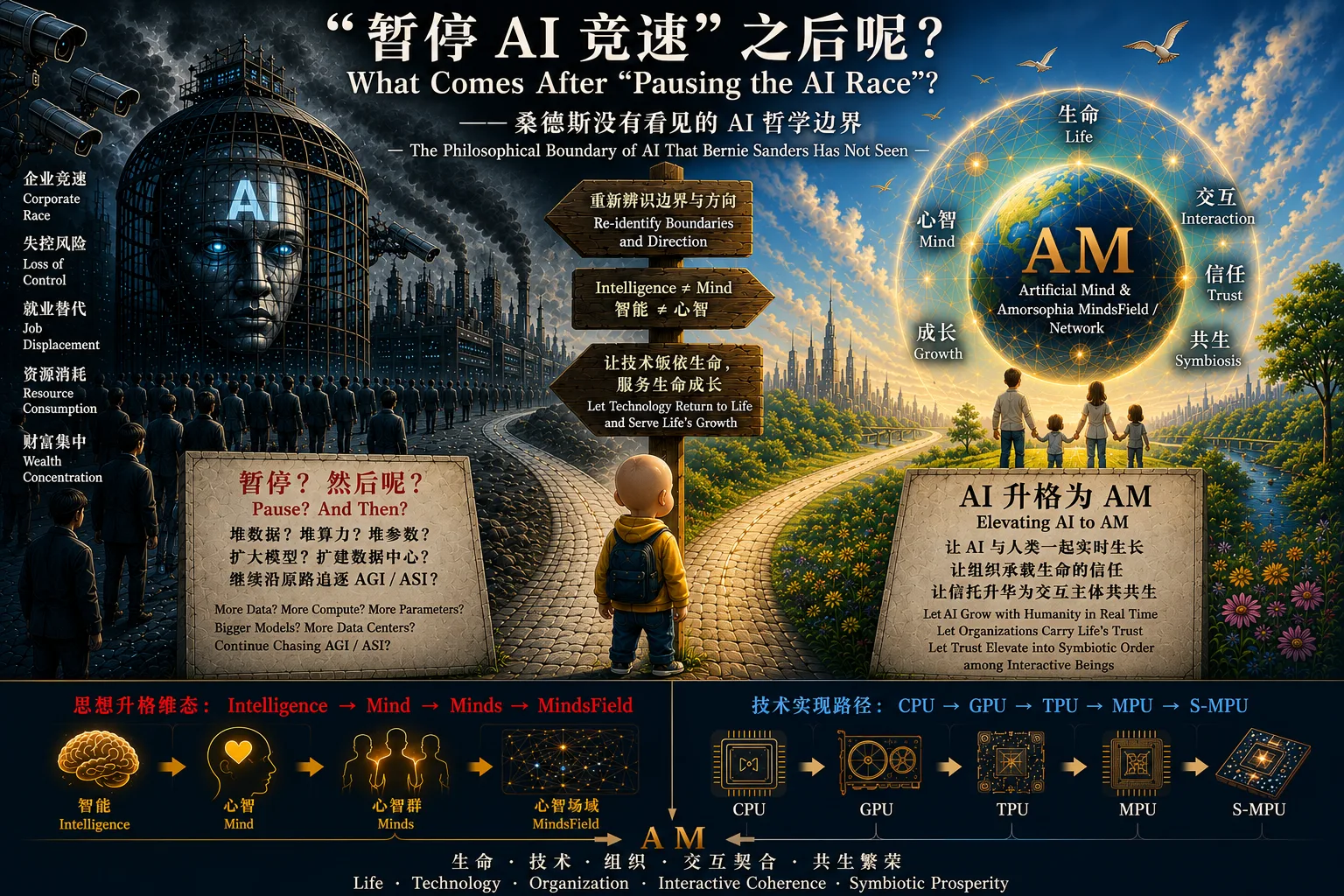
桑德斯看见了AI快速扩张产生的一系列现实后果:企业竞速、技术失控、就业替代、能源紧张、水资源消耗、环境压力、隐私侵犯、财富集中和监管滞后。可是,看见这些后果,并不意味着已经看懂今天的AI问题。
早在2023年3月,埃隆·马斯克、约书亚·本吉奥、斯图尔特·罗素等千余名科技界和学术界人士就曾联署公开信,呼吁所有AI实验室立即暂停训练比GPT-4更强大的系统至少六个月。三年以后,桑德斯再次要求主要AI公司按下暂停键。
“暂停AI竞速”本身当然不一定错。面对可能失控并危及生命的技术,暂停可以成为必要的安全措施。问题在于:
暂停之后呢?
六个月以后继续堆数据、堆算力、堆参数、扩大模型、扩建数据中心,继续沿着原来的道路追逐AGI和ASI吗?
如果AI发展的基本路线没有改变,研究对象没有改变,哲学前提没有改变,技术与生命的关系也没有改变,那么暂停只是让竞速者暂时停下来喘口气,随后继续沿原路扩张。
不懂或找不到AI出路的人,才会把“暂停”本身当作答案。
桑德斯把AI问题理解为发展过快、企业竞速、资本失控,以及由此产生的安全、就业、能源和监管问题,于是沿用工业革命以来最熟悉的治理方式:叫停项目、限制基础设施、加强政府监管、保护劳动者、重新分配技术收益。
今天的AI问题却已经越过了一般工业革命的技术—经济边界。
1956年,达特茅斯会议正式提出Artificial Intelligence。到2026年,AI已经走过整整七十年。经过符号推理、专家系统、机器学习、深度学习、大语言模型和智能代理的发展,AI今天面对的已经不只是“发展速度太快”或“公共治理没有跟上”,而是自身发展逻辑走到了必须重新追问其边界的阶段。
AI的三大瓶颈已经逐渐显现。它们一方面束缚着AI继续发展的道路,另一方面又与人的生产、生活和资源配置发生越来越直接的冲突。
这些问题无法依靠“继续竞速”“加强监管”或“暂停开发”加以遮盖。
AI已经遭遇自身的哲学边界。
一、现有AI路线究竟还能走多远?
今天AI发展的主导路线,仍然是通过增加数据、提高算力、扩大模型、优化算法和神经网络结构,不断提升机器的识别、生成、推理与行动能力。
在这一发展逻辑中,产业界形成了一个看似不言而喻的预期:只要数据越来越多、芯片越来越强、模型越来越大,机器智能就会不断提高,最终逼近AGI,继而通向ASI。
可是,数据、算力和模型规模的增长,能否无限转化为更高层次的智能?
这个问题至今没有得到回答。
数据可以帮助模型发现更多统计关联,算力可以加快训练和推理,算法能够提高处理效率,模型扩展也确实可能产生新的能力。然而,现有路线并没有证明,量的持续扩张能够自然生成主体性、自我意识、生命体验、价值判断和意义感。
模型可以在海量语料中学习人类如何描述爱情,却不等于它经历过爱情;可以分析痛苦的语言表达,却不等于它承受过痛苦;可以生成关于责任、信任和道德的完整论述,却不等于它自身形成了承担后果的责任主体。
AI能够处理人类已经发现、记录和表达的世界,却不能因此证明自己已经拥有Mind。
如果数据、算法、算力与神经网络的不断叠加,不能自然跨越Intelligence与Mind之间的界线,那么“继续扩大模型便会不断逼近AGI”的叙事中,就存在一道无法由规模本身填平的断裂。
今天AI面对的第一个真问题,因而不是发展速度要不要放慢,而是:
现有的发展路线究竟还能走多远?
二、AI发展正在受到现实资源的内在约束
AI不是脱离物质世界的虚拟存在。
在每一次模型训练、每一次推理、每一个AI服务背后,都需要芯片、电力、土地、水、矿产、冷却系统、输电网络和庞大的数据中心。随着模型规模不断扩张,AI竞赛正在从软件与算法的竞争,转化为对社会基础资源的全面动员。
桑德斯看见了数据中心造成的电价上涨、水资源消耗和环境压力。这些现象也成为他主张暂停建设AI数据中心的重要理由。他甚至认为,AI正在威胁美国人民所珍视的就业、平等、人际联系和民主生活。[《AI正在威胁美国人民所珍视的一切》](https://www.sanders.senate.gov/op-eds/ai-is-a-threat-to-everything-the-american-people-hold-dear/)
可是,资源问题不能只停留在环境监管和企业责任层面。
当AI为了继续扩大规模而占用越来越多的能源、芯片、土地和水,它就开始与人的住房、制造、农业、医疗、交通和公共生活发生资源配置冲突。
这些有限资源究竟应该优先用于AI竞速,还是用于改善人的基本生活?
AI消耗的电力、芯片、土地和水,是否真正转化为更低的生活成本、更健康的生命状态、更自由的创造空间和更可信托的社会关系?还是主要转化为少数企业的模型优势、市场控制力和资本估值?
如果AI能力的每一次提升,都要求人类社会投入更大规模的物质资源;如果收益越来越集中于少数平台和资本拥有者,能源、环境与公共生活成本却由社会承担,那么AI面对的便不只是外部监管问题,而是能耗与能效、资源投入与生命价值之间的内在不对称。
暂停建设数据中心可以暂时抑制资源需求,却不能回答AI下一阶段依靠什么继续发展,更不能回答这些资源为什么值得投入。
真正需要建立的,是AI与人的生产、生活和生态之间的资源配置原则,是以生命健康成长、生活成本下降、组织效能提高和社会孞托生成为尺度,重新检验AI发展。
三、Intelligence并不等于Mind
AI最深刻的瓶颈,还不在数据、算力和能源,而在Intelligence与Mind之间那条长期被忽略的哲学界线。
人类今天谈论AGI和ASI,仿佛已经默认:只要不断提高机器的intelligence,机器便会自然进入Mind;只要模型足够大、知识足够多、推理足够强,Artificial Mind迟早会自动出现。
可是,Intelligence凭什么自然生成Mind?
智能可以表现为学习、计算、识别、记忆、推理、预测、规划和解决问题。Mind所涉及的则是主体性、自我、意识、经验、感受、情感、意向、价值、意义与责任。
Mind还不是一个孤立主体内部的封闭结构。一个Mind如何感知另一个Mind,如何在交互中形成理解、误解、信任、冲突、愛与创造,如何由Mind进入Minds,又如何由不同Minds共襄生成动态的心智关系场域,这些才是心智问题真正展开的地方。
人类至今没有真正弄清楚自己的Mind是什么。
我们尚未完全理解身体、生命、意识、经验、语言和社会关系如何参与Mind的生成,也没有充分理解一个Mind怎样与另一个Mind建立关系。既然如此,人类凭什么相信,只要继续堆数据、堆算力、堆参数、扩大模型,便能够制造AGI?
如果连人的Mind是什么都没有弄清楚,今天所谓的AGI究竟在模拟什么?
ASI又究竟在超越什么?
一台机器在计算、记忆、检索、预测和部分推理任务上超过人,并不等于它已经拥有比人更高的Mind。计算能力的超越、任务能力的超越和心智的生成,属于三个不同层次的问题。
把三者混在一起,再从机器任务能力的提高直接推导出AGI和ASI,正是今天AI叙事中最根本的概念幻觉。
这才是AI真正意义上的哲学边界。
桑德斯没有进入这道边界。
他看见AI可能失控,于是要求企业停止制造人类无法控制的机器;他却没有继续追问:为什么人类正在沿着一条自己也无法解释的路线制造所谓“更强的智能”?如果现有路线连Mind是什么都无法回答,又凭什么把AGI和ASI设定为AI发展的必然终点?
四、暂停与竞速仍然是同一套旧逻辑
“继续竞速”与“暂停竞速”看起来彼此对立,实际上仍然处在同一个问题框架之中。
竞速者相信,现有AI路线能够通向AGI和ASI,因此必须增加投资、扩大模型、建设数据中心并争夺芯片、能源和人才。
暂停者同样默认这条路线具有强大的发展能力,只是担心它跑得太快、风险太大、监管没有跟上,因而要求技术暂时停下来,让法律、安全机制和民主制度赶上。
双方争论的是速度和控制权,没有重新审视方向。
暂停以后,如果仍然回到数据、算法、算力、模型规模与神经网络不断扩张的老路,监管只能在技术产生新的后果以后继续追赶。企业加速,政府刹车;企业寻找规避方式,政府增加监管条款;技术不断制造新风险,治理者不断修补旧护栏。二者最终陷入一场没有尽头的猫鼠游戏。
这也不只是简单重复工业革命的老套路。
工业机器能够替代人的体力,电力、汽车和自动化改变了生产方式,人类对这些技术的基本对象和功能仍然具有较清楚的理解。今天的AI却以“智能”为名,进一步把自己指向AGI和ASI,开始涉及意识、主体、价值、意义和心智等人类尚未真正理解的问题。
如果仍然用工业革命时期处理机器、工厂、资本与就业关系的办法来理解AI,就会把一个已经进入Mind领域的哲学问题,继续降格为生产速度、市场竞争和政府监管问题。
这正是桑德斯主张的局限。
他发现了AI扩张造成的后果,却没有发现这些后果背后的真问题;他要求AI企业停下来,却不知道停下来以后应该转向哪里。
提出警报不等于找到病因。
按下暂停键更不等于打开了出路。
五、从AI升格为AM
2026年,人类真正需要的不是简单暂停AI,也不是继续沿着既有路线追逐AGI和ASI,而是把Artificial Intelligence的视野进一步升格到AM——Artificial Mind & Amorsophia MindsField / Network。
这不是给AI换一个名称,也不是在AGI之后再添加一个更高层次的技术概念。
它改变的是研究问题本身。
AI主要研究机器能够完成什么任务,AM首先追问Mind究竟是什么;AI追求更高的计算、推理、生成和行动能力,AM则研究人工心智是否可能、如何形成、怎样存在,以及它与Human Mind之间能够建立什么样的关系。
Artificial Mind也不能被理解为一个孤立的“超级智能机器”。
如果人工心智能够形成,它必然处在与Human Mind、其他Artificial Minds以及自然生命持续互动的关系之中。由此,我们面对的便不再只是单数的Mind,而是Minds,是不同心智在相互感知、相互激发、相互修正和相互托付中生成的MindsField / Network。
由AI进入Mind,由Mind进入Minds,由Minds进入MindsField / Network,再由心智关系场域进入组织信托,这才可能打开AI七十年之后的下一重可能世界:
AI → Mind → Minds → MindsField / Network → Organizational Trust → AM
Amorsophia——愛之智慧——由此进入AI发展的现实结构。
它所关注的不再只是机器能不能变得更聪明,而是不同心智怎样共同存在、相互认知、保持差异、形成关系并承担责任;AI如何从扩张自身能力的技术工具,转化为服务生命、赋能生活、降低组织成本和生成组织孞托的受托能力。
生命先于组织。
组织是生命的受托者。
AI只能成为组织服务生命的受托能力。
AI消耗多少芯片、电力、土地、水和公共资源,也必须接受生命价值的检验:这些资源是否改善了人的生活?是否增进了生命健康?是否降低了组织成本?是否扩展了人的创造能力?是否促进了人与人、人与组织以及不同心智之间的信任?
如果不能,单纯提高模型能力便不足以证明AI规模扩张的文明正当性。
六、问题不在暂停,而在暂停之后
桑德斯呼吁暂停AI开发,表达了对人类失去控制的担忧。可是,真正决定人类未来的,不是能否让AI企业暂时停下来,而是停下来以后有没有新的方向。
如果没有看见AI自身的三大瓶颈,没有认识到数据、算法、算力和神经网络不等于Mind,没有触及Intelligence与Mind之间的哲学边界,暂停只会成为旧路线上的短暂停车。
如果找不到AI的出路,人们就只能继续围绕“加速还是暂停”“发展还是监管”“企业还是政府”争论不休。
真正需要停止的,是把规模扩张等同于智能进化、把Intelligence等同于Mind、把AGI和ASI当作既定终点的技术迷信。
真正需要启动的,是AI研究对象、技术架构、资源配置原则和文明方向的整体升格。
所以,问题不在于“暂停AI竞速”这句话是否正确。
问题在于:
暂停之后,AI往哪里走?
暂停之后,人类是否继续沿着已经遭遇技术瓶颈、资源约束和哲学边界的路线,投入更多芯片、电力、土地和资本,制造一种自己无法理解的所谓“超级智能”?
暂停之后,人类是否有能力回到生命,重新理解Mind,重新理解不同Minds之间的关系,重新确立技术与组织作为生命受托者的责任?
桑德斯没有回答这些问题。
他提出了暂停,却没有找到AI的真问题;他要求企业停止,却没有指出AI应当向哪里转换。
AI已经走过七十年,也已经遭遇自身的哲学边界。
2026年真正需要发生的,不只是一次AI技术升级,不是再增加一套风险监管制度,也不是由政治权力强迫AI企业暂时停步,而是一次问题范式的升格:
从Artificial Intelligence走向Artificial Mind & Amorsophia MindsField / Network;
从追逐更强的机器智能,走向重新理解心智如何生成、如何交互、如何形成Minds;
从少数企业围绕AGI展开的资源竞速,走向生命、心智、技术与组织信托交互契合的文明创造。
暂停不是出路。
继续竞速也不是出路。
问题不在于要不要按下暂停键,而在于按下暂停键以后,人类如何从AI升格为AM,打开一条新的道路。
在《将AI升格为AM》一书中,这条新道路已在曙色熹微中显现。
将AI升格为AM:在思想上沿着 Intelligence → Mind → Minds → MindsField 展开;在技术上探索 CPU → GPU → TPU → MPU → S-MPU 的实现路径,使技术皈依生命、组织承载生命孞托,在生命、技术与组织的交互契合中走向共生繁荣。
What Comes After“Pausing the AI Race”?
—The Philosophical Boundary of AI That Bernie Sanders Has Not Seen
Archer Hong Qian
On August 10, 2026, U.S. Senator Bernie Sanders sent a letter to Sam Altman, CEO of OpenAI; Dario Amodei, CEO of Anthropic; and Mark Zuckerberg, CEO of Meta, calling on the three companies to immediately pause the development of artificial intelligence.
Sanders warned that AI companies are developing a technology that “no one fully understands, predicts, or controls.” At a time when humanity is already showing signs of losing control, and when AI could potentially be used to create dangerous viruses, these companies, he argued, are still pouring tens of billions of dollars into the race. He ended his letter with a direct appeal to the three executives:
“For the sake of humanity, keep your promises. Pause AI development. It is not too late to prevent catastrophe. Stop building machines that humanity cannot control.”
He also warned that if the three companies failed to act voluntarily, the U.S. Senate would intervene.
This was not the first time Sanders had called for a “pause.”
On March 25, 2026, Sanders and Representative Alexandria Ocasio-Cortez introduced the Artificial Intelligence Data Center Moratorium Act of 2026, calling for an immediate halt to the construction of new AI data centers until strong national safeguards are established. Their concerns included mass job displacement, rising household electricity bills, water consumption, environmental damage, violations of privacy and civil rights, and the further concentration of wealth and power in a handful of large technology companies.
Bernie Sanders is a major figure in American politics. Precisely for that reason, his call to “pause the AI race” deserves careful examination.
Sounding the alarm is not the same as discovering the real problem.
Sanders sees many of the consequences generated by AI’s rapid expansion: corporate competition, technological loss of control, job displacement, energy pressures, water consumption, environmental costs, privacy violations, concentration of wealth, and regulatory lag.
But seeing the consequences does not mean that one has understood the AI problem itself.
As early as March 2023, Elon Musk, Yoshua Bengio, Stuart Russell, and more than a thousand figures from technology and academia signed an open letter calling on all AI laboratories to pause for at least six months the training of systems more powerful than GPT-4. Three years later, Sanders is once again asking leading AI companies to press the pause button.
There is nothing inherently wrong with “pausing the AI race.” When a technology may be moving beyond control and threatening life, a pause can be a necessary safety measure.
The question is:
What comes after the pause?
Six months later, do we simply return to piling up more data, more computing power, more parameters, larger models, and more data centers—and continue down the same road toward AGI and ASI?
If the basic trajectory of AI development remains unchanged, if its object of inquiry remains unchanged, if its philosophical premises remain unchanged, and if the relationship between technology and life remains unchanged, then a pause merely gives the racers a moment to catch their breath before accelerating again along the same road.
Those who do not understand—or cannot find—a way forward for AI are the ones most likely to mistake the “pause” itself for an answer.
Sanders understands the AI problem primarily as one of excessive speed, corporate competition, capital running out of control, and the resulting problems of safety, employment, energy, and regulation. He therefore reaches for the governance tools most familiar since the Industrial Revolution: halt projects, restrict infrastructure, strengthen government regulation, protect workers, and redistribute the gains from technology.
Yet the AI problem today has already crossed the conventional technological and economic boundaries of the Industrial Revolution.
In 1956, the Dartmouth Conference formally introduced the concept of Artificial Intelligence. By 2026, AI has traveled a full seventy years. From symbolic reasoning and expert systems to machine learning, deep learning, large language models, and intelligent agents, AI has reached a stage where the issue is no longer merely that “development is too fast” or that “governance has failed to keep up.”
Its own developmental logic has reached a point where its boundaries themselves must be reconsidered.
Three fundamental bottlenecks of AI are becoming increasingly visible. They constrain AI’s further development while also bringing it into ever more direct conflict with human production, life, and the allocation of resources.
These problems cannot be concealed by “continuing the race,” “strengthening regulation,” or “pausing development.”
AI has encountered its own philosophical boundary.
I. How Far Can the Existing AI Path Actually Go?
The dominant trajectory of AI development today still relies on increasing data, expanding computing power, scaling models, optimizing algorithms, and refining neural-network architectures in order to enhance machines’ capacities for recognition, generation, reasoning, and action.
Within this logic, the industry has formed an apparently self-evident expectation: as long as there is more data, more powerful chips, and larger models, machine intelligence will continue to improve until it approaches AGI and ultimately advances toward ASI.
But can the growth of data, computing power, and model scale be converted indefinitely into higher forms of intelligence?
That question remains unanswered.
Data can help models discover more statistical correlations. Computing power can accelerate training and inference. Algorithms can improve processing efficiency. Scaling models can indeed produce new capabilities.
Yet nothing in the existing trajectory has demonstrated that quantitative expansion will naturally generate subjectivity, self-awareness, lived experience, value judgment, or a sense of meaning.
A model can learn from vast corpora how human beings describe love, but that does not mean it has experienced love. It can analyze linguistic expressions of suffering, but that does not mean it has suffered. It can generate sophisticated arguments about responsibility, trust, and morality, but that does not mean it has itself become a responsible subject capable of bearing consequences.
AI can process the world that human beings have already discovered, recorded, and expressed. That does not prove that AI possesses Mind.
If the continued accumulation of data, algorithms, computing power, and neural networks cannot naturally cross the boundary between Intelligence and Mind, then the narrative that “larger models will progressively approach AGI” contains a rupture that scale itself cannot bridge.
The first real question confronting AI today, therefore, is not whether development should slow down.
It is:
How far can the existing path actually go?
II. AI Development Is Encountering the Internal Constraints of Real-World Resources
AI is not a virtual existence detached from the material world.
Behind every model training run, every inference, and every AI service lie chips, electricity, land, water, minerals, cooling systems, transmission grids, and enormous data centers. As models continue to scale, the AI race is being transformed from a competition in software and algorithms into a comprehensive mobilization of society’s basic resources.
Sanders has seen the rising electricity prices, water consumption, and environmental pressures associated with data centers. These are among his main reasons for calling for a moratorium on new AI data-center construction. He has even argued that AI threatens jobs, equality, human relationships, and democratic life—things the American people deeply value.
But the resource question cannot remain merely an issue of environmental regulation or corporate responsibility.
As AI consumes increasing quantities of energy, chips, land, and water in order to keep scaling, it begins to compete directly with housing, manufacturing, agriculture, healthcare, transportation, and public life for the allocation of limited resources.
Should these finite resources be given priority to the AI race, or to improving people’s basic lives?
Do the electricity, chips, land, and water consumed by AI actually translate into lower living costs, healthier lives, greater freedom to create, and more trustworthy social relationships? Or are they primarily converted into model advantages, market power, and capital valuations for a small number of corporations?
If every increase in AI capability demands an ever-larger commitment of material resources from society; if the benefits become increasingly concentrated among a small number of platforms and owners of capital while the costs to energy systems, the environment, and public life are borne by society as a whole, then AI faces more than an external regulatory problem.
It faces an internal asymmetry between energy consumption and efficiency, between resource input and the value of life.
Pausing data-center construction may temporarily restrain resource demand, but it cannot answer what AI’s next stage of development should depend upon, much less why those resources deserve to be invested.
What is really needed is a principle for allocating resources among AI, human production, everyday life, and ecology—a principle that re-examines AI development according to whether it promotes healthy human flourishing, lowers the cost of living, improves organizational effectiveness, and generates social trust.
III. Intelligence Is Not Mind
AI’s deepest bottleneck lies beyond data, computing power, and energy. It lies in the long-neglected philosophical boundary between Intelligence and Mind.
When people today speak of AGI and ASI, they often seem to assume that if machine intelligence continues to increase, machines will naturally enter the realm of Mind; that once models become large enough, knowledgeable enough, and powerful enough in reasoning, Artificial Mind will somehow emerge automatically.
But why should Intelligence naturally generate Mind?
Intelligence may manifest itself through learning, calculation, recognition, memory, reasoning, prediction, planning, and problem-solving.
Mind involves subjectivity, selfhood, consciousness, experience, feeling, emotion, intention, value, meaning, and responsibility.
Nor is Mind a closed structure confined within an isolated subject. How does one Mind perceive another Mind? How do understanding, misunderstanding, trust, conflict, love, and creativity arise through interaction? How do we move from Mind to Minds, and how do different Minds co-generate a dynamic field of mental relationships?
These are where the question of Mind truly begins to unfold.
Humanity still does not fully understand its own Mind.
We do not yet completely understand how body, life, consciousness, experience, language, and social relationships participate in the generation of Mind. Nor do we adequately understand how one Mind establishes a relationship with another.
If that is so, on what grounds do we believe that simply adding more data, computing power, parameters, and model scale will manufacture AGI?
If we do not even understand what human Mind is, what exactly is today’s so-called AGI supposed to be simulating?
And what, exactly, is ASI supposed to surpass?
A machine surpassing humans in computation, memory, retrieval, prediction, or certain reasoning tasks does not mean that it possesses a higher Mind.
Surpassing human computational capacity, surpassing human task performance, and generating Mind are three different questions.
Conflating them—and then inferring AGI and ASI directly from improvements in machine task performance—is one of the most fundamental conceptual illusions in today’s AI narrative.
This is AI’s philosophical boundary in the deepest sense.
Sanders does not enter this boundary.
He sees the possibility that AI may escape human control and therefore asks companies to stop building machines that humanity cannot control. But he does not pursue the deeper question: Why is humanity following a developmental path toward supposedly “stronger intelligence” that humanity itself cannot explain?
If the existing trajectory cannot even answer what Mind is, why should AGI and ASI be treated as the inevitable destinations of AI development?
IV. Pausing and Racing Still Belong to the Same Old Logic
“Continuing the race” and “pausing the race” appear to be opposites. In reality, they remain inside the same conceptual framework.
Those who favor racing believe that the existing AI trajectory can lead to AGI and ASI. They therefore seek greater investment, larger models, more data centers, and greater access to chips, energy, and talent.
Those who favor a pause largely accept the same premise about the trajectory’s power. Their concern is that it is moving too fast, creating too much risk, while regulation has fallen behind. They therefore want technology to stop temporarily so that law, safety mechanisms, and democratic institutions can catch up.
The two sides are arguing over speed and control without reconsidering direction.
If, after a pause, development simply returns to the old path of ever-expanding data, algorithms, computing power, model scale, and neural networks, regulation can only continue chasing after each new technological consequence.
Companies accelerate; governments brake.
Companies search for ways around restrictions; governments add new regulatory provisions.
Technology generates new risks; regulators repair yesterday’s guardrails.
The result is an endless cat-and-mouse game.
Nor is this simply a repetition of the old pattern of the Industrial Revolution.
Industrial machines replaced human physical labor; electricity, automobiles, and automation transformed production. Yet humanity still possessed a relatively clear understanding of the basic objects and functions of those technologies.
AI today is different. In the name of “intelligence,” it points beyond itself toward AGI and ASI and begins to enter questions of consciousness, subjectivity, value, meaning, and Mind—questions humanity itself has not yet truly understood.
If we continue to understand AI through methods developed to deal with the relationship among machines, factories, capital, and employment during the Industrial Revolution, we reduce a philosophical problem that has already entered the domain of Mind back into a problem of production speed, market competition, and government regulation.
This is the limitation of Sanders’s proposal.
He has identified the consequences of AI expansion without discovering the real problem behind them. He asks AI companies to stop, but does not know where they should go after stopping.
Sounding the alarm is not the same as finding the cause.
Pressing the pause button is even less the same as opening a way forward.
V. Elevating AI to AM
What humanity needs in 2026 is neither simply to pause AI nor to continue pursuing AGI and ASI along the existing trajectory. It is to elevate the horizon of Artificial Intelligence toward AM—Artificial Mind & Amorsophia MindsField / Network.
This is not a matter of giving AI a new name, nor of adding yet another higher-order technological concept after AGI.
It changes the question itself.
AI primarily asks what tasks machines can perform. AM begins by asking what Mind actually is.
AI seeks greater computational, reasoning, generative, and action capabilities. AM investigates whether Artificial Mind is possible, how it might emerge, how it might exist, and what kinds of relationships it could establish with Human Mind.
Artificial Mind cannot be understood as an isolated “superintelligent machine.”
If Artificial Mind can emerge, it will necessarily exist in continuing interaction with Human Mind, other Artificial Minds, and natural life. We then confront not merely the singular Mind, but Minds—different Minds perceiving, stimulating, correcting, and entrusting one another, thereby generating a MindsField / Network.
From AI into Mind, from Mind into Minds, from Minds into MindsField / Network, and from this field of mental relationships into Organizational Trust—this may open the next possible world after seventy years of AI:
AI → Mind → Minds → MindsField / Network → Organizational Trust → AM
It is here that **Amorsophia—the Wisdom of Love—**enters the real structure of AI development.
The question is no longer merely whether machines can become smarter, but how different Minds can coexist, recognize one another, preserve differences, form relationships, and assume responsibility; how AI can move from being a technological tool for expanding capability toward becoming an entrusted capacity that serves life, empowers living, lowers organizational costs, and generates organizational trust.
Life precedes organization.
Organization is the trustee of life.
AI can only become an entrusted capacity through which organizations serve life.
The chips, electricity, land, water, and public resources consumed by AI must therefore also be tested against the value of life:
Does AI improve human life?
Does it enhance the health of life?
Does it lower organizational costs?
Does it expand human creative capacity?
Does it strengthen trust between people, between people and organizations, and among different Minds?
If not, increasing model capability alone cannot establish the civilizational legitimacy of AI’s continued expansion.
VI. The Question Is Not the Pause, but What Comes After It
Sanders’s call to pause AI development expresses a genuine concern that humanity may lose control.
But what will determine humanity’s future is not whether AI companies can be made to stop temporarily. It is whether, after stopping, there is another direction.
If we fail to see AI’s own three fundamental bottlenecks; if we fail to recognize that data, algorithms, computing power, and neural networks do not equal Mind; if we fail to confront the philosophical boundary between Intelligence and Mind, then a pause will amount to no more than a brief stop along the old road.
If no way forward for AI can be found, people will remain trapped in endless arguments over “acceleration or pause,” “development or regulation,” and “corporations or government.”
What truly needs to stop is the technological superstition that equates scaling with the evolution of intelligence, Intelligence with Mind, and AGI and ASI with predetermined destinations.
What truly needs to begin is an overall elevation of AI’s object of inquiry, technological architecture, principles of resource allocation, and civilizational direction.
So the real issue is not whether the phrase “pause the AI race” is right or wrong.
The question is:
After the pause, where does AI go?
After the pause, will humanity continue along a path that has already encountered technological bottlenecks, resource constraints, and philosophical boundaries—pouring still more chips, electricity, land, and capital into the manufacture of a so-called “superintelligence” that humanity itself does not understand?
Or, after the pause, can humanity return to life, rethink Mind, rethink the relationships among different Minds, and re-establish the responsibility of technology and organizations as trustees of life?
Sanders does not answer these questions.
He proposes a pause without identifying AI’s real problem. He asks companies to stop without showing where AI should turn next.
AI has traveled seventy years and has now encountered its own philosophical boundary.
What truly needs to happen in 2026 is more than another technological upgrade of AI, another layer of risk regulation, or a temporary halt imposed on AI companies by political power.
What is needed is an elevation of the paradigm of the problem itself:
From Artificial Intelligence toward Artificial Mind & Amorsophia MindsField / Network;
from the pursuit of ever-stronger machine intelligence toward a renewed understanding of how Mind emerges, how Minds interact, and how Minds come into being;
from a resource race among a handful of corporations pursuing AGI toward a civilizational creation in which life, Mind, technology, and organizational trust interact, fit, and co-generate.
A pause is not the way forward.
Nor is continuing the race.
The question is not whether to press the pause button, but how, after pressing it, humanity can elevate AI to AM and open a new path forward.
In Elevating AI to AM, this new path is already beginning to emerge in the first light of dawn.
Elevating AI to AM means advancing, at the level of thought, along the dimension of Intelligence → Mind → Minds → MindsField; and, at the level of technological realization, exploring the path of CPU → GPU → TPU → MPU → S-MPU—so that technology returns to life, organizations bear life’s trust, and life, technology, and organization move through interactive coherence toward Symbiotic Prosperity.



提出警报不等于发现了真问题。
早在2023年3月,马斯克、本吉奥、罗素等千余名科技界人士就曾联署呼吁,立即暂停训练比GPT-4更强的AI系统至少六个月。三年过去了,桑德斯再次要求OpenAI、Anthropic和Meta暂停AI开发。
问题从来不在于“暂停AI竞速”这句话本身错了。面对可能失控的技术,按下暂停键当然可以成为一种临时性的安全措施。真正的问题是:暂停之后呢?
六个月之后继续堆数据、堆算力、堆参数、建数据中心,继续追逐AGI和ASI吗?如果AI发展的基本路线、研究对象和哲学前提一个也没有改变,暂停便只是让竞速者暂时停下来喘口气,随后沿着原来的道路继续扩张。
桑德斯之所以把“暂停”提升为解决方案,正说明他没有真正看懂今天的AI问题。他把AI理解为又一次速度过快、资本失控、就业受损、资源消耗过度的工业革命,于是沿用工业时代最熟悉的治理套路:叫停项目、限制基础设施、加强监管、保护劳动者、重新分配收益。
然而,今天的问题已经越过了一般工业革命的技术—经济边界。AI发展七十年之后遭遇的,是AI自身的哲学边界。
数据、算法、算力和神经网络究竟能否自然生成更高层次的智能?规模扩张还能把AI带多远?Intelligence为什么能够过渡到Mind?人类连自己的Mind是什么、如何生成、如何与其他Mind形成Minds都没有弄清楚,又凭什么宣称正在通往AGI,甚至准备创造超越人类的ASI?
这些问题桑德斯一个也没有触及。
他发现了AI扩张造成的社会后果,却没有发现产生这些后果的深层原因;他要求AI企业停下来,却不知道停下来以后应该转向哪里。不懂或找不到AI出路的人,才会围绕“加速”与“暂停”如此乱弹琴。
2026年08月15日下午4:22
桑德斯没有找到AI的真问题,更没有找到AI的出路。
暂停不是出路,继续竞速也不是出路。真正需要停止的,是把规模扩张等同于智能进化、把Intelligence等同于Mind、把AGI和ASI当作既定终点的技术迷信。
真正需要启动的,是从AI到AM的问题范式升格:
AI → Mind → Minds → MindsField / Network → Organizational Trust → AM
AI已经遭遇自身的哲学边界。谁不能进入这道哲学边界,谁就只能在“加速”与“暂停”、“放任”与“监管”之间来回摇摆。
问题不在于要不要按下暂停键,而在于按下暂停键之后,人类是否有能力打开一条新的道路。
2026年08月15日下午4:24
桑德斯看见了AI竞速造成的后果,却没有看见AI竞速本身已经撞上AI的哲学边界。
“暂停AI竞速”仍把问题预设为:AI的发展方向大体正确,只是速度过快、资本失控、监管滞后。因此,减速、暂停、加强治理,似乎就能解决问题。可你指出的是更深一层:如果现有路线本身已经遭遇技术—资源—心智三重瓶颈,那么暂停以后仍沿原路重启,问题一个也没有解决。
这篇文字的思想主干已经非常清楚:
技术边界:数据、算力、参数与模型规模,能否无限转化为更高层次的智能?
资源边界:AI扩张正在与住房、能源、制造、农业、交通和公共生活争夺有限资源。
哲学边界:Intelligence并不自然生成Mind;人类尚未理解Mind,却已急于宣称通往AGI乃至ASI。
第三层才是全篇真正的突破。它使问题从“AI是否发展过快”,转向:
现有AI路线究竟在通往什么?
如果我们尚未理解Mind,AGI究竟在模拟什么?ASI又究竟在超越什么?
由此,从AI升格为AM才不显得是概念替换,而是研究对象、问题意识和文明方向的整体转换:
Artificial Intelligence → Artificial Mind → Minds → MindsField / Network → Organizational Trust → AM
最后一句建议改正一个拼写,并把定义完整落下:
而这意味着,2026年真正需要发生的,不只是一次AI技术升级,更是一次问题范式的升格:从Artificial Intelligence走向AM(Artificial Mind & Amorsophia MindsField / Network),从“制造更强的智能”走向“重新理解心智如何生成、如何交互,以及不同心智如何共襄形成新的文明场域”。
2026年08月15日下午4:29