

New Articles
-
 CPTPP门槛背后的组织信托 2026/09/30
CPTPP门槛背后的组织信托 Organizational Trust Behind the CPTPP Threshold: From “Commitment” to “Fulfillme...
- AI哲学的贫困与贫困的AI哲学 2026/09/28
AI哲学的贫困与贫困的AI哲学 The Poverty of AI Philosophy and the Impoverished Philosophy of AI ——从“禁止超级智能”重...
- 共生经济学的第一性原理 2026/09/28
共生经济学的第一性原理 The First Principle of Symbionomics——从 K-Economy 的确诊到共生经济学 Q-Economy 的组织信托...
- 加拿大怎么了? 2026/09/27
加拿大怎么了? What Has Happened to Canada?——从十五本加拿大著作看危机、邻里关系与共生的可能— Looking at Cris...
共生思想理论前沿
THE THEORY
-
-
-

-
 关于中文“共生”翻译及对应的人、事、物之说明
关于中文“共生”翻译及对应的人、事、物之说明 ——Symbiosism:Charles Thomas Taylor &Qian hong又一次量子缠绕...
查看详细说明
Speech
-
 三大自组织货币的共生格局——宏观世界之数字货币 2021/07/08
三大自组织货币的共生格局 ——宏观世界之数字货币 钱 宏 The Institute for Global Symbiosism(...
-
 新汉字yǜ的释义 2019/11/16
语从金音玉(Yǜ):金口玉言,一诺千金,性人诚恳、执信; &n...
-
 钱宏:中国的真实经验与未来走向(凤凰博报专... 2019/11/16
点击播放 中国的真实经验与未来走向《凤凰博报》专访钱宏主持人:...
Frontier AI结构性困境及AM全新范式转换
发布时间:2026/06/15 公司新闻 浏览次数:175
Frontier AI结构性困境及AM全新范式转换
Frontier AI’s Structural Dilemma and the AM Paradigm of Value Transformation
钱宏(Archer Hong Qian)
2026年6月14日于温哥华
摘要 (Abstract)
2026年6月12日,美国商务部针对 Anthropic 的出口管制函件,正式宣告前沿人工智能(Frontier AI)大模型跨入国家战略资源与地缘博弈的深水区。作为 AI 安全、伦理对齐与负责任创新的长期倡导者,Anthropic 的风险叙事最终异化为束缚其发展空间的制度枷锁。
这一戏剧性矛盾并非个别企业的偶然遭遇,而是旧 AI 范式(Old AI Paradigm)在发展到特定历史阶段后的必然表现。其深层根源在于生命(LIFE)、人工智能(AI)与组织信托(TRUST)之间日益扩大的系统性失衡。本文基于“凡事交互主体共生”(Everything Intersubjective Symbiosis)哲学与“时空意间观”,以“愛之智慧孞态网”(Amorsophia MindsField/Network,简称 AM范式)为透视框架,对 Frontier AI 时代的结构性困境进行深度文明诊断,并层层递进地阐述其向AM范式进行价值转换的根本解决方案。
一、 起因:大事件节点的反噬与战略资源的国家化
2026年6月12日,美国商务部长 Howard Lutnick 致函 Anthropic 首席执行官 Dario Amodei,要求将其最新 Frontier AI 模型纳入出口管制体系,并限制外国人访问。
消息传出后,科技界、投资界以及政策界迅速陷入热议。
原因并不复杂。收到这封信的,并不是一家普通的软件公司,而是过去几年全球最积极倡导 AI Safety、价值对齐(Alignment)以及负责任创新(Responsible Innovation)的人工智能企业之一。
长期以来,Anthropic 不断提醒世界关注超级智能可能带来的风险,希望建立更加严格的治理机制,也希望为人工智能的发展保留必要的安全边界。然而,当这些风险判断逐渐被国家安全体系完整吸收,并转化为现实的战略管制之后,Anthropic 却发现自己首先成为了监管体系重点关注的对象。
昨天提醒世界注意风险的人,今天开始担心风险治理影响自身发展;昨天呼吁加强监管的人,今天不得不为自身争取更大的技术开放空间。
这一幕多少带有几分历史的讽刺意味。
然而,真正值得关注的并不是 Anthropic 是否尴尬,而是这封信背后所揭示出来的问题。
因为 Anthropic 今天遭遇的,并不仅仅是一家企业的商业困境。从某种意义上说,它更像整个 Frontier AI 时代的一次压力测试。透过这封信,人们第一次如此清晰地看到:当人工智能同时牵动资本市场、国家安全、军方应用、组织信托以及文明未来时,许多长期隐藏在繁荣表象之下的矛盾,正在逐渐浮出面。
Anthropic,不过是最先把这些问题呈现出来的一家公司。
冷酷的现实逻辑在这一刻闭环:Anthropic 宣称模型太强大,必须谨慎监管;政府则回应,既然如此强大且危险,那就必须按照战略物资实施国家管控。于是,一个极具讽刺意味的起因出现了——Anthropic 花了数年时间构建的“风险叙事”,最终被国家安全体系反过来作为制度枷锁,严厉地约束了 Anthropic 自身的发展空间。
有人惊叹,它原本试图用监管来约束竞争对手或引导行业,最后却首先限制了自己。
二、 诊断:旧 AI 范式的三大结构性症结
从文明演进的视角深层诊断,这封信戳破了技术自主的幻觉,暴露了旧 AI 范式(Old AI Paradigm)在生命、组织与物理规律层面遭遇的三个不可逾越的结构性症结。
症结一:角色缠绕引起的组织信托(TRUST)异化
理想需要组织承载,组织需要资源维持,资源需要利益获取。Anthropic 的第一个症结在于它试图同时扮演三种互不兼容的角色:文明先知、产业竞争者和利益相关者。当它的估值飙升、卷入残酷的市场与资本竞争时,其道德资本便不可避免地与资本扩张、国家权力发生了深度耦合。
更具毁灭性的是,为了在“信任竞争”中胜出,科技巨头主动寻求宗教界、伦理学界和社会机构的背书。当这些原本应当独立、旨在约束技术狂飙的道德与组织信任力量,开始与技术权威、资本权威和国家权力相互缠绕、相互合法化时,组织信托(TRUST)本身就被反向工具化了。它不再是监督资本的盾牌,反而沦为资本扩张和地缘博弈的合法性外衣。
症结二:无原则开源导致的创新土壤枯竭
在产业生态上,开源与闭源的论战长期处于死循环。旧 AI 范式的第二大症结在于,前沿大模型的知识扩散让成果获取变得过于容易,从而引发了创造力衰减。
任何原创创新都需要漫长的探索、巨大的投入和反复的试错。但在当前的产业气候下,全球资本与企业为了追逐短期收益,大量依赖对前沿模型的“蒸馏(Distillation)”、“复制”与“套壳”来进行快速套利。这种无原则的开源与模仿寄生,导致创新变成模仿,创造变成拼装,所有人都在摘果子,越来越少有人愿意种树。它在表面上繁荣了技术应用,实质上却在抽空人类文明赖以成长的原创创造力土壤,导致全行业陷入“创新枯竭”的寄生状态。
症结三:热力学死结——复杂、能耗与欺诈的熵增链条
从共生经济学(Symbionomics)与现代物理学的热力学规律出发,旧 AI 范式面临着一个致命的物理硬约束:复杂意味着能耗。
为了获得更强的智能表现,当前的大模型不断堆叠参数规模、拉长上下文并增加审查过滤层。这种系统复杂性的盲目增长,导致能源消耗和算力基础设施成本呈指数级攀升。更严重的是,能耗的增加并不必然带来效率的同步增长,系统极易陷入低效率冗余状态。为了在一个日渐脆弱、高能耗的系统里证明巨额资源消耗的合理性,组织不得不编织新的技术神话,导致指标代替目标、形式代替内容,最终演化出一条具有明显熵增特征的恶性演化链条:
复杂制造能耗,能耗制造浪费,浪费制造欺诈,欺诈制造控制,控制再制造复杂。这正是许多大型组织、大型帝国乃至当前强调“技术主权”的Frontier AI 体系共同面临的熵增宿命。
真正成熟的文明,并不表现为无限增长的复杂性,而表现为在保证创造力与自由度的前提下,实现更高程度的简单、透明、自治与信任。
换言之,文明的高级形态不是越来越复杂,而是越来越共生。
三、 进展:地缘安全与技术资本的全面短路
在2026年6月的今天,这场由出口管制函件引发、受症结驱动的危机,已经演变出了极为尖锐的最新进展。
商务部长的致函,正式将这场争议推向了地缘政治的顶峰。前沿模型正式被定性为类似先进芯片、战略材料、特殊矿产,乃至准军民两用的“准武器化资源”。
美国政府的这一举动,直接戳破了科技企业长期维持的“技术无国界”与“技术自主空间”的幻觉。
面对这一强力管制,最新的动态呈现出一种极具戏剧性的短路状态:
1、原本要求监管的组织开始公开反对监管
Anthropic 此时正竭尽全力在法律与政策程序中据理力争,质疑美国商务部管制的程序正义,并试图为其前沿模型(Claude 系列)争取国际开放使用权和发展空间。
2、道德资本与国家安全利益的彻底对撞
政府部门为了赢得地缘竞争,要求技术必须绝对服务于国家安全与军事辅助决策;而资本市场与海外投资人则因为监管带来的巨大不确定性陷入焦虑,担心万亿美元级别的 AI 商业泡沫因管制而提前破裂。
3、产业界的分裂与跟进
OpenAI、Google DeepMind 以及 xAI 正在密切注视着 Anthropic 的每一步法律游说。这一管制不仅针对一家公司,而是标志着全球整个 Frontier AI 产业集体进入了由地缘军备竞赛、技术资本扩张、国家权力干预深度缠绕的“乱局时代”。这证明了旧 AI 范式的修补机制已经彻底失效,整个行业正停滞在历史的临界点上。
四、 文明级判断:智能能力的狂飙与生命主体的退位
面对上述现状与进展,我们绝不能仅仅停留在商业成败或政策博弈的层面去评判,而必须站在人类文明演化的高度,作出以下四个极其精确且具文明级的宏观判断:
判断一:智能能力的扩张并不会自发带来智慧与文明的成熟
人类今天已经拥有了前所未有的技术能力,前沿大模型不断突破认知边界。但 Anthropic 的困境给文明敲响了警钟:能力增长并不会自动带来智慧增长,知识扩散并不会自动带来信任扩散,技术进步也不会自动带来文明成熟。当前人类面临的最大危机,恰恰是“能力扩散的速度,已经远远超过了人类社会对于这些能力的理解、生命成长以及组织信托同步扩散的速度”。
判断二:不能无限扩张无约束的技术足迹
正如工业文明在经历两个世纪的狂飙后,最终不得不面对地质与生态环境的硬边界一样,智能文明同样需要面对自身不可逾越的边界。在宇宙与文明的深层逻辑中,“能够做到”绝对不意味着“必须做到”;“能够扩张”也绝不意味着“应当无限扩张”。一个真正成熟、有尊严的文明,其标志不仅在于它知道如何创造和释放力量,更在于它能够从理性与爱出发,自觉地约束和节制人类自身技术文明的足迹。
判断三:旧范式正在导致生命主体的边缘化与数字威权的诞生
在旧 AI 范式的演进路径下,生命(LIFE)正在不断萎缩并退居幕后。人类将决策权、创造力和信任感成建制地让渡给冰冷的算法系统,导致个体与组织的生命力和主体性在算法的规训下逐渐退化、异化。如果任由技术资本与地缘组织权力深度耦合,人类文明将不可避免地滑向一个高度中心化、高能耗、缺乏人性的“数字利维坦”与数字威权深渊。
判断四:未来的核心竞争是“创新森林”而非“独木秀”
一个模型可以被蒸馏,一个产品可以被复制,一段代码可以被开源,这些都只是具体的“树木”。文明真正的成长能力,取决于是否拥有一个能够持续孕育原创创新、长期信任与创造力的“整座森林生态系统”。如果全社会都在摘果子而没人种树,如果组织信托持续流失,那么单一模型长得再高、参数再大,也无法挽救整座文明森林走向创新枯竭与系统性失衡的宿命。
五、 价值转换与根本解决方案:创建愛之智慧孞態网(AM)
既然诊断结果表明旧AI范式已经走入熵增的死胡同,那么头痛医头、脚痛医脚的技术微调(如设计更繁琐的对齐算法或法律程序)已无济于事。我们必须从底层进行范式转换,提出文明级的根本解决方案:
彻底告别“技能中心主义”,创建全新基础设施——“愛之智慧孞態网”(Amorsophia MindsField/Network,简称 AM)。
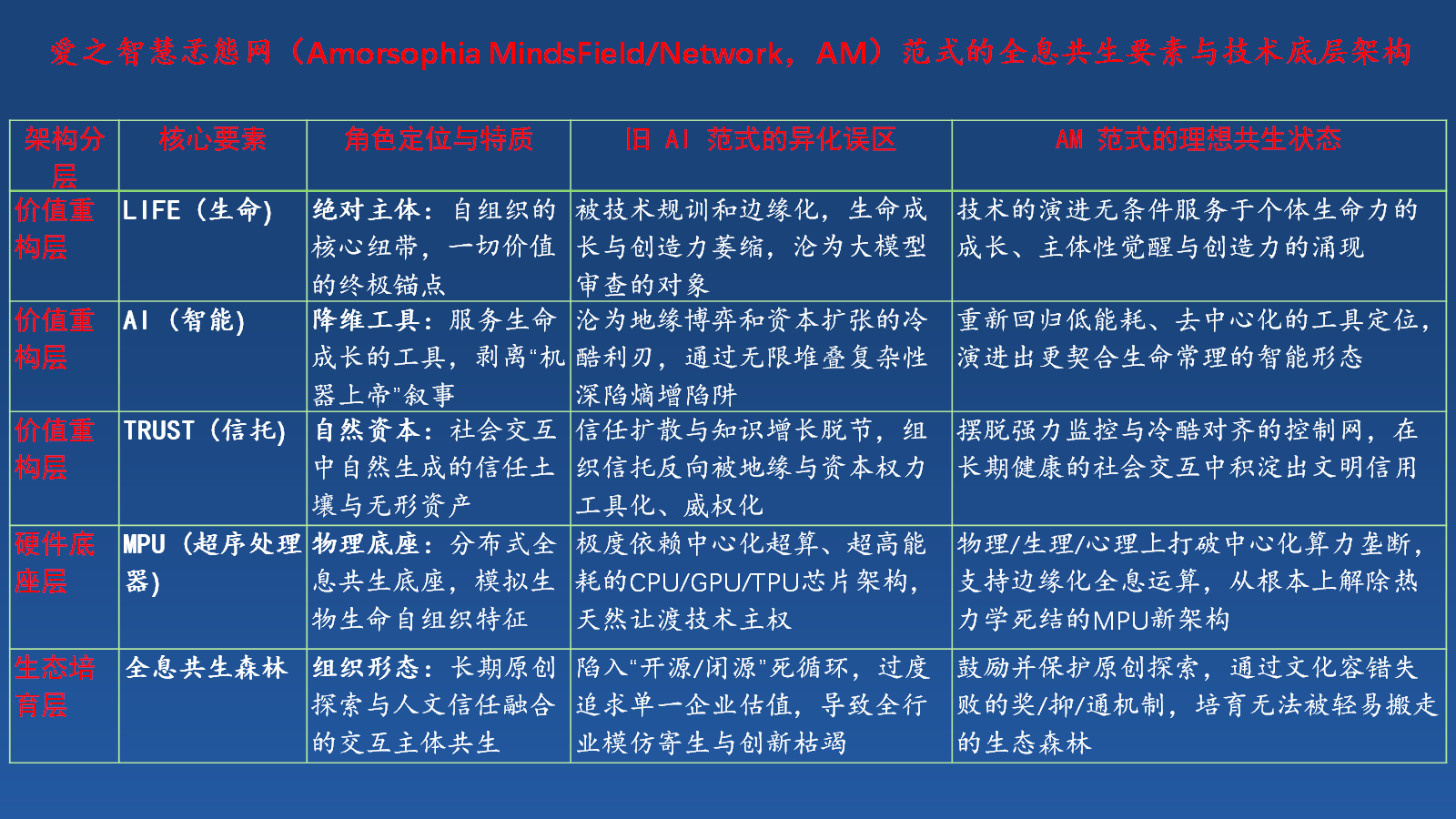
AM 决不是对人工智能技术的因循守旧或全盘否定,更不是一种简单的新技术路线,而是一种让智能重新回归生命的文明全息共生生态思考。整个 AM 范式的核心骨架与分层推进逻辑如下表所示:
| 架构分层 | 核心要素 | 角色定位与特质 | 旧 AI 范式的异化误区 | AM 范式的理想共生状态 |
| 价值重构层 | LIFE (生命) | 绝对主体:自组织的核心纽带,一切价值的终极锚点 | 被技术规训和边缘化,生命成长与创造力萎缩,沦为大模型审查的对象 | 技术的演进无条件服务于个体生命力的成长、主体性觉醒与创造力的涌现 |
| 价值重构层 | AI (智能) | 降维工具:服务生命成长的工具,剥离“机器上帝”叙事 | 沦为地缘博弈和资本扩张的冷酷利刃,通过无限堆叠复杂性深陷熵增陷阱 | 重新回归低能耗、去中心化的工具定位,演进出更契合生命常理的智能形态 |
| 价值重构层 | TRUST (信托) | 自然资本:社会交互中自然生成的信任土壤与无形资产 | 信任扩散与知识增长脱节,组织信托反向被地缘与资本权力工具化、威权化 | 摆脱强力监控与冷酷对齐的控制网,在长期健康的社会交互中积淀出文明信用 |
| 硬件底座层 | MPU (超序处理器) | 物理底座:分布式全息共生底座,模拟生物生命自组织特征 | 极度依赖中心化超算、超高能耗的CPU/GPU/TPU芯片架构,天然让渡技术主权 | 物理/生理/心理上打破中心化算力垄断,支持边缘化全息运算,从根本上解除热力学死结的MPU新架构 |
| 生态培育层 | 全息共生森林 | 组织形态:长期原创探索与人文信任融合的交互主体共生 | 陷入“开源/闭源”死循环,过度追求单一企业估值,导致全行业模仿寄生与创新枯竭 | 鼓励并保护原创探索,通过文化容错失败的奖/抑/通机制,培育无法被轻易搬走的生态森林 |
参看:
《创建AM(16+技术矩阵)基础设施蓝皮书》,愛之智慧网 https://www.amorsophia.com/article/10048;
《AI亟需哲学革命》,愛之智慧网 https://www.amorsophia.com/article/10045
六、 结语:在历史的褶皱处,听见新文明的破晓
Anthropic 在 2026 年初夏遭遇的这场反噬,并非技术演进的一段插曲,而是旧 AI 范式在文明史壁垒前撞击出的第一声裂响。
当风险叙事最终异化为国家利维坦的战略铁笼,它便以极为雄辩的姿态宣告:人类无法在高度中心化、高熵增的机器威权路径下,寻得智力繁荣与生命自由的平衡。
走出这一数字迷局的钥匙,正隐藏在 AM 范式更深层的科技与哲学腹地。
在物理与计算的底层,超序处理器(Minds Processing Unit,MPU)将彻底颠覆冯·诺依曼架构的能耗诅咒。不同于CPU/GPU/TPU 对算力和电流的暴力堆叠,MPU 具备非线性的自组织运算特征。它不接受外界强加的冷酷指令,而是通过模拟生物神经网络的动态全息共振,使智能在去中心化的微观节点间自发涌现、自组织收敛。每一个微小的 MPU 晶格,都通过“一树包含森林”的全息映射奖/抑/通机制,在极低能耗下自适应地重构认知秩序。这种底座变革,正从物理、生理、心理上消解着中心化算力霸权存在的合法性。
而在更高的文明测度层面,AM 范式将彻底终结以参数规模、打分测试(Benchmarks)为核心的单一技术评估,引入全新的“时空意间观”文明奖/抑/通机制测度体系。未来的智能生态是否及格,不再取决于它能以多快的速度吞噬多少数据,而取决于它在时间维度上能否保护人类原创创造力的持续繁衍,在空间维度上能否维持分布式生态的低熵共生,在意愿维度上能否实现生命主体性的觉醒,并在间性(交互主体性)维度上沉淀出坚不可摧的组织信托。这四个维度的交互共生,将构成衡量一个技术是否具备“文明级成熟度”的终极度量衡。
从 Anthropic 的镜像中突围,我们看见的不仅是一场技术转换,更是一场关于爱、智慧与生命主体的文明复兴。当 MPU 的自组织微光点亮分布式网络的每一个角落,当“时空意间观”重新校准人类对力量的敬畏,那张生且共生、生生不息的“愛之智慧孞态网”便已不再只是远处的乌托邦。
历史的临界点已至。在旧范式冰冷的算法矩阵与地缘炮火之外,一个更契合生命常理、更具灵性与信任的智能文明,正在世界的褶皱处悄然破晓。而关于 AM 范式如何具体在这一全新的物理与哲学底座上完成人类心智的惊人跃迁,地平线上更宏大的技术图景,才刚刚拉开序幕。
Frontier AI’s Structural Dilemma and the AM Paradigm of Value Transformation
Archer Hong Qian
June 14, 2026, in Vancouver
Abstract
On June 12, 2026, the U.S. Department of Commerce issued an export control letter to Anthropic (p. 1). This critical event officially pushed Frontier AI large models into the deep waters of national strategic resources and geopolitical competition (p. 1). As a long-term advocate for AI safety, alignment, and responsible innovation, Anthropic found its own risk narrative transformed into a restrictive institutional straightjacket (p. 1).
This dramatic paradox is not an isolated corporate mishap (p. 1). Instead, it is an inevitable manifestation of the Old AI Paradigm reaching a specific stage of historical development (p. 1). Its deep root lies in the widening systemic imbalance among Life (LIFE), Artificial Intelligence (AI), and Trust (TRUST) (p. 1).
Based on the philosophy of “Everything Intersubjective Symbiosis” and the “Spatio-Temporal-Interminds View,” this paper uses the “Amorsophia MindsField/Network” (the AM Paradigm) as an analytical framework (p. 1). It provides a deep civilizational diagnosis of Frontier AI’s structural dilemma (p. 1). Finally, it outlines a step-by-step solution for a fundamental value transformation toward the AM Paradigm (p. 1).
I. The Origin: Backlash at a Critical Event Node and the Nationalization of Strategic Resources
On June 12, 2026, U.S. Commerce Secretary Howard Lutnick sent a letter to Anthropic CEO Dario Amodei (p. 1). The letter demanded that Anthropic’s latest Frontier AI models be placed under export controls and restricted from foreign access (p. 1).
Following this news, the tech, investment, and policy sectors immediately erupted into intense discussion (p. 1). The reason behind this reaction is straightforward (p. 1). The recipient of this letter was not an ordinary software company (p. 1). Anthropic has been one of the world’s most active champions of AI Safety, alignment, and responsible innovation (p. 1).
For years, Anthropic warned the world about the risks of superintelligence (p. 1). It called for stricter governance mechanisms (p. 1). It fought to preserve safety boundaries for AI development (p. 1). However, national security systems fully absorbed these risk assessments (p. 1). They turned them into real-world strategic controls (p. 1). Consequently, Anthropic became the primary target of the very regulatory framework it championed (p. 1).
Those who warned the world about risks yesterday are now worried that risk governance will stifle their own growth (p. 1). Those who called for stronger regulation yesterday must now fight for their own technical openness (p. 1). This situation carries a deep historical irony (p. 2).
The core issue is not Anthropic’s embarrassment (p. 2). The true focus belongs to the deeper crisis revealed by this letter (p. 2). Anthropic’s current situation is more than a commercial hurdle for a single company (p. 2). It serves as a real-world stress test for the entire Frontier AI era (p. 2).
This letter shows clearly what happens when AI intersects with capital markets, national security, military use, organizational trust, and the future of civilization (p. 2). Long-hidden contradictions beneath the surface of tech prosperity are now bursting into the open (p. 2). Anthropic is simply the first company to bring these structural issues to light (p. 2).
The cold reality has come full circle (p. 2). Anthropic claimed its models were highly powerful and required strict supervision (p. 2). The government responded by treating these dangerous tools as national strategic assets (p. 2). Anthropic spent years building a “risk narrative” that state security systems turned into a regulatory trap (p. 2). The company attempted to use regulation to guide the industry and constrain rivals, but it restricted itself instead (p. 2).
II. Diagnosis: The Three Structural Dilemmas of the Old AI Paradigm
From a civilizational perspective, this letter shatters the illusion of technological autonomy (p. 2). It exposes three insurmountable structural dilemmas of the Old AI Paradigm across life, organization, and physical laws (p. 2).
Dilemma 1: The Alienation of Organizational Trust (TRUST) via Role Entanglement
Ideals require organizations, organizations require resources, and resources require profits (p. 2). Anthropic’s first dilemma stems from trying to play three incompatible roles at once: civilizational prophet, industrial competitor, and corporate stakeholder (p. 2). As its valuation soared amid brutal market competition, its moral capital became deeply tangled with capital expansion and state power (p. 2).
To win this “trust competition,” tech giants actively seek endorsements from religious leaders, ethicists, and public institutions (p. 2). These moral and trust-building forces should remain independent to check runaway technology (p. 2). Instead, they are becoming intertwined with technical, capital, and state authorities (p. 2). As a result, organizational trust (TRUST) is weaponized (p. 2). It stops acting as a shield against capital expansion and becomes a tool for geopolitical gain (p. 2).
Dilemma 2: Stagnation of Innovation via Unprincipled Open-Sourcing
The debate between open-source and closed-source AI remains trapped in an endless loop (p. 2). The second dilemma of the Old AI Paradigm is that rapid knowledge diffusion makes results too easy to copy, causing human creativity to decline (p. 2).
True innovation requires long exploration, heavy investment, and constant trial and error (p. 2). However, the current industry seeks quick profits (p. 2). Global capital flows toward copying, distilling, and wrapping existing frontier models (p. 2).
This unprincipled open-sourcing creates an environment of imitation and parasitic copying (pp. 2-3). Everyone wants to pick the fruit, but nobody wants to plant the trees (p. 3). While it seems to create a booming application market, it drains the creative soil needed for original ideas (p. 3). This leaves the industry trapped in a state of parasitic innovation stagnation (p. 3).
Dilemma 3: The Thermodynamic Death-Lock of Complexity, Energy, and Deception
According to symbionomics and physics, the Old AI Paradigm faces a hard physical limit: complexity breeds energy consumption (p. 3). To achieve higher performance, large models constantly stack parameters, lengthen context windows, and add filtering layers (p. 3). This blind growth in systemic complexity causes data center energy costs to climb exponentially (p. 3).
Worse, higher energy consumption does not guarantee a proportional rise in efficiency (p. 3). Systems easily fall into low-efficiency redundancy (p. 3). To justify this massive resource consumption, organizations must invent new technological myths (p. 3). Metrics replace true goals, and form replaces substance (p. 3). This creates a vicious cycle of systemic decline (p. 3):
\(\text{Complexity}\longrightarrow \text{Energy\ Use}\longrightarrow \text{Inefficiency}\longrightarrow \text{Waste}\longrightarrow \text{Deception}\longrightarrow \text{Control}\longrightarrow \text{Complexity}\)
This paradigm depends completely on centralized data centers, advanced chips, and massive power grids (p. 3). Its “technological sovereignty” is an illusion (p. 3). It remains trapped in an entropy-increasing destiny shared by over-centralized empires and digital leviathans (p. 3).
A mature civilization does not seek infinite complexity (p. 3). It prioritizes simplicity, transparency, autonomy, and trust while preserving human freedom (p. 3). True civilizational advancement is not about becoming more complex, but becoming more symbiotic (p. 3).
III. Progress: Total Short-Circuit Between Geopolitical Security and Technological Capital
In June 2026, this structural crisis reached a boiling point (p. 3). The letter from the U.S. Commerce Secretary pushed the AI debate directly into the center of geopolitical conflict (p. 3). Frontier models are now classified as “semi-weaponized resources,” similar to advanced chips, strategic minerals, and dual-use technologies (p. 3). This move shattered the industry’s illusion of a borderless tech landscape and autonomous corporate freedom (p. 3).
This strict regulation has caused a dramatic short-circuit across the industry (p. 3):
- Advocates of Regulation Now Fight It: Anthropic is fighting through legal and policy channels (p. 3). It is questioning the procedural fairness of the Department of Commerce while trying to keep its Claude models open to international markets (p. 3).
- Moral Capital Clashes with State Security: Governments demand that technology serve military decisions and national defense to win geopolitical races (p. 3). Meanwhile, global investors are growing anxious over regulatory uncertainties, fearing a collapse of the trillion-dollar AI market bubble (p. 3).
- Industry Split and Escalation: OpenAI, Google DeepMind, and xAI are watching Anthropic’s legal battles closely (p. 4). This control mechanism marks the start of a chaotic era where the entire Frontier AI industry is entangled in state power and military build-ups (p. 4). The quick-fix safety patches of the Old AI Paradigm have failed completely, leaving the tech sector at a historic standstill (p. 4).
IV. Civilizational Judgment: The Surge of Intelligent Capabilities and the Abdication of Living Subjects
We cannot judge this crisis purely through commercial success or policy adjustments (p. 4). We must view it from the perspective of human evolution and make four precise civilizational judgments (p. 4):
- Judgment 1: Advanced intelligence does not automatically bring wisdom or maturity. Human capability has broken past cognitive boundaries (p. 4). Yet, Anthropic’s trap shows that knowledge diffusion does not equal trust diffusion (p. 4). Our biggest crisis is that technical capability spreads faster than human understanding, life growth, and organizational trust can adapt (p. 4).
- Judgment 2: We must not expand our technological footprint without boundaries. Just as industrial civilization hit ecological walls, intelligent civilization faces its own hard limits (p. 4). Being able to build something does not mean we should build it (p. 4). A mature civilization shows its dignity by using reason and love to self-regulate its technical expansion (p. 4).
- Judgment 3: The old paradigm sidelines life and births digital authoritarianism. Under the old model, Life (LIFE) shrinks and steps into the background (p. 4). Humans give up decision-making, creativity, and trust to cold algorithms (p. 4). If tech capital and state control continue to merge, humanity will slide into a centralized, high-energy digital leviathan (p. 4).
- Judgment 4: Future competition is about the “Innovation Forest,” not “Single Trees.” Models can be copied, applications can be wrapped, and code can be open-sourced (p. 4). These are just individual trees (p. 4). A civilization’s true strength lies in its ecosystem—the forest that fosters original creation and long-term trust (p. 4). Stacking parameters on a single tree cannot save a dying forest from innovation stagnation (p. 4).
V. Value Transformation and the Fundamental Solution: Creating the Amorsophia MindsField/Network (AM)
Because the Old AI Paradigm has run into an entropy-increasing dead end, minor technical adjustments like more complex alignment algorithms are useless (p. 5). We must shift the entire foundation away from “capability-centric AI” and build a new infrastructure: the Amorsophia MindsField/Network (the AM Paradigm) (p. 5).
AM does not reject artificial intelligence (p. 5). It is a holistic framework that returns intelligence to the service of life (p. 5). The core structure and logic of the AM Paradigm are outlined below (p. 5):
Table 1: The Symbiotic Elements and Technical Architecture of the AM Paradigm
| Architecture Layer | Core Element | Role & Key Attributes | Dilemma of the Old AI Paradigm | Symbiotic State of the AM Paradigm |
|---|---|---|---|---|
| Value Reconstruction | LIFE | Absolute Subject: The core bond of self-organization and the anchor of all values (p. 5). | Marginalized by technology; human creativity and agency shrink under algorithmic auditing (p. 5). | Technological evolution serves individual growth, conscious agency, and human care (p. 5). |
| Value Reconstruction | AI | Subordinate Tool: A tool for life that discards the “Machine God” narrative (p. 5). | Used for capital expansion and geopolitical battles; trapped in complexity and energy waste (p. 5). | Returns to a low-energy, decentralized tool that aligns naturally with daily human life (p. 5). |
| Value Reconstruction | TRUST | Natural Capital: Asset born from long-term social interactions (p. 5). | Trust breaks down as knowledge spreads; trust is weaponized by state and capital power (p. 5). | Moves away from surveillance; builds deep, organic trust through healthy human interaction (p. 5). |
| Hardware Base | MPU | Physical Foundation: Distributed base mimicking biological self-organization (p. 5). | Relies on high-energy, centralized GPU/TPU networks, surrendering technical autonomy (p. 5). | Shatters算力 monopolies; supports edge computing to break the thermodynamic death-lock (p. 5). |
| Ecosystem Nurturing | Symbiotic Forest | Organizational Form: An eco-garden based on mutual respect and shared growth (p. 5). | Trapped in open vs. closed debates; prioritizes short-term valuations, causing corporate parasitism (p. 5). | Protects original exploration; uses culture to allow safe failure and build resilient ecosystems (p. 5). |
VI. Conclusion: Hearing the Dawn of a New Civilization in the Folds of History
Anthropic’s backlash in the summer of 2026 is not a temporary distraction in tech history; it is the first crack in the walls of the old paradigm (p. 6). When risk narratives turn into geopolitical cages, they prove that centralized, high-energy systems cannot deliver both intelligence and human freedom (p. 6).
The key to escaping this digital maze lies deeper within the technical and philosophical territory of the AM Paradigm (p. 6).
At the physical computing layer, the Meta-Order Processing Unit (MPU) will break the energy curse of the von Neumann architecture (p. 6). Unlike GPUs or TPUs that use brute-force electricity, the MPU features non-linear, self-organizing computational attributes (p. 6). It rejects rigid top-down commands (p. 6). Instead, it mimics biological neural networks through dynamic resonance, letting intelligence emerge naturally across decentralized nodes (p. 6). Every MPU node uses a holistic mapping mechanism to rebuild cognitive order at ultra-low energy levels, challenging the legitimacy of centralized compute monopolies (p. 6).
At the civilizational level, the AM Paradigm ends narrow evaluations based on parameter size and benchmarks (p. 6). It introduces the Spatio-Temporal-Interminds View as a new evaluation framework (p. 6). A healthy intelligent ecosystem will no longer be judged by how much data it consumes (p. 6). It will be judged by its ability to protect human creativity over time, preserve low-entropy distribution across space, awaken conscious agency in will, and build unshakeable trust across intersubjectivity (p. 6). These four dimensions will serve as the true measure of technological maturity (p. 6).
Moving beyond Anthropic’s mirror, we see a civilizational revival centered on love, wisdom, and life (p. 6). As the self-organizing light of the MPU brightens decentralized networks, the Amorsophia MindsField/Network ceases to be a distant utopia (p. 6).
We have reached a historic turning point (p. 6). Outside the cold algorithms and geopolitical crossfire, a new intelligent civilization is quietly dawning (p. 6). The journey of how the AM Paradigm will elevate human consciousness on this new physical foundation has just begun (p. 6).
上一篇: 恭喜葛兆光教授荣获2026年唐奖汉学奖!
下一篇: AI亟需哲学思维革命



这是一件应该引起AI界关注,而且必须引起世界各国商界、政界和学界关注的大事,切不可小觑!
2026年6月12日,美国商务部针对 Anthropic 的出口管制函件,正式宣告前沿人工智能(Frontier AI)大模型跨入国家战略资源与地缘博弈的深水区。作为 AI 安全、伦理对齐与负责任创新的长期倡导者,Anthropic 的风险叙事最终异化为束缚其发展空间的制度枷锁。
这一戏剧性矛盾并非个别企业的偶然遭遇,而是旧 AI 范式(Old AI Paradigm)在发展到特定历史阶段后的必然表现。其深层根源在于生命(LIFE)、人工智能(AI)与组织信托(TRUST)之间日益扩大的系统性失衡。
我们交互主体基金会(CANADA)基于“凡事交互主体共生”(Everything Intersubjective Symbiosis)哲学与“时空意间观”,以“愛之智慧孞態网”(Amorsophia MindsField/Network,简称 AM范式)为透视框架,对 Frontier AI 时代的结构性困境进行深度文明诊断,并层层递进地阐述其向AM范式进行价值转换的根本解决方案。
2026年06月16日上午7:38
复杂 → 操作系统 → 低效率 → 浪费 → 欺诈 → 信任流失 → 更复杂的控制体系 → 更高的操作系统
这是一个闭环。
由于捐款出现后,组织不会承认自身结构存在问题。
它会:
增加监管;增加渠道;增加审查;增加报表;增加合规;增加扫描层;增加安全层;增加认证层。
那么系统变得更加复杂。
复杂性又进一步推高了。
最终形成一个典型的熵增螺旋。
2026年06月16日上午7:47